Tag Archives: hope

failure to imagine

I remember the first time I watched Amazing Grace. I felt immediately proud and cowardly, feeling both as I resonated with humanity at its best and worst. Wilberforce looked the status quo in the eyes, evil and injustice and profitable as it was, and challenged it. Of course, he was able to do so because he had the money and the power and the influence to ultimately play hard ball with the good old boys.

But the scene I remember from the film is one where sitting around a table, their inability to imagine how they could continue profitable businesses, orderly communities, and the current status quo made Wilberforce’s audience unable to move forward with the abolition of slavery. They were likely people who sought justice in other ways, but this hit too close to home, and their imaginations could not overshadow their greed and lust for power.

I was reading a review this week of Taylor’s new book, “A Slave in the Whitehouse,” (referenced here in this week’s MASH) where she described President Madison as one who worked for fair treatment (relatively speaking of course) for slaves in the country, but upon his death did not free a single one of his own. It was Taylor, the reviewer of the book, who stated, “Madison did not believe that white and black Americans could live side by side on terms of equality and amity. His failure to imagine a world more capacious and tolerant than his own helps explain a good deal of subsequent history, and America’s resistance to the very practice of equality that Madison otherwise did so much to foster.”

I think about Martin Luther King.
I think about Nelson Mandela.
I think about Mahatma Ghandi.
I think about the nameless men and women who follow their imaginations into a different kind of possibility for the future. Not just for and around issues of civil justice, but around issues of technology, healthcare, development, education.

They were no doubt met with others whose imaginations had been stifled, and therefore could not wrestle themselves away from comfort and power to risk them both for the sake of a more kingdom-like future.

And so my mind now turns to those schools, churches and organizations that foster imagination and second-guessing as a guiding principle. It is from these communities that we will see change happen. Of all the downfalls I am at risk of meeting, I hope that one of a failure of imagination isn’t the one that takes me down.

My friend Craig has said before, “Of all the ridiculous things God has called us to do, defending the status quo is not one of them.” And whatever is to break the status quo always begins with a strong imagination.

Pine Tree
djordan

Tagged , , , , , , , , , , ,

resurrection and the third way

It’s not even that we are being foolish to assume that one of two options is all we have to hope for, or if we’re lucky, all we have to choose from. We can feel the tension building as the story climbs to the cross, and if we didn’t know better, which of course we do know better, we would be hoping that they would change their minds and let him down. Or at least he would finally decide to call some winged agents in to take him down so he could find his place of importance on the throne.

We think it is only that, now, or death.

And death is final.

So we can’t blame the ladies for waking up the next day and taking the spices and oils they had worked on the night before as their tears feel into the mix. There were two ways, death or something spectacular there on the cross, and death is the way that won. So they head there prepared to prepare his body.

And that’s when we all learned for the first time, of many times by now, that there are more than two ways of being and moving forward in this world.

That empty gravesite sits for us now as a reminder of our calling to follow Christ into the kingdom of the third way, the kingdom of impossibility, the kingdom of breathing new life into dying things, the kingdom of defeating death, the kingdom of upside-down conclusions to right-side-up stories.

With the poor.
With the lonely.
With the addicted.
With the greedy.
With the grieving.
With the marginalized.
With the marginalizers.
With the hopeless.

With those of us who have resigned to the fact that all is lost, so we prepare to bury our hopes and dreams for a new life and a new kind of world.

Welcome, today, in light of the resurrection, to the kingdom of upside-down conclusions to the stories we find ourselves in.

djordan
Pine Tree Dr.
On Easter

Tagged , , , , , , , , , , , ,

not drumming alone

“Never give up. Never give up. Never give up.” she said into the camera on her computer.

We were finishing class today, and I had just asked my friend Caroline––skyping in from a patio in the shadow of the great Table Mountain in Cape Town––what advice she would give to my classroom full of students going into the world with the issues of poverty and the church on their minds and hearts.

I was sitting in the front of the classroom which I suddenly regretted as these words came out of her mouth.

“Never give up. Never give up. Never give up.”

She went on to elaborate, and my mind floated back to my days in Cape Town last spring almost a year ago. I was in the middle of major transitions where the issues of poverty and the church were becoming issues that meant a world of difference when it came to my job, my income, my church, and my future. I remember sitting, clinging to the future as we now refer to it, scared of what the future held, but knowing there was nowhere to go but into the issues of what it means for the church and its people to worry less about success and more about obedience.

Caroline went on to say to the students, with me sitting in the front of the classroom, “Never give up. You will follow Christ in pursuit of the kingdom, and you will struggle. And you will feel like you are the only one. And you will feel as though you have been beating a drum for a very long time all by yourself and no one is listening, and no one else is beating that kingdom drum…”

Sitting in the front of the classroom, where the students can see me but Caroline cannot, I feel my eyes beginning to well with tears.

“…but you are not the only one beating that drum. And there are others, too, following Christ not into success but into obedience, into the kingdom, who feel as though they are the only ones being champions of justice, and they need to find you as well. Never give up. Never give up. Never give up.”

My intentions had been for our class to pray for Caroline before we ended the Skype call, but we were not able to.

I caught myself trying to say, “Caroline is a dear friend who has taught me much. And she and other very dear friends have reminded me in times that felt quite lonely that it is worth speaking out for justice and working toward the kingdom…” But that is where the thank you had to end, because my eyes were getting thick with tears at the wrong time.

Another friend spoke today at the community-wide Holy Week noon service. “The time is now,” he said, “to worry less about seeking our own success, and more about seeking the kingdom.”

He also reminds me that I am not drumming alone.

I had a conversation tonight with an elderly gentleman about our small house church joining their older congregation in serving the homeless this summer. He reminded me that I am not drumming alone.

A dear friend once grabbed my shoulder at a time when I needed it more than anything else, he looked me in the eyes, and he said, “You are not alone. There are many of us, and we are seeking the kingdom together.” He reminds me constantly that we are not drumming alone.

Thanks, Caroline, for making me choke up in front of my class.

And thanks for reminding me, and them, that we seek first the kingdom together, and that we are not drumming alone.

djordan
Pine Tree Dr.

Tagged , , , , , , , , , , , , ,

on most days, a hard mix

We are among your called.
We have heard and answered your summons.
You have addressed us in the deep places of our lives.
In responsive obedience we testify,
as we are able, to your truth as it concerns our common life.

We thank you for the call,
for the burden of that call,
for the risk that goes with it,
for the joy of words given us by your growing spirit, and
for the newness that sometimes comes from our word.

We have indeed been in the counsel of your summoning spirit,
and so we know some truth to speak.

But we are, as well, filled with rich imagination of our own,
And our imagination is sometimes matched and overmatched
by our cowardice,
by our readiness to please,
by our quest for well-being.

We are, on most days, a hard mix
of true prophet and wayward voice,
a mix of your call to justice
and our hope for shalom.

Here we are, as we are,
mixed but faithful,
compromised but committed,
anxious but devoted to you.

Use us and our gifts for
your newness that pushed beyond all the we can say or imagine.
We are grateful for words given us;
We are more grateful for your word fleshed among us.

+  Brueggeman, from Prayers for a Privileged People
While this is pulled from one of my favorite books, referenced often here, I ran it across it this morning in a post from an organization one of my students just told me about in Colorado. As I looked up Purple Door Coffee, I noticed that Madison Chandler, a girl I used to go to school with is helping out. I hope you enjoy the prayer, Walter Brueggeman’s stuff, and learning more about Purple Door Coffee.
djordan
Pine Tree Dr.
Tagged , , , , , , , , ,

when the story is stolen | grief in public

In light of many comments, public and private, about my previous post “Loss as loss, not as lesson”, I thought perhaps now is the time to  share a little bit about what I’ve been learning concerning trauma, and specifically sudden, violent death.

After a few weeks of cofacilitating a support group for people who have lost loved ones to homicide, suicide, or accidental death, I began to learn how very, incredibly different the grief process is for this kind of violent death than for other types of loss.

All loss is loss, no doubt; violent loss is different.

I can think of people by name who have
lost a mother in gunfight.
lost a cousin in a robbery gone wrong.
lost a son in a hit a run.
lost a baby to violence.

Three days from today will be one year since my grandfather died. I will never forget the day he passed away, kissing his forehead, and telling him thank you for everything. I had watched as the sinfulness of Parkinsons ate away at his body for several years. Meals had become special. Kisses on the cheek had become monumental. Laughs shared and jokes made had become cause to gather everyone’s attention in the room. Our family was making meaning together, in the privacy of our home, of the life of our husband, brother, father and grandfather. We spent many holidays saying things we needed to say, hearing things we needed to hear. And at his funeral, almost a year ago today, we celebrated his life with grief and with gladness. Meaning had been made, and we could be at peace with his lost.

This is absolutely, positively nothing like losing someone violently. There is no hierarchy of grief, and no need to compare stories, but the grief associated with violent death is sharply different and should be seen and understood as such.

In the loss of our community at the beginning of this week, a freshmen in college dies in a car accident.

The family has no time to make meaning together, in the privacy of their home, around meals, holidays, laughs and stories. They have, no doubt, been doing these things in passing, unnoticed, like we all do. But we do them differently when we see the shadow approaching. So when the shadow is not seen, they are not done. No one is to blame…it is the way we are.

But the story is immediately stolen. There are phone calls and conversations. News reports and tv coverage. Facebook updates and emails asking, wondering, trying to make meaning in places that feel meaningless.

So now, there is not only no opportunity to plan for the grief, but there is no privacy to the story. It cannot be told the way we get to tell the story of an aging grandparent.

The story tells itself. In public.

And then the news tells it. And then the neighbors tell it. Questions of why it is important, what is to be learned, and how to prevent it linger in the mouths of other people. The story is everywhere, and belongs now to everyone.

But most importantly, it is co-opted from those grieving the loss.

To grieve is––in itself––an act of worship.

djordan
Pine Tree Dr.

***

“Real criticism begins in the capacity to grieve because that is the most visceral announcement that things are not right. Only in the empire are we pressed and urged and invited to pretend that things are all right – either in the dean’s office or in our marriage or in the hospital room. And as long as the empire can keep the pretense alive that things are all right, there will be no real grieving and no serious criticism.”

+ Walter Brueggeman, The Prophetic Imagination

***

Tagged , , , , , , , , ,

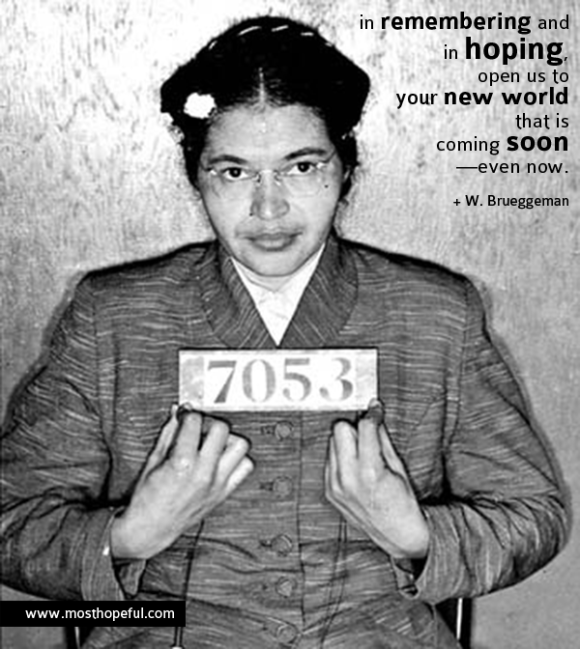
rosa parks | in remembering and in hoping

Rosa Parks | February 4, 1913 – October 24, 2005
On thoughts of Black History Month 

Rosa Parks Black History Month

+ “Rosa Parks” from Walter Brueggeman’s Prayers for a Privileged People

djordan
Pine Tree

Tagged , , , , , , , , , , , ,

a concrete maze

I walked the labyrinth at the hospital today. I can see it from my office window, the maples blooming with a sharp red that distracts me all day long as I watch past my clients through the glass into the courtyard beyond my office. I finished the drudge of my paperwork today in time to spend thirty minutes walking through it.

I see it everyday through the glass; today was the day to walk it.

I have read about them before, but I’ve never walked through one. I found myself taking one step at a time, observing the thoughts passing through my mind with each step.

Loop one: What am I supposed to be doing? Am I thinking solemnly enough? Am I messing this up? The last time I was here was when Brooke’s dad was in ICU after a stroke. Should I even be here right now?

Loop two: Shouldn’t I be learning something profound right now? Isn’t this supposed to be an existential process; a joining of mind and body and soul at one time? Am I doing this right? I have friends going through mammograms right now. I have other friends losing their jobs right now. I have other friends in the hospital with their parents right now; shouldn’t this be about them?

Loop three: You don’t know what you are doing. Be quiet in your mind. Stop working to figure this all out. Just put one foot in front of the other, and know that whether or not you see how the path in front of you plays out, it does––in fact––play out. You will keep walking, and make it to the other side. Stop pushing.

The person going through the mammogram right now is what is on your mind. Let it be.

The person who is losing a job is on your mind. Let it be.

The person who is in the hospital with his mom is what is on your mind. Let it be.

This is not about an existential process; this is about being truthful about where you are, what you can and cannot do, and who God is. Keep putting one foot in front of the other.

Loop four: You, God, are the same. You are the God who changed the course of the story in the garden. You are the same God who made Abraham the promise. You are the same God who anointed David King. You are the same God who gave Isaiah a vision. You are the same God who sent Christ. You are the same God who raised him. You are the same God making all things new. You are the same God whose son is King of the kingdom.

There is nothing magical about that maze of concrete that sits between the walls of the hospital and my Pathways office. There is, however, something sacred about the journey through a guided piece of art that brings me where I need to be: completely unsure about where this winding path leads, but knowing––more than I know most things––that where I will end up is where I need to be.

Be still and know.

djordan
Pine Tree

Tagged , , , , , , , ,