Category Archives: what they are teaching me

and once again we sing

Vietnam B-52 Bomb Craters

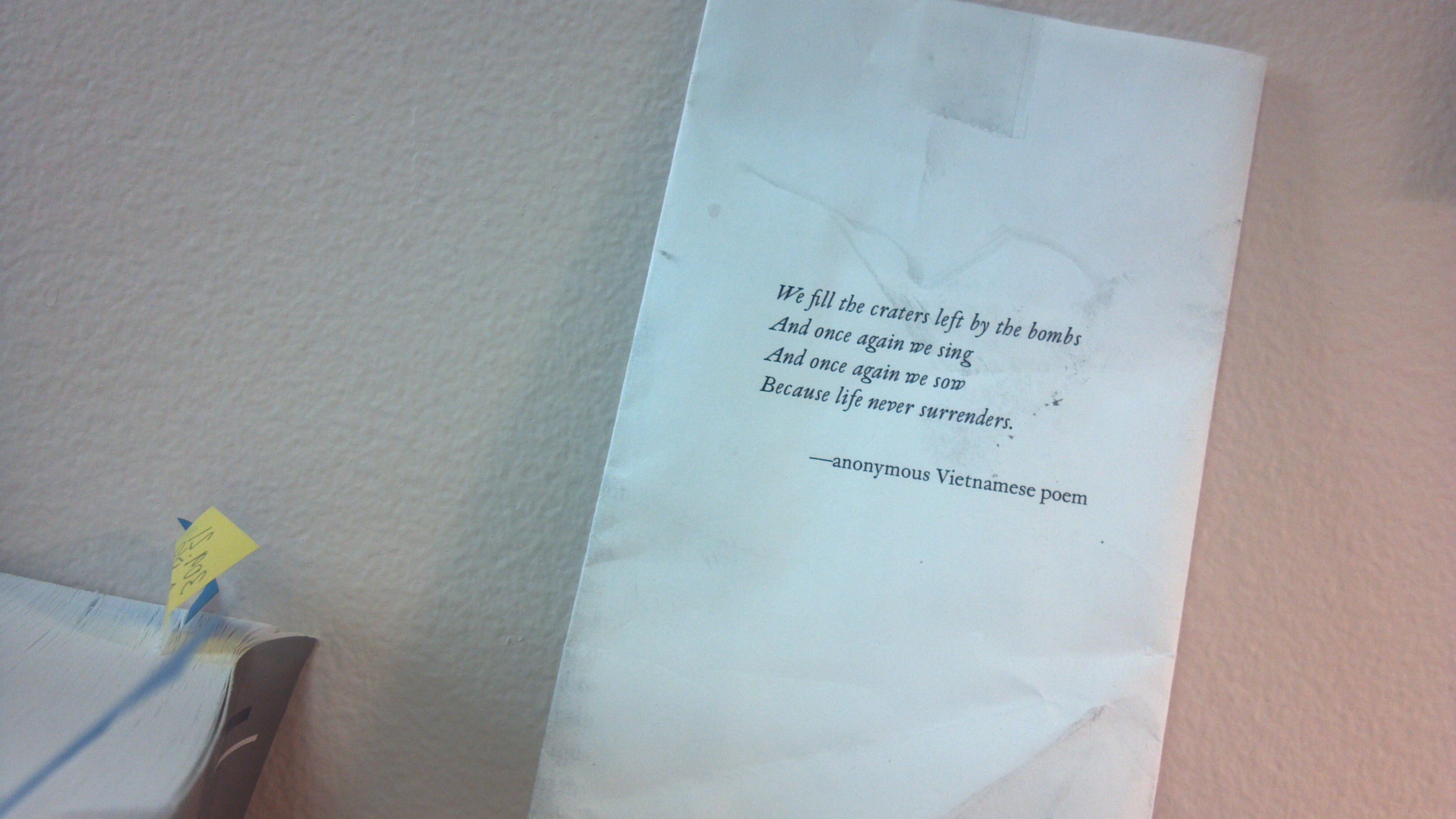
Throughout my last two jobs, I’ve had the same folded-up xerox copy of the first page of a memoir which has the following lines attributed to an anonymous Vietnamese poem taped to the wall above my desk:

We fill the craters left by the bombs
And once again we sing
And once again we sow
Because life never surrenders.

These words struck me when reading the memoir, but these days I don’t remember why. Over the last three years, I’ve thought a great deal about trauma and grief. First motivated to begin understanding it more while working with the survivors of homicide-loss, and then through my own personal journey through difficult work days, and now in the context of the lives of my individual clients as well as communities in which we work for transformation and development.

The notion that suffering and pain, while seen to be inherently private and uber-personal, is in reality communal and fundamentally social, the words are becoming more and more haunting.

As the church moves into communities of violence, systemic injustice, stigma, poverty, materialism, greed, addiction and isolation, we are often afraid to sing songs that the people waiting for the kingdom have sung for hundreds upon hundred of years…

By the rivers of Babylon we sat and wept
    when we remembered Zion.
There on the poplars
    we hung our harps,
for there our captors asked us for songs,
    our tormentors demanded songs of joy;
    they said, “Sing us one of the songs of Zion!” 
(from Psalm 137)

As a people waiting and working for transformation, before we fill the craters, before we take on life again, we must tell the dirty truth about our loss and despair and all that is wrong and evil and messy and undone in the world, in our private and personal worlds, and in our communal and social worlds. If we, those who hold the promise that life never surrenders, can’t tell the truth about the mess of it all, then we aren’t yet ready, aren’t yet brave enough, to sing and sow once again.
2013-02-01_16-01-42_735

djordan
Summar Dr.

Tagged , , , , , , , , , , , , , , , ,

“it’s dark in here” | reflections on MLK Day

mlk-day-2013

It’s no secret that racism is not okay.

Most people know it. A lot of people pretend like they agree with it. Some people fake it. Everyone deals with it.

But we all know that racism is not okay.

And so we think of ourselves as matured. As evolved. As just and honest and good and lovely.

But we are, all of us, racist, of course.

+++

I was walking through the mall a few weekends ago with a guy who used to be a college student in a small group of mine. We were there for me to run an errand, and this guy, a man who is soon to be a youth pastor in a church, made a comment that has been haunting me since that day.

“It’s dark in here.”

I looked around, looked up at the skylights, around at the stores and back at him.

“What?”

“It’s dark in here.”

The same again.

I looked around, the sky is blue, the light is shining in through the skylights, the mall is brightly lit, and at the same time as my head is turning back toward him in confusion, I understand what he is saying. I feel my heart break the moment we make eye contact, and I wish I could control anything but in that moment I realize that I can control nothing.

“There are lots of black people,” he whispers.

I have no idea what I said. I’m sure I was a jerk. My memories of that day go back to me as much as they do to him.

And today, both Inauguration Day and the day we celebrate the life and work of Martin Luther King Jr., I find myself speechless, still.

I grew up in a world where racism was acceptable, and in a home where it was not. I grew up in a faith where if you are poor and on drugs, it’s because you don’t know Jesus, not because of personal, systemic and global injustice.

More than this, I grew up knowing that it’s not okay to be a racist, but seeing those around me make it okay to be a little racist. At the right time, with the right people, in the right way.

As an upper, middle-class white male, that means that many around me, outside my home and often in a family of faith, think that those who are not any of those things are likely not Christians, so we should pray for them, and that they are both irresponsible and dangerous, so we should be afraid of them.

And whether I admit it or not, that same thought is buried deeply in me somewhere. Thank you, Southern, wealthy, Christian United States.

+++

And today, I show up for work each day with brothers and sisters of faith, both black and white. I show up for work with men and women seen as equally bringing the truth of the faith and the work of the kingdom. I show up to work each day and hash out the difficulty of what it means to work and live and laugh with those who are both the same as well as different from me, and I am a better man for it.

I am still racist. I still make assumptions about others who look like me that I would hope to never be associated with. And I know, in turn, that I am still seen as someone who makes those assumptions.

It is not completely unfair.

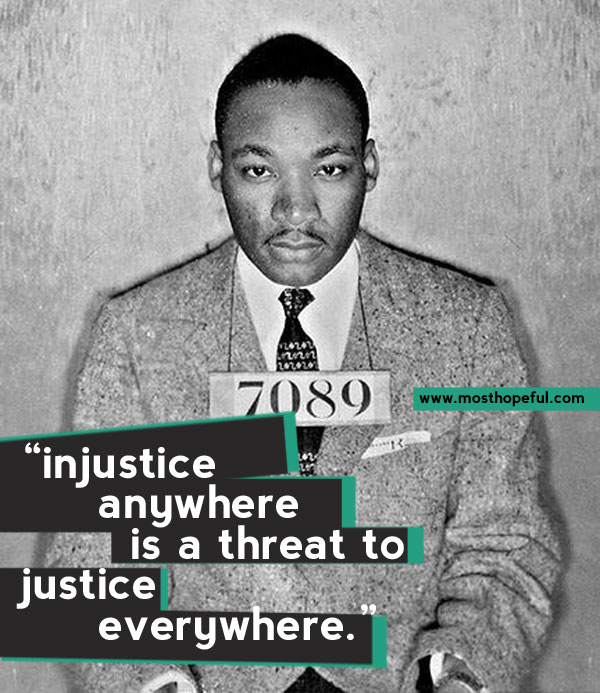
So on this day, when I think about the black pastor in the southern US who wrote letters to white pastors in the Southern US saying this must be the time––when I think about a pastor who wrote those letters from a Birmingham Jail–I hear them now in a deeper place than I have heard them before. I see and feel those white pastors listening who are convinced that the calls are untimely. And the challenge is more personal than it has been before. And in the global world, in the polarized world, in the rich and poor world, I hear the words of Martin Luther King, Jr. say “Injustice anywhere is a threat to justice everywhere,” and I hear my King say, “The kingdom of heaven belongs to them.”

+++

To my buddy in the mall that day, as I felt my jaw drop and my eyes broaden and heart sink, I wish I had told you, “There is so much of the kingdom you are missing.”

djordan
Pine Tree Dr.

Other recommended links for MLK DAY

KATHY ESCOBAR | THIS DREAM IS SO POSSIBLE – Kathy Escobar
10 THINGS YOU MAY NOT HAVE KNOWN ABOUT MLK – Huffington Post
A DREAM THAT CAME TRUE – The Washington Post

Tagged , , , , , , , ,

the illusion of the one thing

clock and time and counseling

Privileged, I sat and listened to seven different people today, varying in ages and colors and backgrounds and struggles, all sharing the clouds in which they find themselves. I saw myself in them today, all of us looking for the one way of thinking about it or labeling it or diagnosing it that would set them, set me, set all of us free. If that one thing was found, they could get the right medicine or the right outlook or take the right action or make the right choice to fix it all.

“Fixing it all” is of course the goal they hurried in with, and the goal I hurry in most places with. It is, of course, the goal that all of us most often run into the cloudy situations with. Tell me the one thing that will fix all of this.

We scramble and wrestle and our ears turn red and our voices raise and tears fall and our heart rate takes off. Everything in us is trying to churn together to locate, isolate and intervene on that one thing.

Our inevitable not finding it leads to our heartbrokenness, growing frustration and often to our hopelessness.
And there is in the places where we sit quietly, listening to the clock tick, watching the moth walk across the window, feeling that part of our sock that isn’t fitting right, we begin to let go the illusion of the one thing. And we take a breath, and we see that in the middle of the cloudy struggle, there is still a ticking clock. Still across the window a walking moth, still a tangled sock buried deep down in our boot.

And in those moments, we realize the cloudy struggle isn’t all that is true. And there, our hope begins.

djordan
Pine Tree

Tagged , , , , , , , , , , , , , , ,

when thirty was old

Image

There was a time, of course, when thirty was old.

It was not that long ago, and I remember it well. My parents were, then, in their late thirties, and were, of course, ancient. Then, as I grew older, the forties became cool, and thirties were early old-age. Then, I hit my twenties, and the fifties were prime, and the twenties were young, and the thirties were when I became an adult.

Now, of course, as I am pushing the hands of the thirty clock into their final destination, the sixties seem young, and the eighties seem old.

Until lately.

My grandfather died in his early eighties, and it seemed completely unfair. He had more traveling, more reading, more drinking, more laughing, more teaching and talking and leading to do. So suddenly, the eighties seemed like when people had it all together and could tell those of us who were young, (thirties) what choices to make that we would regret.

Tonight, I left my neighbor’s 80th birthday party before she did. I was sweating from laughing,  stuffed from eating, and thoughtful from conversation. As I walked the fifteen yards back to my front door, I realized how quickly time flies, how young eighty is, and how, at thirty, life is only beginning.

Cheers, Ms. Coleman, on hitting 80. And thanks for the reminder.

djordan
Pine Tree (one house over)


Tagged , , , , , , , , , ,

dinner at the coffee table

2013-01-07 20.09.31

I don’t know why it has all come together in my brain this way.

Growing up, I remember being furious that this rule was put in place, even in middle and high school, that I MUST be present at the dinner table at least three or four nights a week. If I went out after that, that was one thing. If I ate or not was another thing, but my presence at the dinner table was required three or four nights a week. (I don’t remember which, so obviously it wasn’t as traumatic as I would like to pretend.)

As with many things I now reflect back on from growing up, I hated this rule at the time, and yet now I wouldn’t trade anything for it.

And a few nights ago, I joined some incredible friends from present day around their coffee table for dinner. At our home growing up, when I was huffing and puffing about having to be home for dinner around a table, we would every now and then sit around the coffee table, the same one I now have in my den, and eat pizza and watch TV together. I remember being angry that my parents could guess what was going to happen on the TV show, and I was likely more angry about this because I wanted to be anywhere but there at the moment.

But a few nights go, legs crossed over pillows on the floor, eating while sitting around their coffee table, I found myself in a kind of time freeze. The four year old daughter of my friends was pretending to make meals or be a drummer with her metal bowls and plastic whisks, and we were eating sushi with chopsticks out of styrofoam sakura to-go boxes.

There was much that reminded me, though, of growing up. The space for imagination and casualness, and play and informality. The insistence of good food even though it was spread out across a coffee table reminded me of how much has changed, and how little has changed at the same time.

And today, I’m in a counseling session with a family who can’t pay the bills so they share a home with another family. Four parents, five children, three minimum wage jobs, exponential stress. They were sitting in my office, a mom and dad, completely undone by the situation, and parenting skills to reflect the same. As they were talking, I found myself returning to the living room coffee table a few nights ago with incredible friends learning to be good parents, a four year old playing kitchen, and myself wondering how things will be remembered ten years later.

For all of us.

And most of all, I found myself glad that someone made me sit down for dinner three or four nights a week, no matter how unbelievable and unrealistic a request it seemed at the time.

djordan
Pine Tree


Tagged , , , , , , , , , , , , ,

scarred by struggle, transformed by hope

scarred-by-struggle,-transformed-by-hope
I received a book in the mail today from a friend I met through the blog.

Multiple conversations have been had via email, with time and oceans in between, about issues of faith and justice and loss and hope and hopelessness and holding on. When I recently had a time of near blog-silence, she checked in to see how things were. She immediately hit right on the nature of the issues adding to the silence, and gracefully wrote words that echoed like prayers of acceptance of creative silence, and requesting of hopeful imagination.

And today, after waking up to run, pour a slow cup of coffee and then get back to work at Area Relief Ministries for the first time since mid-December, I walked in to see a package on my desk. I opened it up and immediately knew who it was from, as this friend had referenced the book in an email during those dry days.

The following is an excerpt, and the book itself, sitting on my desk in its packaging waiting quietly like the sneaky gift it was is now a reminder, of how the kingdom community is broader and larger and more powerful than I remember on most days. It is ebbing and flowing in and out of our quiet and alive places, keeping us moving and pushing forward, even when we aren’t sure why it’s worth it.

So to this friend, and the other friends of which there are many brave and marginalized kingdom-souls, who are willing to tell the stories of struggle in an effort to sing the true songs of hope, I cannot say thank you enough.

djordan
108 S Church

“Hope is rooted in the past but believes in the future. God’s world is in God’s hands, hope says, and therefore cannot possibly be hopeless. Life, already fulfilled in God, is only the process of coming to realize that we have been given everything we need to come to fullness of life, both here and hereafter. The greater the hope, the greater the appreciation of life now, the greater the confidence in the future, whatever it is. 

But if struggle is the process of evolution from spiritual emptiness to spiritual wisdom, hope is a process as well. Hope, the response of the spiritual person to struggle, takes us from the risk of inner stagnation, of emotional despair, to a total transformation of life. … The spirituality of struggle gives birth to the spirituality of hope.” 

from “Scarred by Struggle, Transformed by Hope,” by J.D. Chittister


Tagged , , , , , , , , , , , , , , , , ,

in our honest hours

in our honest hours
of anxiety
of unsureness
of exhaustion
of insecurity
of restlessness
of loneliness
of misunderstanding
of arrogance
of boredom
of transition
of self-righteousness
of worry
of confusion
of isolation
in our honest hours
where we are altogether not our best

we come face to face
even when through a dim mirror
with the promise of how things will be
and we feel our souls
lift
weightless
weightlessly
to the sky
with the promise of how all things will be
when all things are as they should be

and then, we live more musically
in our honest hours

djordan
Pine Tree

Tagged , , , , , , , , , , , , , ,

he measured time in houses

When asked how long ago something happened, he said, “three houses ago.”

We were both laying on the floor of my therapy office, playing with cardboard boxes painted to look like bricks. Recently adopted into the “last house” he was placed in, at around ten years old, he’s in trouble here and there for stealing and lying.

I’m always amazed at how conversations are hijacked by the problems, and both parent and child never notice that the problem begins to run the show and determine who the child is and who the child will be. Most of the time, the therapist is fooled as well.

Trying to see how we could stack the cardboard bricks in ways that would almost crash down, but stay standing, it was his answer that snapped me out of my haze. It was his answer to a simple question that made me realize I had been thinking about him as a child who is a sometimes thief and liar, rather than as a child who, after his parents were caught and incarcerated for drugs, has moved so many times to so many different foster homes, it has become a reliable method of time-telling.

Me: “When did you last see your mom?”
Him: “Three houses ago.”

The session ended soon after, with block stacking and rearranging happening as I was realizing how off-track I’ve been in working with him. The only other words spoken once he answered “three houses ago,” were one last exchange between the two of us before our time was up.

Me: “Do you know I think you’re a pretty strong dude?”
Him: “No.”
Me: “Well, I think you’re a pretty strong dude. Can we discover together next time what it is that makes you so strong?”
Him: “That would be cool.”
Me: “I think so too.”


djordan
Nashville

Tagged , , , , , , ,

the class who shows up | on the 5th annual homicide-loss walk

After five years of standing in line watching men and women, propped up babies on hips and grandparents escorted with walkers, this year was different altogether.

It is both encouraging and discouraging to see the crowd grow year after year at the Commemorative Walk for survivors of homicide-loss. It’s been my privilege to listen to and learn from these men and women in a weekly support group, but to see them walk through candlelit paths holding photos of their murdered husbands, sons, grandsons, wives, mothers and grandmothers is altogether horrifying and holy at the same time.

And it has been every year these last five years since the very first walk. It is always holy in the way honestly telling the honest truth is always holy and almost always horrifying.

But this year, there was something new for me as I stood in the evening’s mist.

Looking into the line of men and women with faces barely glowing from the candles in their hands, I saw my students. The clock strikes nine every Monday, Wednesday and Friday and my students are faithful to be patient with me in class as I dance onto tangents, threaten with grades and bribe with food. They have listened to me grow awkwardly teary about the histories of movers and shakers from the margins of the field whom God has used to bring kingdom change across the globe. They have held on as we’ve acted out counseling sessions, as we’ve debated the reasons for poverty and welfare, and as we have pushed the questions of power dynamics and our goodwill to the limits. They always show up.

But this night, lining the sidewalks where women and men who have become dear to me walk through their glowing candles and make clear that their murdered loved ones will not be forgotten, my students showed up. As tears filled my own eyes, I lost my breath in thinking that these very students were standing physically and symbolically right on a dangerous line. They were being both witness to the hard and horrible and hopeless truths like rampant homicide in a community, and were also making a symbolic promise that as social workers who are Christians they will join in the kingdom work to make peace on earth as it is in heaven.

My prayer for those students and any of my students, is that some day in the not-so-distant future there will be professors of Social Work or Theology or Education or Business standing up in front of their own classes telling the names of my students, and talking about how they pushed in from the margins to make peace and to change the world with and for Christ and his kingdom.

And when I hear those stories told, I’ll remember the way their faces glowed this night.

djordan
Pine Tree

RELATED POSTS | what they are teaching me | what they are teaching me 2 | when others tell their stories

Tagged , , , , , , , , , , , , , ,

from the heart of my bottom


A mess is made whenever people get together.

Always.

And I’m amazed how others, but mostly myself, still pretend that any time people get together it will not be a mess, among all the other beautiful and stunning things that it always is as well, of course.

But beyond that mess, ever present and reliable, is something deeper and a little more true. Beyond the inevitable mess made when people get together is a promise that people stay together, in one way or another, in the mess of it all. And sometimes staying together means staying physically housed together. Sometimes it means continuing to work together.

And sometimes it means taking the pieces of each other that, as much as we thought or intended or assumed would do otherwise, still stick to us and move into new worlds and new places and new possibilities with those sticky pieces of where we come from and what we are made of.

It’s bound to us in the same way our family name is bound to us and the heritage of our story and trial and DNA are bound to us. Like it or leave it, this is where we have come from, and this is who we are.

This morning, I had the chance to celebrate the 175th anniversary of the church I was raised in. And while time has passed and circumstances have moved faster than passing time, I was struck by the celebration of the organist who has played at that church for the last fifty years. He was playing the organ for the church when my parents met, when they were married, when I was born, when I chose to commit to the faith, when I graduated, and when it was time for me to move on.

His service is marked by a long-time faithfulness to the ins and outs of the messiness of people and groups of people just as much as his long-time faithfulness to the celebration of all that is good and true in a congregation. And today, as he marched up the platform stairs with his cane to receive a gift of appreciation for his fifty-year service, I was caught emotionally off guard. His walk up the stairs reminded me of the value of the mess, and the occasional times of not-messiness, that happen when people get together, and what it can mean to see things through.

But moreso, it reminded me of the goodness of looking back, half a century later, and seeing that the work continues, and the call continues, and the kingdom still comes. Mess and no mess. God works through his people toward kingdom come on earth as in heaven.

So to Bobby, from the heart of my bottom as he would say, thanks for your longtime service, and for the reminder that the world goes not well, but the kingdom comes.

djordan
Pine Tree

Tagged , , , , , , , , , , , ,