Category Archives: what they are teaching me

on grief | a collection of work

Click any of the images below for past reflections on grief and trauma, loss and losing, and the kind of mix of hopelessness and hopefulness that always accompanies both. Here, again, is a favorite quote on grief:

“Real criticism begins in the capacity to grieve because that is the most visceral announcement that things are not right. Only in the empire are we pressed and urged and invited to pretend that things are all right – either in the dean’s office or in our marriage or in the hospital room. And as long as the empire can keep the pretense alive that things are all right, there will be no real grieving and no serious criticism.”

+ Walter Brueggeman, The Prophetic Imagination


Remember Me Commemorative Walk for Homicide-Loss Survivorsa time for everything under the sunheavy boots, i pinched myself, extremely loud and incredibly closejohn chapter 11, lazarus, jesus, mary, marthalazarus, mary, martha, jesus, death, grief, time, too lategrief, losing, loss, death, sudden death, violent deathgrieving in public, grief and the news, sadness, publicity, gossip

Tagged , , , , , , , , , , , , ,

when the story is stolen | grief in public

In light of many comments, public and private, about my previous post “Loss as loss, not as lesson”, I thought perhaps now is the time to  share a little bit about what I’ve been learning concerning trauma, and specifically sudden, violent death.

After a few weeks of cofacilitating a support group for people who have lost loved ones to homicide, suicide, or accidental death, I began to learn how very, incredibly different the grief process is for this kind of violent death than for other types of loss.

All loss is loss, no doubt; violent loss is different.

I can think of people by name who have
lost a mother in gunfight.
lost a cousin in a robbery gone wrong.
lost a son in a hit a run.
lost a baby to violence.

Three days from today will be one year since my grandfather died. I will never forget the day he passed away, kissing his forehead, and telling him thank you for everything. I had watched as the sinfulness of Parkinsons ate away at his body for several years. Meals had become special. Kisses on the cheek had become monumental. Laughs shared and jokes made had become cause to gather everyone’s attention in the room. Our family was making meaning together, in the privacy of our home, of the life of our husband, brother, father and grandfather. We spent many holidays saying things we needed to say, hearing things we needed to hear. And at his funeral, almost a year ago today, we celebrated his life with grief and with gladness. Meaning had been made, and we could be at peace with his lost.

This is absolutely, positively nothing like losing someone violently. There is no hierarchy of grief, and no need to compare stories, but the grief associated with violent death is sharply different and should be seen and understood as such.

In the loss of our community at the beginning of this week, a freshmen in college dies in a car accident.

The family has no time to make meaning together, in the privacy of their home, around meals, holidays, laughs and stories. They have, no doubt, been doing these things in passing, unnoticed, like we all do. But we do them differently when we see the shadow approaching. So when the shadow is not seen, they are not done. No one is to blame…it is the way we are.

But the story is immediately stolen. There are phone calls and conversations. News reports and tv coverage. Facebook updates and emails asking, wondering, trying to make meaning in places that feel meaningless.

So now, there is not only no opportunity to plan for the grief, but there is no privacy to the story. It cannot be told the way we get to tell the story of an aging grandparent.

The story tells itself. In public.

And then the news tells it. And then the neighbors tell it. Questions of why it is important, what is to be learned, and how to prevent it linger in the mouths of other people. The story is everywhere, and belongs now to everyone.

But most importantly, it is co-opted from those grieving the loss.

To grieve is––in itself––an act of worship.

djordan
Pine Tree Dr.

***

“Real criticism begins in the capacity to grieve because that is the most visceral announcement that things are not right. Only in the empire are we pressed and urged and invited to pretend that things are all right – either in the dean’s office or in our marriage or in the hospital room. And as long as the empire can keep the pretense alive that things are all right, there will be no real grieving and no serious criticism.”

+ Walter Brueggeman, The Prophetic Imagination

***

Tagged , , , , , , , , ,

loss as loss, not as lesson

Loss as loss, not as lesson

Maybe it springs from our own deep need to protect ourselves when we know we cannot.

When a tragedy happens of some kind, especially the loss of a son or friend to a kind of accidental death, it is our nature to jump to working at meaning-making. When someone is lost to old age, or even long-term illness, there are many bedside conversations that make space for meaning to be made.

I am sorry for this.
I want you to know this.
I wish we had this.
I want us to do this.

You mean this to me.
You taught me this.
You are loved.

But when an accident happens, or a sudden death, or a suicide, or a crime…
There is no time for words to fill the space.
No hands touching hands.
No way to know they know.

And so we end up stuck on this side of the sleep, trying our damnedest to make sense of the whole thing. We look into every question we could possibly ask to make meaning, and there is none to be found. Often those closest to the loss are stuck spinning in the losing itself, until they can solve it, keep it from having ever happened, get those last words in.

Which of course, proves meaningless as well.

And then there are the onlookers among us, tucking our children in at night, kissing our spouse, patting our buddies on the back, and wondering what we would ever do if we were to lose them.

That’s when we find ourselves making the loss a lesson, as if that makes it worth happening. As if it protects us from it happening to us or those we love. We begin to talk about how “it has taught us …”

And there is an illusion to our nature of doing this that suggests there is meaning as long as we learn something from it. If we make a tragic loss a lesson, it won’t be meaningless anymore.

But I don’t want my dead son, spouse, buddy to be a lesson; I want them to be my son, spouse, buddy. We want lives to be meaningful, not deaths. We want to say their names and images of life, not tragedy, to be conjured up. And when they are gone, especially when I didn’t have time to make meaning with them, I want to grieve. And I want them to be remembered for what their lives taught others, not their meaningless, untimely, horribly tragic death.

The meaning is in remembering who they were.
The grief is in losing them to begin with.

The loss is a loss.
Meaningless.
Void.
Empty.
It is not things as they should be.
It is before all things are made new.

There is, however, meaning in remembering.
And grief is not our enemy, but a sign that we have hearts full of love and woven with connection.
In our caring for the greiving, may we, like our God, be close to those whose hearts are breaking.

Breaking hearts are not a lesson; they are breaking hearts.
And they, in themselves, are worth all the world.

djordan
Pine Tree Dr.

Tagged , , , , , , ,

against single stories

adichie

We listen long enough to get the details needed to tell one story about those around us, and then we move on. It’s more about coping for us than about knowing another.

Someone is allowed either to be awesome or horrible.
Either cool or sketchy.
Either generous or greedy.
Either loving or hateful.
Either honest or dishonest.
Either strong or weak.
Either whole or damaged.
Either victim or perpetrator.
Either faithful or unfaithful.

And so we only give the humans we find ourselves in life with the opportunity to plead their cases for one or the other. And as soon as we have enough information to sort them into single categories, we do so.

And then we stop listening.

But we don’t stop talking; we often then take our labeling into conversations with others and inform them of where and what certain people are…and only are.

We get to stop listening, you see, and then those around us get to stop listening as well. We become a community of talkers.

We can see it clearly in global narratives about genocide, xenophobia, welfare and war.

But we don’t see it clearly in our conversations over coffee, in our sermons from our pulpits, in our clients in our offices.

Because we’ve been taught to stop listening once we’ve heard a single story about someone.

And then we imagine the way that King Jesus managed to interact with women and men in ways to suddenly surface more than single stories that had been communicated about them. Tax collectors become humble and generous. Centurions become sensitive and scared. Prostitutes become beautiful and hopeful.

But only after an opportunities for actual conversation. Only after listening. Only after assuming we may not know more than only one story about someone.

May we work to listen to those we think we already know. And may we be eager to have stories rewritten by the characters themselves rather than histories and jargon. It is part of living in the kingdom.

djordan
Pine Tree

Tagged , , , , , , , , , ,

the in between time

I got a lesson in stars a few nights ago. Camping underneath the South African sky in Franshoek for a couple of nights, I found myself one evening settling into the sleeping bag, staring up at Orion on his head, the bright Southern Cross nestled near the thick Milky Way smear across the sparkling sky. I knew that it was moments like these where existential thoughts come. You hear them referenced time and again: “Underneath the stars, I looked up and decided right then that my life needs to …”

So I waited.

I closed my eyes again–a hard close like we do when trying to reset our thoughts so we can find what we are looking for–and opened them again. Same breathtaking sky, still no existential question or declaration born.

So I waited.

Nothing. I passed out for the night.

The next morning, we stumbled out of sleeping bags and tents and strolled in together, faces, hair and clothes not put to rights. We made coffee for each other. We laughed heavy laughs before ever brushing our teeth (or, at least I had not yet brushed mine).

I have had three weeks of this kind of in between time, and the size of my world has grown bigger because of it.

Coffee and tea made for each other first, ugly thing in the morning.

Deep laughs on the way to and from the school and market.

Back yard stillness that’s almost too dark to make sense of, but the sense of it is clearly very, very good.

Walks through the commons. Walks through the forest.

Laughs that turn to tears ordering items on menus, cradling bicycles, and sitting around with the boys over a beer.

The endings of conversations where it’s clear that people have seen each other.

Words about work and hope and pain with feet dangling in a tiny pool on the side of a mountain.

It’s the in between times of work and play that add up to those existential realizations that something else is always brewing in the world of ours, something holy and real, something a bit thicker than what we are aware of at our worst, and a bit richer than those things we finally notice when we are at our best.

Thanks, Craig, Liesl, Caroline, and the kiddos for making me at home, and for challenging me to live into the great news of the kingdom. And for teaching me that it’s the lesson in stars itself which ends up being the existential moment we wait for.

Thanks for the in between times this month. They have born in me great courage.

djordan
Cape Town

Tagged , , , , , , , ,

closing the book | Extremely Loud and Incredibly Close

I cannot remember the last time I’ve fallen so deeply into a novel. I’ve said for many years that I’m not grown up enough to read fiction, so I mostly stick with memoirs and textbooks.

After finishing Foer’s “Extremely Loud and Incredibly Close,” I’m sticking to my guns and saying I’m not grown up enough for fiction,

but that it is surely time for me to start growing up.

A better summary can be found HERE, but in a single swipe of great injustice, I’ll try: it’s a story of a young boy whose father was killed in the 9/11 attacks. It is his parallel journeys through finding a lock that a mysterious key of his father’s opens, and through a child’s honest and sharp grief of losing a father on “the worst day ever.” I often found myself with tears about to break, just after a laugh would suddenly erupt. I felt more human while reading than I’ve felt in a very long time.

What I noticed the most were the dozen times that I would find myself shielding my eyes from the upcoming lines, often closing the book in the middle of a conversation, an argument in motion, a story in telling, a memory in recollection.

I knew I wasn’t ready for it.

I knew I couldn’t bear to go on. Yet.

So I shut the book; I looked around to wonder why no one else was as worried about the impending outcome as me. And then finally, after the not-knowing would outweigh the not-wanting-to-know, I would flip the book back open, hold my breath, and …

***

I read books and journal articles constantly about clinical and community work because I want to do justice with the beyond-generous people who offer me their beyond-personal stories as we look to do hopeful and honest work together in therapy.

But I’ve never closed a text on grief and grieving because I couldn’t bare to read what came next. My heart doesn’t bleed out onto the pages of an article about responses of communities to children who lost parents on September 11. A text can name and normalize complex emotions, but the voice in a well-written novel can make me feel it.

Make me feel it so much that I have to close the story and catch my breath.

And you can close the book and catch your breath until you know that you must find out what happens in a novel. And precisely in those closed-book moments, I think we are being honest with ourselves, and the teller of the story––and ourselves when we are the teller of the story––honest in that we simply can’t bare it anymore, and we must take a breather if we are to remain human. The thickness of our humanity is often more than even we can tell or hear or feel about.

Textbooks make it clean. Novels make it raw. Living voices make it true.

So we have to do whatever it takes to finish hearing the stories.

The stories of poverty.

Of abuse.

Of abused power.

Of arrogant leadership.

Of selfless givingship.

Of painful loss.

Of ridiculous loss.

Of silent suffering.

Of resilient sufferers.

Of global conflict.

Of über-local conflict.

Of the conversations and stories of the flesh-and-blood people who are acting in those roles as antagonist and protagonist and an(pro)tagonist.

If it takes closing the book for a few moments to catch our breath before we say, “Go on. If you have to tell, I have to know…”

***

I’m a better person for feeling what the book invited me to feel. I’m sure I’ll keep reading textbooks and articles, but it’s time for me to grow up into a deeper humanity and brave the world of fiction for all that it can help me see and feel. For all that it can help me hear. And then listen to.

It feels necessary as part of living and leaning into the kingdom.

Even if it takes closing the book multiple times over to catch my breath before losing it again.

djordan
Cape Town, South Africa

RELATED POSTS | Fahrenheit 451 and Mrs. Kee | Narrowing the Voices

Tagged , , , , , , , , , , , , , , , , ,

The best first class ever, and what they are teaching me

I debated before my very first classroom teaching experience whether or not to pretend like I knew what I was doing. Whether or not to tell the truth when we began that they were joining me on a journey that was the first of its kind for me, or “Don’t let them see you sweat,” as I’ve heard people in leadership say to me before. It never settled well with me. We all sweat. Why shouldn’t they see it?

I think when I walked into the room, I still had not made up my mind. They were seated quietly (this once), waiting to see what the shape of the class would be. I was just as curious as they were.

“Well, I tried to decide whether to pretend like I know what I’m doing with you folks, but, I feel like I should come clean: This is my first undergraduate teaching experience. So there. Now you know.”

Apparently, my mouth had decided the game plan but had not remembered to inform my mind.

“Uh oh…” someone said, then the room laughed, and then we began one of the most enjoyable experiences I’ve ever had. Definitely the best first class ever. Admitting that I would likely sweat that very first day allowed us to sweat together, and made something very communal, spiritual and human possible and present in the room.

We engaged for the next semester in a class about “faith-based social service,” and the wheres, hows, whys, and whats of how the church and people of faith bring the good news that God through Christ will make right all things cursed by sin, bringing his kingdom come on earth as it is in heaven. Things you can get fired for talking about. Things like the human heart, sex-trafficking, homelessness, planned poverty, economic injustice, christian arrogance and ignorance, poverty, greed, pride, loneliness, mental illness, individualistic idolatry, systemic injustice, abuse, trauma, and on and on and on.

“As far as the curse is found,” the old hymn reminds us. And it’s found far beyond only our human hearts and inside our churches, but in our broken communities waiting to see and hear the good news all the same. The big and broad good news that has more to do with everything else than it has to do with us.

And as a class, we began to engage these issues, tried different typologies out on them, dressed them in different best-practice approaches, and delved into scripture to see what it is we work toward and how we are called to work toward it. Throughout, we explicitly tried to guide our discussions and studies with a few questions that we would ask of each other, authors of the texts, practitioners in the field, and pastors in our churches:

1. Is it a bad either or?
Are these bad either/or scenarios that we are working within? Have we picked a side on something that may not (although it very well may) be a real either/or situation? How can we back up enough to see this clearly?

2. What are the assumptions?
What assumptions are we working from but ignoring as we move forward? Have we questioned these assumptions, and are we okay with them if we are building on them? How can we notice these assumptions? Who or what can be engaged to reveal them to us?

3. What are the power dynamics?
What power dynamics are at play, and what are they costing us and those we serve? Are we being honest to notice them, or are we trying to convince ourselves that they don’t exist? Whose voice and eyes can help us see them, and readjust?

4. Where did this information come from?
Where did this information come from? Is it valid? Is it biased? (Yes.) So where is the other side of the bias, and have we considered it? Are we looking for the truth, or looking for something that defends our current stance?

And finally,

5. What is absent but implicit?
Built out of the narrative therapy tradition that has stolen my imagination, this question is important and fresh. What have we left out of our questions, our conversations, our research, our planning, our programming and our praying? And what can its absence reveal to us about how we may be thinking wrongly or ignorantly about the issues? Whose voice, opinion, insight or criticism are we ignoring, and what does that reveal about us and our work?

When the class would be engaged in discussion, and a student would offer one of these questions to help push us into more clarity, I would feel my insides jump for joy. More than any solutions or approaches we came to as a class, or read about in our texts, the impact for Christ and his kingdom that is likely to be had will come from a student being guided by the curiosity and humility that these guiding questions encourage. So when they were thrown into the conversation by the students themselves, I would immediately envision them running organizations, pastoring churches, or working in businesses in the future, throwing out these same questions from the field, the pulpit, or the boardroom.

It makes me beyond hopeful.

And then, the best of all, toward the end of the semester, I was challenged––called out––by a student when I made a comment beginning with a phrase I had warned them to be wary of. In talking about a particular issue, the words, “Well, it all boils down to this: …” came from my lips.

I didn’t hear them. But my students did. One spoke up from the back, “But Donald, does it really? Does it really all boil down to that?” Much like that first class, we all laughed, someone says, “Uh oh….” and we continue with a more honest, more appropriate, more life-giving conversation than ones stifled by a person in the front informing everyone of how complex and nuanced issues “all boil down” to something that they of course do not and cannot. I had been called out, and it was the most rewarding experience of the entire semester.

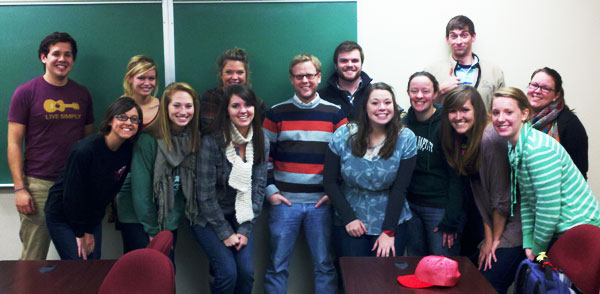
So to those students, the best first class I will ever have, I give my deep thanks! You have taught me to be comfortable with what I do and do not know. You have taught me that laughing at myself and the clumsiness of the process creates space for honest dialogue and true progress. You have taught me that respect comes in the form of accountability and honesty, not position or title. And you have taught me that making room to be called out can be most rewarding.

And you have taught me that there is much to be hopeful for as you enter the world with the good news of Christ and his kingdom. The practice fields, the pulpits, and the boardrooms you operate in will be graced with a fresh humility and curiosity that will always be pregnant with the hope of all things being made new.

I look with great anticipation toward your futures.

djordan
Pine Tree Dr.

Tagged , , , , , , , , , ,

what they are teaching me | 2

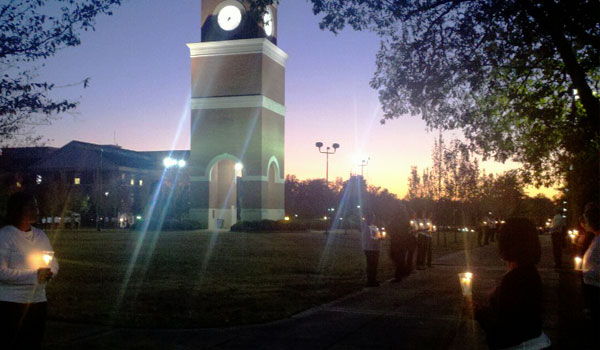
There is something quite stunning about this group of men and women. I watched them walk through the candle-lit, witness-lined path at the fourth annual Remember Me walk for homicide-loss survivors, and while emotions varied from person to person, there was a stunning mark of resilience that was breathtaking on all faces. Faces covered in tears beamed with resilience. Faces covered in solemnness beamed with resilience.

And it is stunning.

I am prone to be all one thing.

All furious.

All joyful.

All hopeful.

All helpless.

But I am learning the deeply human art of being all of two things at once. I am learning to carry two emotions in their fulness at one time, refusing to let one swallow up the other. I can be enraged at injustice, arrogance and ignorance on my own part or the part of others that causes grief and pain in the world; and at the same time, I can be grateful for the peacemaking, the meekness and the thoughtful engagement on my own part or the part of others that slowly gives promise to the reality of the coming kingdom.

There is this need for the truly human women and men to stand in a space between horror and hope and refuse to lie about the former in an effort to find the latter. There is a call to stand, much like Christ, with arms outstretched in an effort to keep a tight grip on both reality and promise, knowing our hearts can hold the tension.

And these men and women––walking with photographs in hand of the husband, daughter, mother, grandbaby they had ripped from their lives in violent murder––they walk, faces shining with complete resilience and complete grief. They promise by the mere act of putting one foot in front of the other that God has placed deeply within us his own nature of being fully enraged and fully proud of all that humanity is and will one day be.

Kingdom come.

djordan
Memphis, Tennessee

Tagged , , , , , ,

what they are teaching me

You think you know what you have to offer, but you’re always surprised by those you think to be the recipients.

In the last few weeks, on top of counseling with individuals one on one, I’ve been helping facilitate group therapy for people who have lost someone to homicide.

The first meeting, I flew in to the group meeting, just in time, from a day at Pathways filled with clients.

I sat around the table, and felt my emotions move from wherever I store them to the edges of my eyelids. I heard stories from men and women who have had fathers, mothers, daughters, brothers and sons stolen from them. The weight is incredibly heavy, and yet, they show up. They have their clothes on, their faces on, and their minds on.

And they show up. No matter what.

One man talked about the temptation to get in “the mode.” He went on to describe a mode that keeps him trapped in sorrow, pain, and the stories of the past and futures that will not be realized. He said he works hard to keep from falling into that “mode.” And when he does fall into that mode, he recognizes it, stops, keep going.

And that was where he made all the difference for me. I heard his wise, steady, strong voice for the next eight days.

Recognize it. Stop it. And keep going.

I continue to play out conversations, actions, past and future possibilities that could be different. And when I don’t pay attention, these played-out conversations consume the space in my mind that could be occupied with far more beneficial things. And in the past, when I have discovered myself stewing there, I have added anger to misery.

But I hear his voice now.

Recognize it. Stop it. And keep going.

If five minutes later, I have to stop stewing about what is distressing me and look to all that is hopeful––it’s the same response.

Recognize it. Stop it. And keep going.

Thanks to the man in our support group who is working through his own unspeakable grief––and who, in the process, is changing my world.

djordan
Pine Tree Dr.