Tag Archives: death

and once again we sing

Vietnam B-52 Bomb Craters

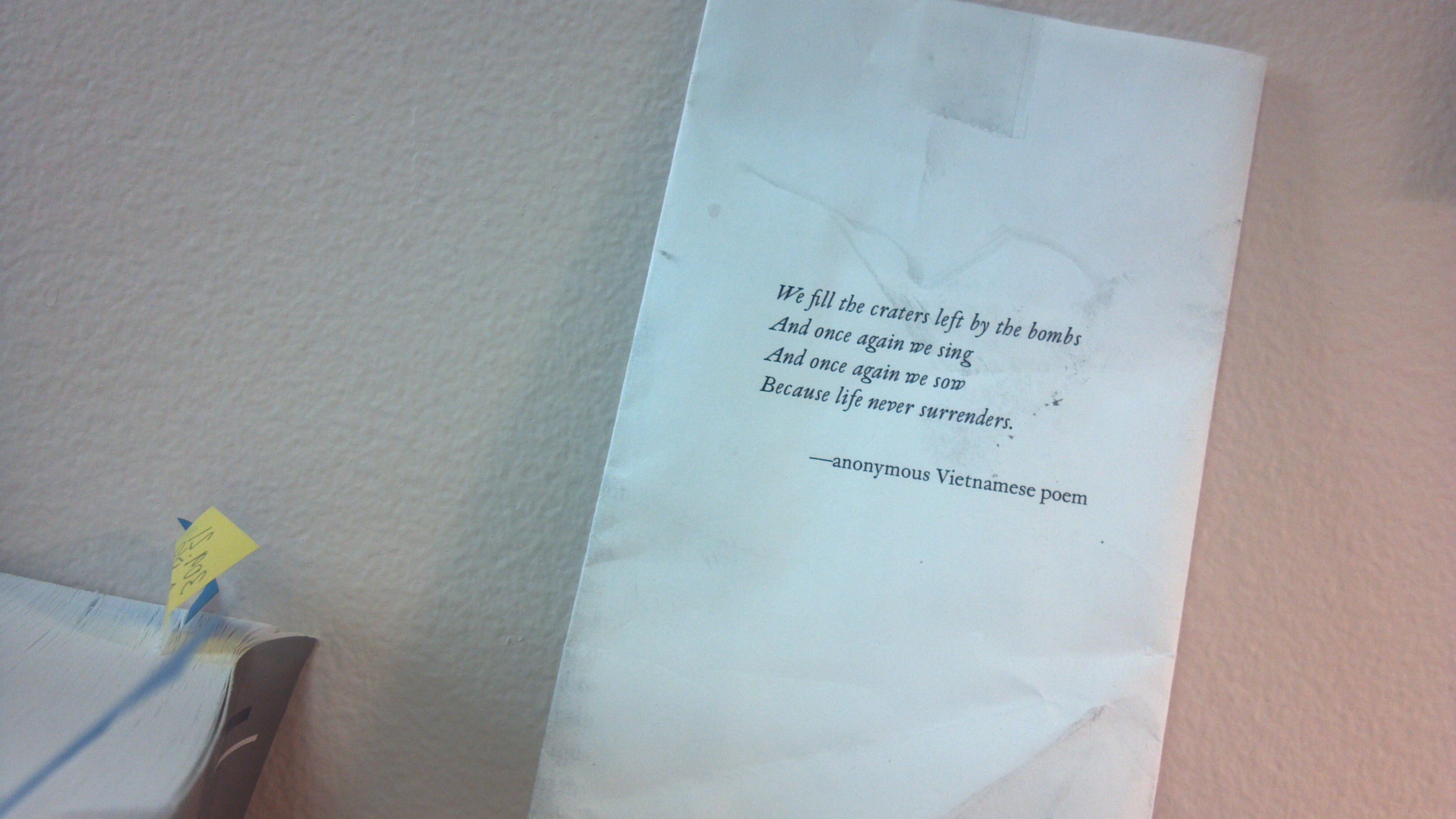
Throughout my last two jobs, I’ve had the same folded-up xerox copy of the first page of a memoir which has the following lines attributed to an anonymous Vietnamese poem taped to the wall above my desk:

We fill the craters left by the bombs
And once again we sing
And once again we sow
Because life never surrenders.

These words struck me when reading the memoir, but these days I don’t remember why. Over the last three years, I’ve thought a great deal about trauma and grief. First motivated to begin understanding it more while working with the survivors of homicide-loss, and then through my own personal journey through difficult work days, and now in the context of the lives of my individual clients as well as communities in which we work for transformation and development.

The notion that suffering and pain, while seen to be inherently private and uber-personal, is in reality communal and fundamentally social, the words are becoming more and more haunting.

As the church moves into communities of violence, systemic injustice, stigma, poverty, materialism, greed, addiction and isolation, we are often afraid to sing songs that the people waiting for the kingdom have sung for hundreds upon hundred of years…

By the rivers of Babylon we sat and wept
    when we remembered Zion.
There on the poplars
    we hung our harps,
for there our captors asked us for songs,
    our tormentors demanded songs of joy;
    they said, “Sing us one of the songs of Zion!” 
(from Psalm 137)

As a people waiting and working for transformation, before we fill the craters, before we take on life again, we must tell the dirty truth about our loss and despair and all that is wrong and evil and messy and undone in the world, in our private and personal worlds, and in our communal and social worlds. If we, those who hold the promise that life never surrenders, can’t tell the truth about the mess of it all, then we aren’t yet ready, aren’t yet brave enough, to sing and sow once again.
2013-02-01_16-01-42_735

djordan
Summar Dr.
Tagged , , , , , , , , , , , , , , , ,

the class who shows up | on the 5th annual homicide-loss walk

After five years of standing in line watching men and women, propped up babies on hips and grandparents escorted with walkers, this year was different altogether.

It is both encouraging and discouraging to see the crowd grow year after year at the Commemorative Walk for survivors of homicide-loss. It’s been my privilege to listen to and learn from these men and women in a weekly support group, but to see them walk through candlelit paths holding photos of their murdered husbands, sons, grandsons, wives, mothers and grandmothers is altogether horrifying and holy at the same time.

And it has been every year these last five years since the very first walk. It is always holy in the way honestly telling the honest truth is always holy and almost always horrifying.

But this year, there was something new for me as I stood in the evening’s mist.

Looking into the line of men and women with faces barely glowing from the candles in their hands, I saw my students. The clock strikes nine every Monday, Wednesday and Friday and my students are faithful to be patient with me in class as I dance onto tangents, threaten with grades and bribe with food. They have listened to me grow awkwardly teary about the histories of movers and shakers from the margins of the field whom God has used to bring kingdom change across the globe. They have held on as we’ve acted out counseling sessions, as we’ve debated the reasons for poverty and welfare, and as we have pushed the questions of power dynamics and our goodwill to the limits. They always show up.

But this night, lining the sidewalks where women and men who have become dear to me walk through their glowing candles and make clear that their murdered loved ones will not be forgotten, my students showed up. As tears filled my own eyes, I lost my breath in thinking that these very students were standing physically and symbolically right on a dangerous line. They were being both witness to the hard and horrible and hopeless truths like rampant homicide in a community, and were also making a symbolic promise that as social workers who are Christians they will join in the kingdom work to make peace on earth as it is in heaven.

My prayer for those students and any of my students, is that some day in the not-so-distant future there will be professors of Social Work or Theology or Education or Business standing up in front of their own classes telling the names of my students, and talking about how they pushed in from the margins to make peace and to change the world with and for Christ and his kingdom.

And when I hear those stories told, I’ll remember the way their faces glowed this night.

djordan
Pine Tree

RELATED POSTS | what they are teaching me | what they are teaching me 2 | when others tell their stories

Tagged , , , , , , , , , , , , , ,

from the archives | loss as loss, not as lesson


In reflecting on the upcoming one-year anniversary of mosthopeful.com on August 23, I’m throwing some of the posts that readers have looked at the most back into the mix. Thanks for allowing me the space. It’s been a most humbling experience.

Below is the most viewed post from the blog over the last year, the first year of the blog. Thanks to the friends, families, and clients who have helped me grow in understanding and practice as it involves those grieving, and for helping me learn that we are all learning how to live in a world that is not yet whole.

+++

View the original post and comments from March 12, 2012


loss as loss, not as lesson


Loss as loss, not as lesson

Maybe it springs from our own deep need to protect ourselves when we know we cannot.

When a tragedy happens of some kind, especially the loss of a son or friend to a kind of accidental death, it is our nature to jump to working at meaning-making. When someone is lost to old age, or even long-term illness, there are many bedside conversations that make space for meaning to be made.

I am sorry for this.
I want you to know this.
I wish we had this.
I want us to do this.

You mean this to me.
You taught me this.
You are loved.

But when an accident happens, or a sudden death, or a suicide, or a crime…
There is no time for words to fill the space.
No hands touching hands.
No way to know they know.

And so we end up stuck on this side of the sleep, trying our damnedest to make sense of the whole thing. We look into every question we could possibly ask to make meaning, and there is none to be found. Often those closest to the loss are stuck spinning in the losing itself, until they can solve it, keep it from having ever happened, get those last words in.

Which of course, proves meaningless as well.

And then there are the onlookers among us, tucking our children in at night, kissing our spouse, patting our buddies on the back, and wondering what we would ever do if we were to lose them.

That’s when we find ourselves making the loss a lesson, as if that makes it worth happening. As if it protects us from it happening to us or those we love. We begin to talk about how “it has taught us …”

And there is an illusion to our nature of doing this that suggests there is meaning as long as we learn something from it. If we make a tragic loss a lesson, it won’t be meaningless anymore.

But I don’t want my dead son, spouse, buddy to be a lesson; I want them to be my son, spouse, buddy. We want lives to be meaningful, not deaths. We want to say their names and images of life, not tragedy, to be conjured up. And when they are gone, especially when I didn’t have time to make meaning with them, I want to grieve. And I want them to be remembered for what their lives taught others, not their meaningless, untimely, horribly tragic death.

The meaning is in remembering who they were.
The grief is in losing them to begin with.

The loss is a loss.
Meaningless.
Void.
Empty.
It is not things as they should be.
It is before all things are made new.

There is, however, meaning in remembering.
And grief is not our enemy, but a sign that we have hearts full of love and woven with connection.
In our caring for the greiving, may we, like our God, be close to those whose hearts are breaking.

Breaking hearts are not a lesson; they are breaking hearts.
And they, in themselves, are worth all the world.

djordan
Pine Tree Dr.


Tagged , , , , , , , , , , , , , ,

from the archives | a little help from his friends


In reflecting on the upcoming one-year anniversary of mosthopeful.com on August 23, I’m throwing some of the posts that readers have looked at the most back into the mix. Thanks for allowing me the space. It’s been a most humbling experience.

+++

View the original post and comments from April 2, 2012

a little help from his friends | guest post by Rayna Bomar


rayna bomar guest posts

This is the first guest post here on mosthopeful.com, and I couldn’t be more convinced of its appropriateness. Hugh and Rayna Bomar have become friends of mine these last few years, and their ongoing journey of remembering their son Sam has had an impact in my own life. I hope you glean from Rayna’s words about what has helped and what has not helped as she has been on her own very personal journey with grief. 

In August 2009, as my son Sam started his senior year of high school, I happened upon an essay by a woman named Mimi Swartz entitled “Empty Nest: In a Week He’ll Be Gone – And I Can’t Stand It.”  Her son, also named Sam, was leaving for college a year before my Sam would leave, and I read her words to prepare for what, I thought, I would be experiencing the following August. And, the following August, I did share some of the life changes described by Swartz – dinner for three became dinner for two, my schedule no longer revolved around the school calendar, and the “mundane rituals of child rearing,” just as Swartz had predicted, were gone.  But my role as a mother changed for a reason not anticipated. My Sam didn’t leave for college. Instead, he died on May 4, 2010, ten days before graduation.

There are many things that I could say about the past almost 23 months, but what I would like to do now is share some of the ways that others have helped us get through those months – and a few things that have hindered us.

My husband Hugh and I quickly realized that all grief is personal. What you have experienced losing a loved one, even a child, is not the same as what I have experienced losing Sam. My experience is not the same as Hugh’s experience. Therefore, things that I mention that have helped (or hindered) us may not help (or hinder) you.  I am an expert only about my own grief.

We have been most touched by the kindnesses that have been shown by Sam’s friends. We are in awe of the young men and women who are so naturally compassionate and who have put aside their own grief to help us with ours. They have taken us out to eat on Mothers’ Day and Fathers’ Day, visited on holidays, designed t-shirts and bumper stickers in Sam’s memory, mowed our yard, shared stories about Sam (what we love the most), written letters and sent cards, laughed with us and cried with us, helped with chores, preserved Sam’s spot in the high school parking lot, invited us to their celebrations- I could go on and on.  We are greeted with open arms and a hug. Sometimes we get more than one hug. They tell us that they love us. They share their lives with us and allow us to be part of their future. Their actions are drops of water on parched ground.

What they don’t do is, perhaps, more important. They don’t tell us that it’s almost two years since the accident and it’s time to “move on.” They don’t give us any advice.  They understand that our world changed when Sam died and that we will never be the same. They don’t expect us to be the same because they will never be the same after losing their friend. They don’t try to “fix” us. They don’t make any demands on us. If we feel like a visit, that’s great. If we don’t, they understand, and they don’t take it personally.

Maybe because of their relatively young ages (late teens to early twenties) they don’t have any preconceived ideas about how we should act or feel. Therefore, they don’t think they know what’s best for us, and they don’t try to impose their own feelings on us or try to dictate what is appropriate behavior.

Instead of trying to make us be who they think we should be, they already know who we are. We are Sam’s parents, and we always will be. That’s good enough for them, and it’s good enough for us.

“Death ends a life, not a relationship.” Robert Benchley.

One of the upcoming ways you can join the Bomars in remembering Sam is by attending the 3rd annual Sam Bomar Night at the Jackson Generals. Half of each ticket pre-ordered with the promo codeSamBomar goes to the Sam Bomar Scholarship FundClick HERE to learn more, and to buy tickets for the event on June 23.  

For other most hopeful posts on grief, loss, trauma and resilience, CLICK HERE.


Tagged , , , , , , , , , , , , , , , ,

resurrection and the third way

It’s not even that we are being foolish to assume that one of two options is all we have to hope for, or if we’re lucky, all we have to choose from. We can feel the tension building as the story climbs to the cross, and if we didn’t know better, which of course we do know better, we would be hoping that they would change their minds and let him down. Or at least he would finally decide to call some winged agents in to take him down so he could find his place of importance on the throne.

We think it is only that, now, or death.

And death is final.

So we can’t blame the ladies for waking up the next day and taking the spices and oils they had worked on the night before as their tears feel into the mix. There were two ways, death or something spectacular there on the cross, and death is the way that won. So they head there prepared to prepare his body.

And that’s when we all learned for the first time, of many times by now, that there are more than two ways of being and moving forward in this world.

That empty gravesite sits for us now as a reminder of our calling to follow Christ into the kingdom of the third way, the kingdom of impossibility, the kingdom of breathing new life into dying things, the kingdom of defeating death, the kingdom of upside-down conclusions to right-side-up stories.

With the poor.
With the lonely.
With the addicted.
With the greedy.
With the grieving.
With the marginalized.
With the marginalizers.
With the hopeless.

With those of us who have resigned to the fact that all is lost, so we prepare to bury our hopes and dreams for a new life and a new kind of world.

Welcome, today, in light of the resurrection, to the kingdom of upside-down conclusions to the stories we find ourselves in.

djordan
Pine Tree Dr.
On Easter

Tagged , , , , , , , , , , , ,

a little help from his friends | guest post by Rayna Bomar

rayna bomar guest posts

This is the first guest post here on mosthopeful.com, and I couldn’t be more convinced of its appropriateness. Hugh and Rayna Bomar have become friends of mine these last few years, and their ongoing journey of remembering their son Sam has had an impact in my own life. I hope you glean from Rayna’s words about what has helped and what has not helped as she has been on her own very personal journey with grief. 

In August 2009, as my son Sam started his senior year of high school, I happened upon an essay by a woman named Mimi Swartz entitled “Empty Nest: In a Week He’ll Be Gone – And I Can’t Stand It.”  Her son, also named Sam, was leaving for college a year before my Sam would leave, and I read her words to prepare for what, I thought, I would be experiencing the following August. And, the following August, I did share some of the life changes described by Swartz – dinner for three became dinner for two, my schedule no longer revolved around the school calendar, and the “mundane rituals of child rearing,” just as Swartz had predicted, were gone.  But my role as a mother changed for a reason not anticipated. My Sam didn’t leave for college. Instead, he died on May 4, 2010, ten days before graduation.  

There are many things that I could say about the past almost 23 months, but what I would like to do now is share some of the ways that others have helped us get through those months – and a few things that have hindered us. 

My husband Hugh and I quickly realized that all grief is personal. What you have experienced losing a loved one, even a child, is not the same as what I have experienced losing Sam. My experience is not the same as Hugh’s experience. Therefore, things that I mention that have helped (or hindered) us may not help (or hinder) you.  I am an expert only about my own grief.    

We have been most touched by the kindnesses that have been shown by Sam’s friends. We are in awe of the young men and women who are so naturally compassionate and who have put aside their own grief to help us with ours. They have taken us out to eat on Mothers’ Day and Fathers’ Day, visited on holidays, designed t-shirts and bumper stickers in Sam’s memory, mowed our yard, shared stories about Sam (what we love the most), written letters and sent cards, laughed with us and cried with us, helped with chores, preserved Sam’s spot in the high school parking lot, invited us to their celebrations- I could go on and on.  We are greeted with open arms and a hug. Sometimes we get more than one hug. They tell us that they love us. They share their lives with us and allow us to be part of their future. Their actions are drops of water on parched ground.  

What they don’t do is, perhaps, more important. They don’t tell us that it’s almost two years since the accident and it’s time to “move on.” They don’t give us any advice.  They understand that our world changed when Sam died and that we will never be the same. They don’t expect us to be the same because they will never be the same after losing their friend. They don’t try to “fix” us. They don’t make any demands on us. If we feel like a visit, that’s great. If we don’t, they understand, and they don’t take it personally.         

Maybe because of their relatively young ages (late teens to early twenties) they don’t have any preconceived ideas about how we should act or feel. Therefore, they don’t think they know what’s best for us, and they don’t try to impose their own feelings on us or try to dictate what is appropriate behavior.  

Instead of trying to make us be who they think we should be, they already know who we are. We are Sam’s parents, and we always will be. That’s good enough for them, and it’s good enough for us.

“Death ends a life, not a relationship.” Robert Benchley.

One of the upcoming ways you can join the Bomars in remembering Sam is by attending the 3rd annual Sam Bomar Night at the Jackson Generals. Half of each ticket pre-ordered with the promo code SamBomar goes to the Sam Bomar Scholarship Fund. Click HERE to learn more, and to buy tickets for the event on June 23.  

For other most hopeful posts on grief, loss, trauma and resilience, CLICK HERE.

Tagged , , , , , , , , , ,

on grief | a collection of work

Click any of the images below for past reflections on grief and trauma, loss and losing, and the kind of mix of hopelessness and hopefulness that always accompanies both. Here, again, is a favorite quote on grief:

“Real criticism begins in the capacity to grieve because that is the most visceral announcement that things are not right. Only in the empire are we pressed and urged and invited to pretend that things are all right – either in the dean’s office or in our marriage or in the hospital room. And as long as the empire can keep the pretense alive that things are all right, there will be no real grieving and no serious criticism.”

+ Walter Brueggeman, The Prophetic Imagination


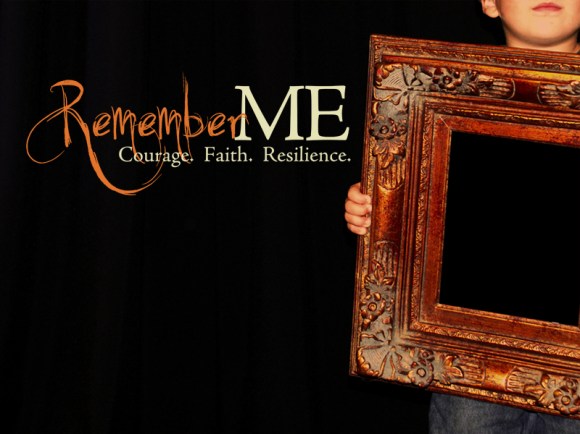
Remember Me Commemorative Walk for Homicide-Loss Survivorsa time for everything under the sunheavy boots, i pinched myself, extremely loud and incredibly closejohn chapter 11, lazarus, jesus, mary, marthalazarus, mary, martha, jesus, death, grief, time, too lategrief, losing, loss, death, sudden death, violent deathgrieving in public, grief and the news, sadness, publicity, gossip

Tagged , , , , , , , , , , , , ,

when the story is stolen | grief in public

In light of many comments, public and private, about my previous post “Loss as loss, not as lesson”, I thought perhaps now is the time to  share a little bit about what I’ve been learning concerning trauma, and specifically sudden, violent death.

After a few weeks of cofacilitating a support group for people who have lost loved ones to homicide, suicide, or accidental death, I began to learn how very, incredibly different the grief process is for this kind of violent death than for other types of loss.

All loss is loss, no doubt; violent loss is different.

I can think of people by name who have
lost a mother in gunfight.
lost a cousin in a robbery gone wrong.
lost a son in a hit a run.
lost a baby to violence.

Three days from today will be one year since my grandfather died. I will never forget the day he passed away, kissing his forehead, and telling him thank you for everything. I had watched as the sinfulness of Parkinsons ate away at his body for several years. Meals had become special. Kisses on the cheek had become monumental. Laughs shared and jokes made had become cause to gather everyone’s attention in the room. Our family was making meaning together, in the privacy of our home, of the life of our husband, brother, father and grandfather. We spent many holidays saying things we needed to say, hearing things we needed to hear. And at his funeral, almost a year ago today, we celebrated his life with grief and with gladness. Meaning had been made, and we could be at peace with his lost.

This is absolutely, positively nothing like losing someone violently. There is no hierarchy of grief, and no need to compare stories, but the grief associated with violent death is sharply different and should be seen and understood as such.

In the loss of our community at the beginning of this week, a freshmen in college dies in a car accident.

The family has no time to make meaning together, in the privacy of their home, around meals, holidays, laughs and stories. They have, no doubt, been doing these things in passing, unnoticed, like we all do. But we do them differently when we see the shadow approaching. So when the shadow is not seen, they are not done. No one is to blame…it is the way we are.

But the story is immediately stolen. There are phone calls and conversations. News reports and tv coverage. Facebook updates and emails asking, wondering, trying to make meaning in places that feel meaningless.

So now, there is not only no opportunity to plan for the grief, but there is no privacy to the story. It cannot be told the way we get to tell the story of an aging grandparent.

The story tells itself. In public.

And then the news tells it. And then the neighbors tell it. Questions of why it is important, what is to be learned, and how to prevent it linger in the mouths of other people. The story is everywhere, and belongs now to everyone.

But most importantly, it is co-opted from those grieving the loss.

To grieve is––in itself––an act of worship.

djordan
Pine Tree Dr.

***

“Real criticism begins in the capacity to grieve because that is the most visceral announcement that things are not right. Only in the empire are we pressed and urged and invited to pretend that things are all right – either in the dean’s office or in our marriage or in the hospital room. And as long as the empire can keep the pretense alive that things are all right, there will be no real grieving and no serious criticism.”

+ Walter Brueggeman, The Prophetic Imagination

***

Tagged , , , , , , , , ,

loss as loss, not as lesson

Loss as loss, not as lesson

Maybe it springs from our own deep need to protect ourselves when we know we cannot.

When a tragedy happens of some kind, especially the loss of a son or friend to a kind of accidental death, it is our nature to jump to working at meaning-making. When someone is lost to old age, or even long-term illness, there are many bedside conversations that make space for meaning to be made.

I am sorry for this.
I want you to know this.
I wish we had this.
I want us to do this.

You mean this to me.
You taught me this.
You are loved.

But when an accident happens, or a sudden death, or a suicide, or a crime…
There is no time for words to fill the space.
No hands touching hands.
No way to know they know.

And so we end up stuck on this side of the sleep, trying our damnedest to make sense of the whole thing. We look into every question we could possibly ask to make meaning, and there is none to be found. Often those closest to the loss are stuck spinning in the losing itself, until they can solve it, keep it from having ever happened, get those last words in.

Which of course, proves meaningless as well.

And then there are the onlookers among us, tucking our children in at night, kissing our spouse, patting our buddies on the back, and wondering what we would ever do if we were to lose them.

That’s when we find ourselves making the loss a lesson, as if that makes it worth happening. As if it protects us from it happening to us or those we love. We begin to talk about how “it has taught us …”

And there is an illusion to our nature of doing this that suggests there is meaning as long as we learn something from it. If we make a tragic loss a lesson, it won’t be meaningless anymore.

But I don’t want my dead son, spouse, buddy to be a lesson; I want them to be my son, spouse, buddy. We want lives to be meaningful, not deaths. We want to say their names and images of life, not tragedy, to be conjured up. And when they are gone, especially when I didn’t have time to make meaning with them, I want to grieve. And I want them to be remembered for what their lives taught others, not their meaningless, untimely, horribly tragic death.

The meaning is in remembering who they were.
The grief is in losing them to begin with.

The loss is a loss.
Meaningless.
Void.
Empty.
It is not things as they should be.
It is before all things are made new.

There is, however, meaning in remembering.
And grief is not our enemy, but a sign that we have hearts full of love and woven with connection.
In our caring for the greiving, may we, like our God, be close to those whose hearts are breaking.

Breaking hearts are not a lesson; they are breaking hearts.
And they, in themselves, are worth all the world.

djordan
Pine Tree Dr.

Tagged , , , , , , ,