Tag Archives: humility

although we intend justice, mercy and humility


we intend to do justice
but we find ourselves surprised by what it involves
and so our feet shake a little when our toe begins to touch the water

we intend to love mercy
but in our eagerness to do justice we catch a glimpse of our own hate toward the other
and we temper down our justice because
we don’t know how to both do justice and love mercy at the same time

we intend to walk humbly
but as we barrel on toward doing justice we grow proud
and as we tip-toe up to loving mercy we grow soft
and we end up missing the mix of meekness altogether

but we know that what you’ve called us to is simple
and it is clear
and so we ask on the eve of difficult days and trying things
to give us the willingness to let you in,
so that you can, through us,

do justice, love mercy, so we can walk humbly with you, O God.

amen.

djordan
Pine Tree


Tagged , , , , , , , , , , , ,

once upon every time

It’s as much of once upon every time as it is has ever been once upon a time.

Power and ambition kill. Others first, ourselves finally.
Humility and selflessness kill. Ourselves first, evil and injustice finally.

Having just returned from Snow White and the Huntsman, I found myself reeling throughout the whole thing, and even still.

The first words were, of course, voiced over in thick accent…

“Once upon a time…”

But it is once upon this time. And once upon a time a year ago today. And once upon every time.

The storytellers have tried to make it clear for ages upon ages and times upon times,

But we have to learn it again for ourselves once upon our times, and sometimes more than once.

All that is in us tells us to fight with might to protect our own.
But fighting with might to protect our own,

fighting with educations, investments, gates, codes, doctrines, prejudices, words, wars,
fighting with might to protect our own leads to a slow unraveling.

But fighting that actually protects is a byproduct of other pursuits.

a byproduct of seeking the good of others,
of giving up on great ambitions,
of investing for the sake of the lives of others rather that for the protection of ourselves against others, of opening gates, sharing codes, listening to the doctrines of others,
knowing before judging,
listening,
serving,
fighting with humility and selflessness, not with great ambitions of winning,
but simply because we can’t imagine not fighting for whatever things are

true
good
just
lovely
honest

And then, in the end, of course, just as the story begins with once upon a time, it finishes with…

But alas, we have never been known, in life outside the tales spun by fairies, as patient enough to wait for the ever after.

As if we’ve ever had a choice.

djordan
Pine Tree

Tagged , , , , , , , , , , , , , ,

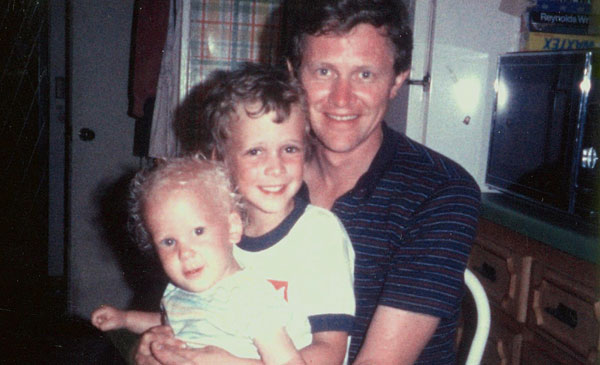
to dad on father’s day

All in this year, Dad hit sixty years old, resigns in a few weeks from practicing law for the last thirty years, and starts a (semi) new career as professor. It’s all of these things together that remind me again how much I have to celebrate about my pops.

I’ve only known Dad’s career as that of a lawyer. When I was born, he was just beginning the practice after going back to law school at the age of thirty after running the “Card Shop” which was the old Greg’s Hallmark in the mall. The decision he made thirty years ago changed the life that my brother and I both led in multiple ways, none of which were difficult.

Day after day I work with people who have lost their fathers, hated their fathers, been abused by their fathers, been left by their fathers, been distanced from their fathers, or been tormented by the lives of their fathers. The ways that these choices bleed into self-image, confidence, disposition, and relationships are undeniable.

Also undeniable are the ways that a father’s ambitions and goals influence the steps and thoughts of his children. Pursuit of power, ambition, wealth, status, image, often are found successful, but leave a great wake of cost in the lives of those trailing behind in either diapers or adolescent pimples.

And so, this year for Father’s Day, I celebrate the fact that I have no sad stories to tell about my dad, and I thank him––and Mom––for it.

I remember as a child of about five or six, Dad dressed up as a judge, Jamey as an attorney, and my split roles as both sheriff and son (costume being only that of removing the cowboy hat). We put Mom on trial for Mother’s Day with the crime that of “Being a good mother.” She was convicted, and sentenced to Mother’s Day cake and hugs by her boys.

Dad taught us great respect of what women, working or not, and mothers, and grandmothers stood for, accomplished, offered to their businesses and homes, and ultimately of how much they were worth. I never saw him demean, belittle, roll his eyes, or even yell at Mom. They disagreed, as they should, but even their disagreements modeled ways of respect, patience and kindness.

Thanks, Dad.

I remember only two major arguments with Dad over the years; both were in late adolescence. And while the subject matter isn’t important, the far that the arguments were about things that mattered greatly is. I don’t remember petty disagreements. I don’t remember my point of view or disagreement being met with anything but ongoing questions and pushing of insight. I do, however remember apologies. I don’t remember what the arguments were about, but I remember, and my brother says the same, that Dad would always, always, apologize when he thought he had been unfair or unkind. It was commonplace after a small argument to hear a gentle knock on the door followed by a soft, “come in.”

Dad taught us that the strength of a man is not in stubbornness, arrogance, strength, ambition, or “not letting them see you sweat.” We were taught, by example more than words, that strength is found in humility, truth-telling, apology, integrity and gentleness.

Thanks, Dad.

I remember Dad saying to “think of your education as a way of life, not something to finish to get to life.” I also remember him saying, “Don’t choose a job where you work for the weekends.” I’ve heard of him changing careers once for this reason, and now at sixty, he does it again. His excitement for entering this new field, and the seriousness with which he is taking it on, and the courage to make a move thirty years later have not gone unnoticed my either my brother or me.

Dad taught us to value learning, trying, becoming and doing. He offered us stability and safety so that we could try anything. He took up guitar in his fifties because he saw a sixteen year old girl playing at a Clapton festival. The regular images I remember of Dad playing air guitar behind the couch have turned into Dad playing an actual guitar, and his example now of entering a brave new world have not gone unnoticed.

Thanks, Dad.

I can’t hit all the things…we were taught to value experiences and people over things. We were taught that generosity is the only appropriate response to wealth and possessions. We were taught that the world is bigger than our circle of friends, and so our circle of friends should be broadened to include the world. We were taught that new ideas were reason for great excitement and careful discernment, not fear and stoning. We were taught that to be a man was to honor all women, stand up for other men, live generously, choose carefully, and act thoughtfully.

As a child, I must admit, I was bothered by how different my parents were. How we didn’t make decisions and spend money and value things like many others did.

As a young adult, I couldn’t be more grateful. The more I learn about what it means to seek first the kingdom, and to live in kingdom ways, I’ve had no better example, and I now have no excuse.

Thanks, Dad. Happy Father’s Day.

djordan
Pine Tree

Tagged , , , , , , , , , , , , ,

reversing the questions

I find myself often asking questions to clients that I know I need to be asking myself. Much of the art of clinical work has little to do with giving answers or telling people what they need to know, as these things are never beneficial when I am struggling with something.

The art seems instead to be in asking the questions, out loud, that we are unable to ask ourselves when we are holding on with dear life to whatever it is that is holding on to us so tightly. And in all the ways that my clients are generous enough with me to offer the space for me to put a new question in the air, it is in that same moment that I hear that question being asked out loud.

Often, like it was today, the words float in space and I recognize that I am hearing the question posed for the very first time as I ask it to the person sitting across from me…

“Why do you think you need the last word?”

“Why do you think it is so important that they understand what you are saying?”

“Why do you think they heard it one way when you intended something very different?”

“Why do you think that became so unbearable for you? What about it is really so impossible?”

‘Why do you think those words from that person meant so much to you?”

“Why do you think you worry about this particular possibility so much?”

“What is it about you that makes this in particular worth so much?”

The bravery my clients show in speaking their realities into the air offers me the opportunity to hear, usually for the first time, the questions that I have not yet been brave enough to ask myself. And so as they share in their own vulnerability, I am able to take a more honest look at whatever is buried in my quiet interior. I am able to ask myself a question that I didn’t even know I needed to ask.

Paired with the gift this has become is the frightening reality that at whatever moment I think I know enough to tell a client what they should know or need to do…in that moment I am missing the opportunity to learn from them what I need to be asking myself.

Their humility and bravery, and generosity with their humanity, are teaching me a great deal about what it means to be a human being in the world.

djordan
Pine Tree

RELATED POSTS | What they are teaching me | What they are teaching me 2 

Tagged , , , , , , , , , , , ,

because you did not ask

head in the shrubs, photography, surrealism, asking, leadership, authority, questioning, questions

 The questions that learning leaders pose challenge their followers to see complexities and interrelationships in [major issues] and launch inquiries that stretch the bounds of their worldview. Moreover, this work is never done. What is learned one day is used the next as a bridge to considering a new set of understandings and challenges. 

+ from “Learning as a Way of Leading” by Preskill and Brookfield

It isn’t uncommon to reference the idea that Jesus answered most questions with questions. At times when women and men were at risk of facing persecution or losing their lives for following him, it would seem that if there were ever a time to answer directly, clearly, give the people “something to hang their hats on,” break it down because “only a few can understand,” it would have been then; it would have been when guards were carrying him off; it would have been when asked an ultimatum of a question by Pilate; it would have been after coming back to new life. But he only asked questions, adding to the confusion with people who were having a hard time understanding anyway.

There is an ease in going along without questions, resting on what others have said with authority. There is an ease in “taking their word for it,” and leaving the hard stuff to those we think know better. But Jesus engaged those who “wouldn’t understand” with questions that made these even more confusing.

Christ was constantly explaining what the kingdom of heaven was like, and it was always upside-down, backwards, inside-out, heretical, inappropriate. And on-purpose.

And it was always posed with a question. A set of illusive stories with no explanation, but counted on the fact that those listening, who had ears to hear, would indeed hear it.

I had coffee a couple of weeks ago with a friend who had been told not to ask any questions about this and that from those in leadership. Something in her, because of what she knows about what Jesus is up to in her own life and world, forced her to ask more questions. In respecting leadership, she was forced to ask them more questions. Ask others more questions. Listen past the answers sometimes shaped to shut down thought and conversation and merely align allegiance. And she took on the challenge.

What was so thrilling for me was her excitement now on the other side of those initial questions. She is renewed in what her calling is, what her faith is about, what her God is doing in the world, and what Christ has set in motion.

She is reminded all over again of the extreme danger that asking questions poses, and the risks involved when shattering what has been by asking what should be. But more than that, I am reminded of the great job that comes in assuming we are always missing something important, in asking others, in reading and learning, in trusting the largeness of God enough to bring him our questions.

Her face and grin as she sipped her coffee has become a symbol for me of what, whenever I am tasked to lead others, I am really being called to do; God doesn’t need me to tell them what they need to know as if they aren’t smart enough to think…instead, I get to join others in asking good questions about a good God who is making all things new.

djordan
Louisville, KY

Some content on this page was disabled on January 22, 2024 as a result of a DMCA takedown notice from Rodney Smith. You can learn more about the DMCA here:

https://wordpress.com/support/copyright-and-the-dmca/

Tagged , , , , , , ,

The best first class ever, and what they are teaching me

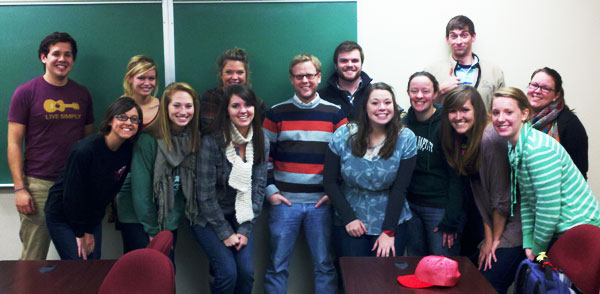
I debated before my very first classroom teaching experience whether or not to pretend like I knew what I was doing. Whether or not to tell the truth when we began that they were joining me on a journey that was the first of its kind for me, or “Don’t let them see you sweat,” as I’ve heard people in leadership say to me before. It never settled well with me. We all sweat. Why shouldn’t they see it?

I think when I walked into the room, I still had not made up my mind. They were seated quietly (this once), waiting to see what the shape of the class would be. I was just as curious as they were.

“Well, I tried to decide whether to pretend like I know what I’m doing with you folks, but, I feel like I should come clean: This is my first undergraduate teaching experience. So there. Now you know.”

Apparently, my mouth had decided the game plan but had not remembered to inform my mind.

“Uh oh…” someone said, then the room laughed, and then we began one of the most enjoyable experiences I’ve ever had. Definitely the best first class ever. Admitting that I would likely sweat that very first day allowed us to sweat together, and made something very communal, spiritual and human possible and present in the room.

We engaged for the next semester in a class about “faith-based social service,” and the wheres, hows, whys, and whats of how the church and people of faith bring the good news that God through Christ will make right all things cursed by sin, bringing his kingdom come on earth as it is in heaven. Things you can get fired for talking about. Things like the human heart, sex-trafficking, homelessness, planned poverty, economic injustice, christian arrogance and ignorance, poverty, greed, pride, loneliness, mental illness, individualistic idolatry, systemic injustice, abuse, trauma, and on and on and on.

“As far as the curse is found,” the old hymn reminds us. And it’s found far beyond only our human hearts and inside our churches, but in our broken communities waiting to see and hear the good news all the same. The big and broad good news that has more to do with everything else than it has to do with us.

And as a class, we began to engage these issues, tried different typologies out on them, dressed them in different best-practice approaches, and delved into scripture to see what it is we work toward and how we are called to work toward it. Throughout, we explicitly tried to guide our discussions and studies with a few questions that we would ask of each other, authors of the texts, practitioners in the field, and pastors in our churches:

1. Is it a bad either or?
Are these bad either/or scenarios that we are working within? Have we picked a side on something that may not (although it very well may) be a real either/or situation? How can we back up enough to see this clearly?

2. What are the assumptions?
What assumptions are we working from but ignoring as we move forward? Have we questioned these assumptions, and are we okay with them if we are building on them? How can we notice these assumptions? Who or what can be engaged to reveal them to us?

3. What are the power dynamics?
What power dynamics are at play, and what are they costing us and those we serve? Are we being honest to notice them, or are we trying to convince ourselves that they don’t exist? Whose voice and eyes can help us see them, and readjust?

4. Where did this information come from?
Where did this information come from? Is it valid? Is it biased? (Yes.) So where is the other side of the bias, and have we considered it? Are we looking for the truth, or looking for something that defends our current stance?

And finally,

5. What is absent but implicit?
Built out of the narrative therapy tradition that has stolen my imagination, this question is important and fresh. What have we left out of our questions, our conversations, our research, our planning, our programming and our praying? And what can its absence reveal to us about how we may be thinking wrongly or ignorantly about the issues? Whose voice, opinion, insight or criticism are we ignoring, and what does that reveal about us and our work?

When the class would be engaged in discussion, and a student would offer one of these questions to help push us into more clarity, I would feel my insides jump for joy. More than any solutions or approaches we came to as a class, or read about in our texts, the impact for Christ and his kingdom that is likely to be had will come from a student being guided by the curiosity and humility that these guiding questions encourage. So when they were thrown into the conversation by the students themselves, I would immediately envision them running organizations, pastoring churches, or working in businesses in the future, throwing out these same questions from the field, the pulpit, or the boardroom.

It makes me beyond hopeful.

And then, the best of all, toward the end of the semester, I was challenged––called out––by a student when I made a comment beginning with a phrase I had warned them to be wary of. In talking about a particular issue, the words, “Well, it all boils down to this: …” came from my lips.

I didn’t hear them. But my students did. One spoke up from the back, “But Donald, does it really? Does it really all boil down to that?” Much like that first class, we all laughed, someone says, “Uh oh….” and we continue with a more honest, more appropriate, more life-giving conversation than ones stifled by a person in the front informing everyone of how complex and nuanced issues “all boil down” to something that they of course do not and cannot. I had been called out, and it was the most rewarding experience of the entire semester.

So to those students, the best first class I will ever have, I give my deep thanks! You have taught me to be comfortable with what I do and do not know. You have taught me that laughing at myself and the clumsiness of the process creates space for honest dialogue and true progress. You have taught me that respect comes in the form of accountability and honesty, not position or title. And you have taught me that making room to be called out can be most rewarding.

And you have taught me that there is much to be hopeful for as you enter the world with the good news of Christ and his kingdom. The practice fields, the pulpits, and the boardrooms you operate in will be graced with a fresh humility and curiosity that will always be pregnant with the hope of all things being made new.

I look with great anticipation toward your futures.

djordan
Pine Tree Dr.

Tagged , , , , , , , , , ,