



does the sky bother at all when the ground quakes
when the things built crash on the builders
and hopes fall deep into the crevices made by an angry earth?
does the sky bother at all?
one completely ravished,
the other, chirping and shining.
a source of both hope and disrespect.
perhaps the sky jumps into sudden action
filling the cracks with its fulness
and making a way for the dawn to reach
the new boundaries of the horizon.
however deep and devastating they may be.
djordan
Pine Tree
On reading Paul Farmer‘s Haiti: After the Earthquake, a Harvard doctor with 30 years of best-practice shaping and informed work in Haiti with Partners in Health, the recent hurricanes and earthquake, and the influx of not-best-practice charity that further weakens the infrastructure of an already colonialism-wrecked nation. Farmer recounts the resilience, strength and ingenuity of the Haitian people, and the imperative to work with them, not for them.

I remember the first time I watched Amazing Grace. I felt immediately proud and cowardly, feeling both as I resonated with humanity at its best and worst. Wilberforce looked the status quo in the eyes, evil and injustice and profitable as it was, and challenged it. Of course, he was able to do so because he had the money and the power and the influence to ultimately play hard ball with the good old boys.
But the scene I remember from the film is one where sitting around a table, their inability to imagine how they could continue profitable businesses, orderly communities, and the current status quo made Wilberforce’s audience unable to move forward with the abolition of slavery. They were likely people who sought justice in other ways, but this hit too close to home, and their imaginations could not overshadow their greed and lust for power.
I was reading a review this week of Taylor’s new book, “A Slave in the Whitehouse,” (referenced here in this week’s MASH) where she described President Madison as one who worked for fair treatment (relatively speaking of course) for slaves in the country, but upon his death did not free a single one of his own. It was Taylor, the reviewer of the book, who stated, “Madison did not believe that white and black Americans could live side by side on terms of equality and amity. His failure to imagine a world more capacious and tolerant than his own helps explain a good deal of subsequent history, and America’s resistance to the very practice of equality that Madison otherwise did so much to foster.”
I think about Martin Luther King.
I think about Nelson Mandela.
I think about Mahatma Ghandi.
I think about the nameless men and women who follow their imaginations into a different kind of possibility for the future. Not just for and around issues of civil justice, but around issues of technology, healthcare, development, education.
They were no doubt met with others whose imaginations had been stifled, and therefore could not wrestle themselves away from comfort and power to risk them both for the sake of a more kingdom-like future.
And so my mind now turns to those schools, churches and organizations that foster imagination and second-guessing as a guiding principle. It is from these communities that we will see change happen. Of all the downfalls I am at risk of meeting, I hope that one of a failure of imagination isn’t the one that takes me down.
My friend Craig has said before, “Of all the ridiculous things God has called us to do, defending the status quo is not one of them.” And whatever is to break the status quo always begins with a strong imagination.
Pine Tree
djordan

It’s not even that we are being foolish to assume that one of two options is all we have to hope for, or if we’re lucky, all we have to choose from. We can feel the tension building as the story climbs to the cross, and if we didn’t know better, which of course we do know better, we would be hoping that they would change their minds and let him down. Or at least he would finally decide to call some winged agents in to take him down so he could find his place of importance on the throne.
We think it is only that, now, or death.
And death is final.
So we can’t blame the ladies for waking up the next day and taking the spices and oils they had worked on the night before as their tears feel into the mix. There were two ways, death or something spectacular there on the cross, and death is the way that won. So they head there prepared to prepare his body.
And that’s when we all learned for the first time, of many times by now, that there are more than two ways of being and moving forward in this world.
That empty gravesite sits for us now as a reminder of our calling to follow Christ into the kingdom of the third way, the kingdom of impossibility, the kingdom of breathing new life into dying things, the kingdom of defeating death, the kingdom of upside-down conclusions to right-side-up stories.
With the poor.
With the lonely.
With the addicted.
With the greedy.
With the grieving.
With the marginalized.
With the marginalizers.
With the hopeless.
With those of us who have resigned to the fact that all is lost, so we prepare to bury our hopes and dreams for a new life and a new kind of world.
Welcome, today, in light of the resurrection, to the kingdom of upside-down conclusions to the stories we find ourselves in.
djordan
Pine Tree Dr.
On Easter
I’m learning from those around me––those I’ve interacted with in church, in the hospital, in the community, in the classroom, not to mention those I live in community with––that brokenness and mess is everywhere, seeping into cracks we didn’t even know existed. With each client that comes in my office, or each friend that sits down to the table, there is this secret notion that no one else is wrestling with the grief, the guilt, the conflict, the doubt that she or he is.
And there is a kind of comfort that flashes across faces when they learn they are not the only one, but they are one of many.
It is only a flash, though. There is a certain amount of comfort that comes in knowing our misery shares company, but then we are stuck in misery with others.
But still stuck nonetheless.
And that is where some of the magic of the Saturday between Good Friday and Easter Sunday exists. Holy Saturday, Low Saturday, Easter’s Eve: It is that day where the black drapery still hangs over the cross and the Easter lilies, unless the church staff were too eager to prepare for the bright whiteness of Sunday morning.
The silence of the Saturday seems to be the place we find ourselves in most often. We have the luxury, now, of knowing that Good Friday leads to Easter Sunday, but we sit in between the two with our fingers crossed and our noses raw from rubbing them with tear-stained tissue.
And I believe, as I interact with these men in women in my office and in the community and in the churches…I believe that God honors our tight stomachs and heavy hearts on the Holy Saturdays of our lives and worlds. We must challenge the need to jump to Easter Sunday, and honor the grief and struggle on the day before the inauguration of all things new.
djordan
Pine Tree Dr.
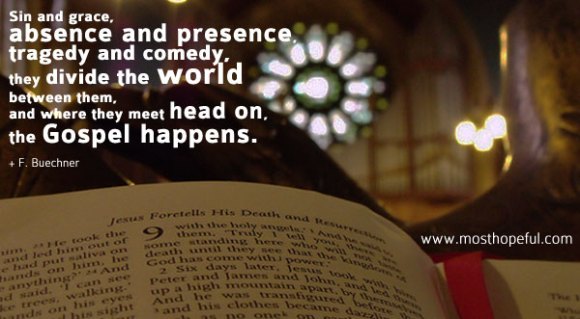
Switching on the lectern light and clearing his throat, the preacher speaks both the word of tragedy and the word of comedy because they are both of them the truth and because Jesus speaks them both, blessed be he. The preacher tells the truth by speaking of the visible absence of God because if he doesn’t see and own up to the absence of God in the world, then he is the only one there who doesn’t see it, and who is then going to take him seriously when he tries to make real what he claims also to see as the invisible presence of God in the world? Sin and grace, absence and presence, tragedy and comedy, they divide the world between them and where they meet head on, the Gospel happens. Let the preacher preach the Gospel of their preposterous meeting as the high, unbidden, hilarious things it is.
+ Frederick Buechner, from Telling the Truth

Click any of the images below for past reflections on grief and trauma, loss and losing, and the kind of mix of hopelessness and hopefulness that always accompanies both. Here, again, is a favorite quote on grief:
“Real criticism begins in the capacity to grieve because that is the most visceral announcement that things are not right. Only in the empire are we pressed and urged and invited to pretend that things are all right – either in the dean’s office or in our marriage or in the hospital room. And as long as the empire can keep the pretense alive that things are all right, there will be no real grieving and no serious criticism.”
+ Walter Brueggeman, The Prophetic Imagination



It is just after the time when it’s too late.
Our prayers are guided this way. We pray leading up to the time when it is obviously too late. And then we explain why he didn’t show up. Why he didn’t answer.
When our prayers are answered the ways we ask, we give God thanks, and remember it as a way to explain that God indeed does answer prayers.
When our prayers are not answered the ways we ask, when they are not answered in time, we explain that God knows better. We talk about his soveriegnty, and our need to trust him.
We say things like, “Our ways are not God’s ways,” and, “We will know when we should know.”
And in many ways, we come up with explanations either to give God credit, or to let him off the hook.
We pray, and still families fall apart.
We pray, and still jobs are lost.
We pray, and still the famine continues.
We pray, and still we are abused.
We pray, and still we abuse.
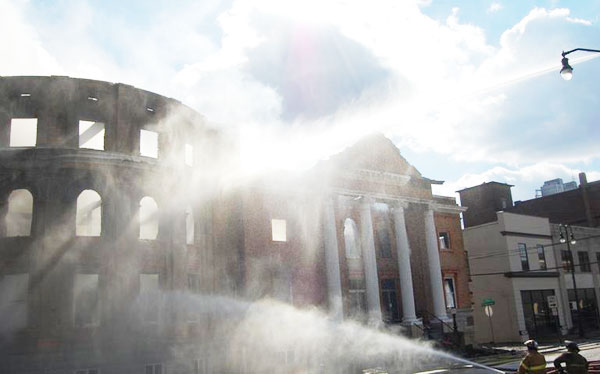
We pray, and still the fire burns it all the way down.
We pray, and still the gunshots are fired.
We pray, and still the son is lost.
And so, we say, God knows best. Our ways are not his ways. We will know when we should know.
But not Martha. She is angry.
She had faith, and called him early. When he got sick, she sent for him to get there.
But he did not. He was too late. And she let him know, “If you had only been here.”
And this time, of course, he was not too late. In the ways that he is never too late. There is no too late. Time waits for him, and he does not need time to work in his favor.
And this time, the too late was just on time. When the stone gets pushed out of the way, he comes stumbling out wrapped up like a mummy.
And we talk of the sovereignty of God, Jesus’ power against death, his ways as being other than our ways.
And we are comforted, for a moment. The story helps us take a deep breath, and say to ourselves, it is never too late for him.
But still, we are sitting in the aftermath of
families that have fallen apart.
jobs that are still nowhere to be found.
famine that is murdering millions and millions.
abuse that does not stop.
abusing that cannot stop.
crumbles of chard homes, businesses, churches.
gunshot wounds and hospital noises.
gravestones of our sons and daughters.
And to say the he is never late feels poisonous escaping from our lips.
Martha says, “But even now, I know that God will give you whatever you ask him for.”
In some ways, this makes it worse because we are sitting in the murky puddles of loss and hopelessness.
In other ways, this makes it better because we know that we have seen you more than once defy time and loss and death.
Help us let this make it better.
And when it does not, and we cannot, call for us as you called for Mary, from our mourning…
djordan
Pine Tree Dr.


 most hopeful