Category Archives: the calendar

mother’s day proclamation

woman in the kitchen

In the culturally Christian environment of the south where the rules of who women should be and what they should do, mixed as strongly with who they should not be and what they should not do, I am reminded today of the women and mom’s in my own world who have lived into the fulness of themselves for the sake of the world. Those who seek to follow Christ have just as much lived into themselves for the sake of the kingdom come. In areas of health, justice, faith, education, art, academia, research, motherhood, women are pushing what it means into the heart of what it actually does mean.

So on this mother’s day, as reminded by this recent article, here’s to the women who are changing the world as they were made and meant to do, not quietly living into a solemn story someone else told them they had to act in. And to my own mom, thanks for teaching me to ask the questions.

Below is the “Mother’s Day Proclamation” written by Julia Ward Howe in in 1870, pushing women to pacifism and resistance.

Arise then…women of this day!
Arise, all women who have hearts! Whether your baptism be of water or of tears!
Say firmly…
“Disarm! Disarm!
The sword of murder is not the balance of justice.”
Blood does not wipe our dishonor,
Nor violence indicate possession.
As men have often forsaken the plough and the anvil
At the summons of war,
Let women now leave all that may be left of home
For a great and earnest day of counsel.
Let them meet first, as women, to bewail and commemorate the dead.
Let them solemnly take counsel with each other as to the means
Whereby the great human family can live in peace…
Each bearing after his own time the sacred impress, not of Caesar, But of God –

For the article by Diana Butler Bass on the history of Mother’s Day as a day celebrating radical mothers, CLICK HERE.
For an article posted today on women seeking to pray through the violence of tradition, CLICK HERE.
Or for a more light-hearted open letter to Moms by Kid President, CLICK HERE.

djordan
Pine Tree

 

Tagged , , , , , , , , , , , ,

an occupying generosity

occupying-generosity

“Grace is the occupying generosity of God that redefines the place.”W. Brueggeman

I find myself in multiple conversations over this wedding weekend trip. This will be the only wedding of my brother I ever get to be a part of. Our family, those by blood and those by commitment, have gathered together as we are never really able to do in a spectacular city for an important moment.

And as in almost all holy gatherings like these, as all gatherings are likely holy but we only notice some, we find ourselves telling stories together of memories that have scaffolded our shared histories up to these moments. As many perspectives as wedding guests, stories are told over rich food and drink from years upon years of moments, all reminding us of how incredibly fortunate we are.

Children in diapers looking out windows.
Promises made and promises kept.
Phrases learned from repetition that stick years later.
Shared community homes.
Shared inside jokes.
Shared holy lives.

And in moments where we make our promises out loud in fanfare and flower-lined rooms, we are reminded that we have no ability to actually keep them even when we are acting out of our best.

And it’s in these moments, also, that we look back over shared histories from varying perspectives and realize that we have been living in an occupied place, filled with the sometimes subtle and sometimes breathtaking generosity of God. And in those moments, when we have to clench our jaws together to keep from crying out with joy because it will ruin our faces or our makeup, we own up to the holiness of grace filled lives, occupied by the generosity of God.

And we are redefined.

So we celebrate in promise and in party, knowing that a family occupied like ours is a glimpse of the kingdom breaking into earth.

Congratulations, Jamey and Emily. Looking forward to this one.

djordan
Chicago

Tagged , , , , , , , , , , , , , , ,

things regarded as dead

Screen Shot 2013-04-01 at 8.45.26 AM

I woke up Easter morning to find an email from a friend that only read:

“Today may you start seeing God’s resurrection of things regarded as dead.”

One week later, I’m not sure in what ways I’m starting to see the resurrection of things regarded as dead.

I let a lady check out in front of me today at the store, and she replied that chivalry might not be dead.

Another lady at another store had to ask me a million different questions and try to sell me on a million different offers during the checkout process. I thought nothing of it all until she leaned over the register and said, “thanks, at least, for being nice about all this, young man.”

I went to the funeral today of a good friend’s father who got sudden news of serious cancer, and within weeks, goodbyes were said and tearful thanks given for the notion that the end of life might not actually be an end at all. As much as it still hurts like hell, of course.

And so I wonder, one week after Easter, what it means to begin seeing God’s resurrection of things regarded as dead.

Chivalry.
Kindness.
The lost life of a father.

What about hope that good can overcome evil?
That generosity can overcome greedy anxiety?
That humility beats out power and success and ambition?
That justice can break its way into dark injustices?
That forgiveness is stronger than any force of revenge and retaliation.
That families can come together, no matter how they’ve wrestled apart.
That marriages can make it.
That children can make it to adulthood.
That adults can remember the joy of childhood.
That abundance can make its way to those living in great scarcity.
Abundance and scarcity of money, identity, understanding and freedom.

We don’t build our church buildings next to our graveyards anymore, and we’ve likely forgotten altogether the resurrection we’ve been counting on as a ragtag group of women and men and liars and lovers all these years.

We’ve also likely forgotten that things we’ve already written off and sealed up and buried deep as dead impossibilities are waiting, one week after Easter as much as easter morning itself, for the resurrection.

Hope, generosity, justice, families, marriages, children, adults, abundance, scarcity and equality, identity, understanding and freedom.

Chivalry isn’t dead.

Neither is the hope, and therefore the prayer, that God’s kingdom come, and his will be done, on the earth this week after Easter Sunday, as it is in heaven.

djordan
Pine Tree

Tagged , , , , , , , , , , ,

up for anything

2013-03-19 17.48.46

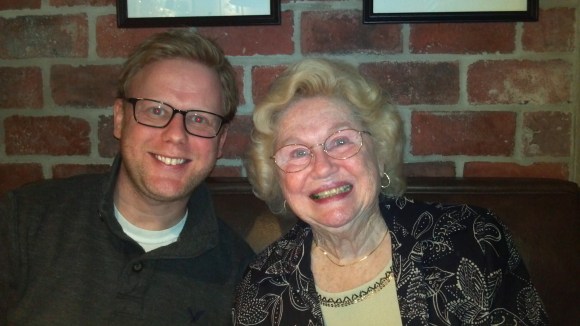
Today is my grandmother’s birthday. She turns 82.

When I asked her if it was her 83rd, she replied “No” with an exclamation point and said that she apologized for being blonde, but it would take her another whole year to get to 83. She said, “But I’m up for anything…”

This conversation happened on facebook messaging.

I see TuTu more now (TuTu is what I call her of course) because she volunteers for us at least one day a week at Area Relief Ministries. We joked at the office just today about her requesting to close up shop one day after the office had closed, letting everyone know that she would close up shop because she hadn’t finished what she wanted to finish yet. We didn’t allow it, of course.

Some of my stubbornness comes from TuTu.

So does some of my shortness, my red checks, and my fast sweating. Those all come from TuTu as well.

And hopefully, my willingness at 82 years of age to be a part of what God is doing with the homeless, the at-risk, the materially poor, the families in crisis…hopefully being wiling to take part in the work of the kingdom at 82 years of age…not 83 yet…is some trait of TuTu’s that I will inherit beyond my 5’8″ stature and red, sweaty cheeks. If my height, cheeks, and temperature are inherited from TuTu, I’m proud of them too.

Even more so if I will redefine the 80s and 90s as times to pour into what God is doing in the world to make all things new, it will be a proud legacy. As my boss at ARM used to sing, “Age ain’t nothin’ but a number”.

I teach class at Union University a few days a week, and it brings me great joy to hear from students and acquaintances, “You are TuTu’s grandson, aren’t you. She has talked about you.” To work to keep up with my grandmother’s social calendar might bring me shame, but instead, it brings me great pride. To try to keep up with the textbooks she is reading on New Testament theology and Christian history might make me feel dumb, but instead it makes me ambitious.

To TuTu on her 82nd birthday, you make the passing of time seem like a great reward. Thanks for the legacy, and for my red, sweaty cheeks. All my love.

djordan
Pine Tree

Tagged , , , , , , , , , ,

a people who tell the truth | thoughts on ash wednesday

from dust you came, and to dust you will return

It occurred to me while getting a cross of ash smeared over my brow, hearing the words, “from dust you came, and to dust you will return,” that one of the things I appreciate the most about the faith I’m finding myself leaning into more and more is that we are a people not only allowed to tell the whole truth, not only even encouraged to do so, but ultimately demanded to do so.

We must tell the truth: the good, the heartbreaking, and the completely unexplainable.

And so we operate in a season of lament and reflection. We begin it by marking ourselves with the dust we come from and the dust to which we will return. We take time to fast from things to remind us of our desperation and dependence on the king of the coming kingdom for anything to be worth telling in the end.

And even when shiny churches and slick preachers grin and tell us how to be happy, we must tell the truth that the world goes not well. Injustice abounds and work toward justice often feels like tiny drops in an enormous ocean. Hearts ache with broken families and open wounds. Loss stings years later like the day death stole life from our fingertips.

And so we tell the truth. All of it.

The hope of the kingdom coming is only truly hopeful if it is the refrain after the we see the deep gray all around us, and admit that we are both broken by it and perpetrators of it.

Until all is made new.

And so, for lent, we remember that from dust we came, and to dust we will return.

djordan
Washington D.C.

Tagged , , , , , , , , , , , , , ,

“it’s dark in here” | reflections on MLK Day

mlk-day-2013

It’s no secret that racism is not okay.

Most people know it. A lot of people pretend like they agree with it. Some people fake it. Everyone deals with it.

But we all know that racism is not okay.

And so we think of ourselves as matured. As evolved. As just and honest and good and lovely.

But we are, all of us, racist, of course.

+++

I was walking through the mall a few weekends ago with a guy who used to be a college student in a small group of mine. We were there for me to run an errand, and this guy, a man who is soon to be a youth pastor in a church, made a comment that has been haunting me since that day.

“It’s dark in here.”

I looked around, looked up at the skylights, around at the stores and back at him.

“What?”

“It’s dark in here.”

The same again.

I looked around, the sky is blue, the light is shining in through the skylights, the mall is brightly lit, and at the same time as my head is turning back toward him in confusion, I understand what he is saying. I feel my heart break the moment we make eye contact, and I wish I could control anything but in that moment I realize that I can control nothing.

“There are lots of black people,” he whispers.

I have no idea what I said. I’m sure I was a jerk. My memories of that day go back to me as much as they do to him.

And today, both Inauguration Day and the day we celebrate the life and work of Martin Luther King Jr., I find myself speechless, still.

I grew up in a world where racism was acceptable, and in a home where it was not. I grew up in a faith where if you are poor and on drugs, it’s because you don’t know Jesus, not because of personal, systemic and global injustice.

More than this, I grew up knowing that it’s not okay to be a racist, but seeing those around me make it okay to be a little racist. At the right time, with the right people, in the right way.

As an upper, middle-class white male, that means that many around me, outside my home and often in a family of faith, think that those who are not any of those things are likely not Christians, so we should pray for them, and that they are both irresponsible and dangerous, so we should be afraid of them.

And whether I admit it or not, that same thought is buried deeply in me somewhere. Thank you, Southern, wealthy, Christian United States.

+++

And today, I show up for work each day with brothers and sisters of faith, both black and white. I show up for work with men and women seen as equally bringing the truth of the faith and the work of the kingdom. I show up to work each day and hash out the difficulty of what it means to work and live and laugh with those who are both the same as well as different from me, and I am a better man for it.

I am still racist. I still make assumptions about others who look like me that I would hope to never be associated with. And I know, in turn, that I am still seen as someone who makes those assumptions.

It is not completely unfair.

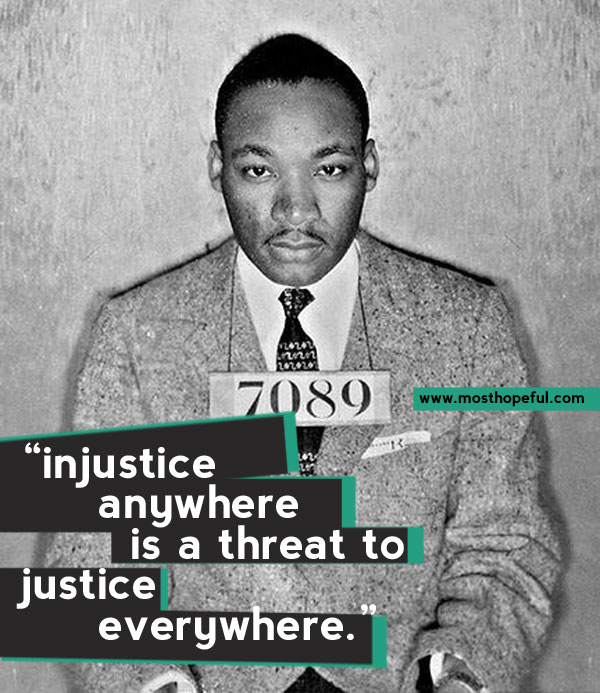
So on this day, when I think about the black pastor in the southern US who wrote letters to white pastors in the Southern US saying this must be the time––when I think about a pastor who wrote those letters from a Birmingham Jail–I hear them now in a deeper place than I have heard them before. I see and feel those white pastors listening who are convinced that the calls are untimely. And the challenge is more personal than it has been before. And in the global world, in the polarized world, in the rich and poor world, I hear the words of Martin Luther King, Jr. say “Injustice anywhere is a threat to justice everywhere,” and I hear my King say, “The kingdom of heaven belongs to them.”

+++

To my buddy in the mall that day, as I felt my jaw drop and my eyes broaden and heart sink, I wish I had told you, “There is so much of the kingdom you are missing.”

djordan
Pine Tree Dr.

Other recommended links for MLK DAY

KATHY ESCOBAR | THIS DREAM IS SO POSSIBLE – Kathy Escobar
10 THINGS YOU MAY NOT HAVE KNOWN ABOUT MLK – Huffington Post
A DREAM THAT CAME TRUE – The Washington Post

Tagged , , , , , , , ,

rainy thursday afternoons

rainy-day-window

God of Thursday afternoons
of rainy days
and dreary skies
when we  try our best to be excited about the work
but may find ourselves struggling
to keep our eyes open.

Give us eyes to see
and ears to hear
and minds to understand
all that you are doing in the world.

Even on rainy Thursday afternoons.

Amen.


djordan
108 S Church


Tagged , , , , , ,

when christmas is over, the work begins

Screen Shot 2013-01-04 at 4.01.13 PM

When the song of the angels is stilled,
When the star in the sky is gone,
When the kings and princes are home,
When the shepherds are back with their flock,
The work of Christmas begins:
To find the lost,
To heal the broken,
To feed the hungry,
To release the prisoner,
To rebuild the nations,
To bring peace among people,
To make music in the heart.

“The Work of Christmas”
Howard Thurman


Tagged , , , , , , , , , , , , , , ,

cheers to the 2nd of January

Screen Shot 2013-01-02 at 7.46.40 PM

the 1st is easy enough
to be big
to be bold
to be daring
to be hopeful enough about the future
to set big goals
to make big promises;

we reflect on a year that has passed and
choose what we hope will be better
or more
or truer
or braver in the year to come.

But most days of our lives
happen on the 2nd
the day after we make
big decisions
bold promises
daring declarations
hopeful comments about the future
big goals for the days and weeks ahead
big promises for the future that waits ahead.

And so we ask that
the prayers and hopes and energies of our 1sts
become the fuel of our 2nds.
And that we hold out hope,
and join with others who do the same for us.

Happy January 2nd.

djordan
Pine Tree

Tagged , , , , ,

intolerance of uncertainty | thoughts on a new year

Las_Vegas_New_Years_Celebrations_0aede

It’s no doubt that the things which are the most important for us to know are the things which, once heard, feel the most obvious. The things which, once said, feel the most simple. And yet, it is these things which are often, once heard and said, the things which change us the most. The things which make the biggest impact in our worlds because even though they are obvious and even though they are simple, they are still the things which are most important and have the most impact.

A New Year’s resolution has been to read an article a workday. Workday means ultimately five articles a week, and article means a research or peer-reviewed journal article, so what to do when throwing a party or how to build biceps fastest doesn’t count as articles.

I was reading, a few days ago (because I’ve also learned that New Year’s resolutions I wait to start until New Year’s are 100% less likely to happen than New Year’s resolutions I start a few days before) an article* about depression, anxiety and rumination. I was reading for a client that I’ve been making little progress with, and also reading for myself as is almost always the case whether any of us in the field choose to admit it or not.

The article speaks to depression, anxiety and rumination, or ongoing perseverative thoughts about situations or details, as moderated by the intolerance of uncertainty. And while the phrase “intolerance of uncertainty” feels as common and as known and as obvious as any other phrase that’s said over coffee or in elevators or across lunch tables, I felt myself freeze in the phase of the written words, as if the obvious and known was suddenly becoming an answer to a mystery.

The more we are intolerant of what we can’t control and what we don’t know, the greater our anxiety, depression and stalling.

With multitudes of caveats and uncontrollable variables, the notion has stuck with me since. The ability that I, or others, have to tolerate uncertainty influences the way we see the future and handle its impending realities in the present. Since all of the future is uncertain, no matter the degree at which we enjoy misleading ourselves, my ability to tolerate that uncertainty is a predictor of my emotions, attitudes, and decisions.

Since reading this article, no doubt an encouragement to keep up my New Year’s resolution, I’ve been challenged to face each day with a reminder to myself that what is to come is unknown, and my trust in the fact that all things are done well and that all things work together is and will be a major factor in my ability to move forward well into the grief and joy that lies ahead in 2013.

Here’s to an uncertain new year.

djordan
Pine Tree

* Liao, K. Y. & Wei, M. (2011). Intolerance of uncertainty, depression, and anxiety: The moderating and mediating roles of rumination. Journal of clinical psychology, 67(12), 1220-1239.

Tagged , , , , , , , , , , , , , , ,