Category Archives: what they are teaching me

the risk of narrowing the voices

asking questions, freedom, safety, church, power

Choosing a paint color is one thing; seeking the truth is another.

One of my favorite lines of Madeleine L’Engle’s is, not in quotations because I can’t remember where it was, that God does not need our protection, and welcomes as many questions as we can dream up.

And I’ve noticed in the meantime that we are at risk not only of taking other people’s answers for truth, but also of taking other people’s advice on what the questions are to be asking in the first place. When our questions are guided, we are of course lead to certain answers from certain narrowed voices.

When we narrow the voices, we weaken our ability to discern at all. In thinking throughout history of all the situations and all those power and all those in the church, even, who have been led in obedience because they trust that someone else is doing the discerning, it is horrifying. We mistake proclaimed expertise for due diligence, and we are left unthinkingly joining in protection of the status quo.

Stifled questions means stifled dialogue, and it is in dialogue that progress is born and we get a little closer to the truth we are all of us after. Dialogue requires broad voices rather than a single voice, and there is perhaps no doubt in the promise that where two or more are gathered, there is something more true and holy present and happening.

I’ve been reading, this time by choice, the book that we long ago read in high school by mandate: Fahrenheit 451. I remembered thinking at the time that how ridiculous the notion was that people would be told what to read and what not to read, and that reading and thinking off of an approved list could result in death.

Book burning followed driven by those in charge, under the guise of protecting humanity from dangerous thought. Children then came up into families never knowing the art of book reading, thinking, questioning, debating, creating and imagining.

I thought it foolish then, but it doesn’t seem so foolish now. In fear of discerning many voices, we seek to narrow them down to the ones we know, or the ones we have been told to agree with: the approved book list. To read past the first page of another voice becomes treacherous and intimidating, because we wont know what to do with another line of thought. And so, as encouraged, we don’t think anymore. We ask the questions we’ve been told to ask and take the answers we’ve been given.

If we idolize those speaking or writing, or simply take their words, we aren’t able to listen to multiple voices because we have challenged the ability for the spirit to work in community, and given authority to some single voice.

With broad voices, however, we learn the art of listening and asking, hearing and being heard. With broad voices we learn how experience shapes understanding, and how injustice and power breed certain lines of thought. We learn where we are blind, and where we are gifted. With broad voices, we think enough to welcome for dinner a Boo Radley or a Hester Prynne. With broad voices,  the combination of these truly human acts yields compassion and humility.

I’ve been in meetings where a million voices made it impossible to choose a paint color, and it has indeed been a nightmare.

I’ve also been in meetings where power is used to beg discussion, criticism, thoughtfulness, ideas, questions, dreams and disagreement…none of which should be mistaken for disunity…and it has been a beautiful and community-affirming endeavor.

There’s a difference between choosing a paint color and seeking the truth.

And what have we to fear if it’s the truth we’re after together.

djordan
Pine Tree

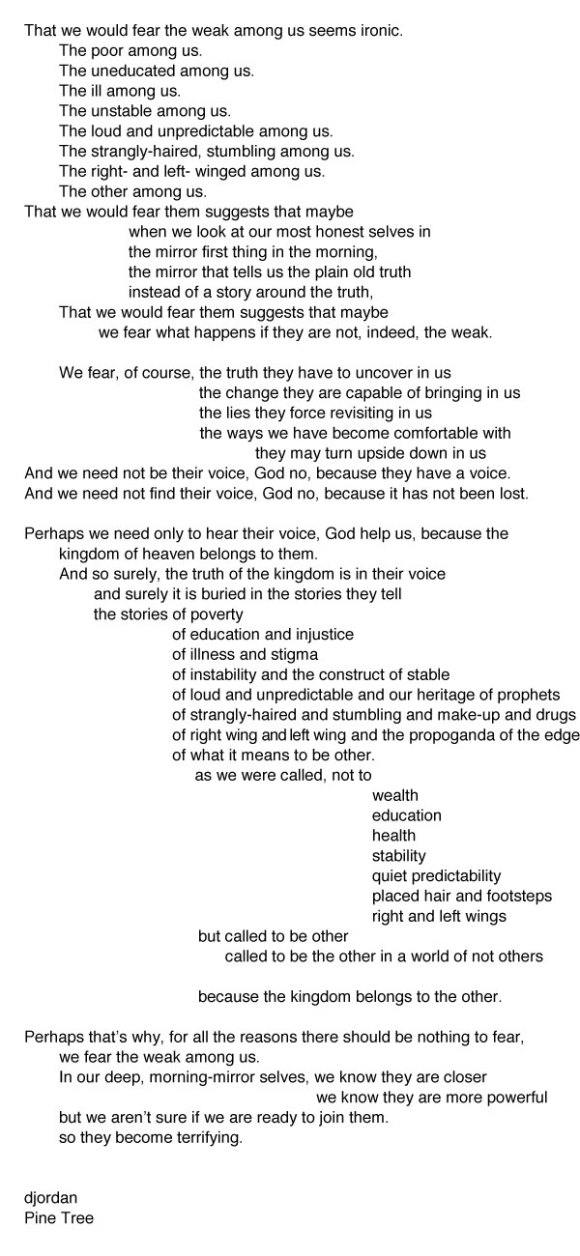
OTHER RELATED POSTS | BECAUSE YOU DID NOT ASK, FEAR OF THE WEAK AMONG US

Tagged , , , , , , , , , , , , , , , , , , , , , , , ,

calling out in the darkness

I sat this morning watching a video (below) that highlights the last five years of a homeless ministry that houses and feeds the homeless in churches every night of the winter months. My mind went back to one evening about six years ago spent with Jonathan Stewart and Wes Gristy; we had been making and serving sandwich dinners on Friday evenings in a parking lot downtown, and our question had become “are there homeless in our community?”

In following that question and other rumors that accompanied it, we met at the church late one evening, made a pot of decaf coffee, and headed to the amphitheater where we had heard those who were homeless stayed.

I remember conversations about exit plans, what we would talk about, how we would find them. We parked facing the main road, flashlights in hand, and started walking through the damp ground toward the amphitheater calling out in the darkness.

“Are you there?”
“We won’t hurt you.”
“We aren’t the cops.”
“We have coffee.”

There was, of course, no one there.

Six years later, with churches across the community working together to host those who are homeless in their buildings night after night, what seems most certain now is that we were, indeed, calling out in the darkness.

We are, those of us fortunate enough to have grown up in church, blessed with a great deal of treasured heritage, and at the same time plagued by a deep spiritual paternalism that we can’t see until we are staring our ignorance straight in the face.

Were I to ask “Are the homeless christians?” the answer would no doubt be, “not necessarily.”
Were I to ask “Are the homeless not christians?” the answer would no doubt be, “not necessarily.”

But were I to have asked “Why do we serve the homeless?” the answer might have likely been “to show them Jesus.”

We are still often calling out in the darkness.

Six years later, I can say that I have learned more about who Jesus is and what he has done from the Christian men who are homeless in our community. Their homelessness is not a result of their not-Christian-ness. And they were not necessarily waiting around for me to show them Jesus.

They are often showing Christ to me, as even Jesus made clear that when we interacted with them we were interacting with him.

But we say we serve to show them Jesus, so we do little looking to see him in them.

But that is changing with those who are willing to open their eyes and see that when we have experienced relationship with those in need, we have experienced relationship with Christ.

Here’s to a future of continuing to open our eyes more and more, and continuing to call out in the darkness less and less.

Theirs is the kingdom, of course.

djordan
South Church St.


OTHER RELATED POSTS | the fear of the weak among us | we can assume | crack our great ambitions

Tagged , , , , , , , , , , , , , , , , , , , , ,

losing and finding ourselves

When in Louisville this March, I went to see an art exhibit of Goicolea’s work at the Museum Hotel 21C. The piece above is a photo of his work where a relative of the Cuban American artist has been drawn from a negative rendering of the old photo, then posted on a telephone poll that sits inside the gallery.

I’ve been haunted by the piece ever since, and have been trying to understand myself what is so compelling about it.

With an ancestor’s portrait posted as lost on a telephone poll, it seems as though there is something deeply honest about looking, as if for someone lost, to find out who we are, where we’ve come from and what we are made of. We know that the stories we can remember of our own lives have been incredibly impacting, and we know that our parents share similar stories which have shaped who they are as well, and on and on through a timeline of generations ahead of us, a timeline that will precede after us.

Everyone looking for and finding themselves.
Shaped by the stories of who we are and who those who came before us were.

And we claim the stories of heritage we want attached to us. Stories of hard work and family and ingenuity and generosity and imagination.

And we wrestle against the stories we don’t want attached to us. Stories of racism and illness and greed and selfishness and arrogance.

The folks who check in for help to the psychiatric inpatient unit have been teaching me this last month what it means to grasp both sets of stories as we search for who we are and who we can be in the world. We look at our own lives and the lives of those who have come before us, we take a deep and unjudging breath, and we embrace the stories of hard work and racism and family and illness and ingenuity and greed and generosity and selfishness and imagination and arrogance.

In losing hopes of curating our stories to manipulate who we wanted to be, we find ourselves in the wholeness of who we are.

And in so doing, we are held and found accountable by those who have struggled with stories before us.

***

The picture below is a triptych of Goicolea’s where he has brought together all the family images from generations past and present, and placed them next to each other in one print. Because of the dates of the compiled photographs, a grandmother might be sitting as a child in her own granddaughter’s lap, blurring the lines of space and time while fortifying the lines of influence.

djordan
Pine Tree

Tagged , , , , , , , , , , , , , , , , , ,

when others tell their stories

It often takes only a few minutes into a counseling session for me to realize that I have no way of speaking solutions into the room. A story begins, a tear drops, and people began to share with me the kinds of things I would never be brave enough to speak out loud to another…or myself for that matter. And after only a little bit of training in graduate school, I learned that me offering advice isn’t the craft of therapy to begin with.

And it also doesn’t take long to realize the kind of disrespect or arrogance that my solution-speaking or advice-offering would actually be suggesting. It seems, when I think about it for a moment, that in no situation would I ever allow someone who has talked to me for thirty minutes, once a week, for a month, tell me what to do with my life or how to orient my grief or what to do in my marriage.

And yet the role of counselor or therapist or even pastor sometimes has those connotations attached.

So in a kind of powerlessness, when others begin their stories, begin to tell the truth about the life they have been living in and wrestling with and learning from since birth, my only option is to switch into the mode of curiosity. And in that curiosity, I become another human being in the room, asking questions that the person sitting across from me may never have asked before even to themselves.

And in the magic of the room, new things are learned. New things are learned for my own life and for the client’s life.

Good helping doesn’t come from being the answer-man, but rather from being the questioner, a facilitator of the insight that is buried within the person who has come in seeking counsel. And more often than not, as two human beings sit in the room listening to each other in spaces that don’t judge, don’t lie, don’t have other agendas… people find their ways.

There is a deep, dangerous humanity in offering to simply bear witness to the grief, pain, fear, horror, loss, confusion or despair of another. And in staring it in the face, we both become, together, a little more human.

djordan
Pine Tree Dr.

Tagged , , , , , , , , , , ,

telling secrets

after you’ve been holding your breath

for a long time

you tell the truth.
you tell the truth into the fear.
you tell the truth into the sadness.
you tell the truth into the ear of a trusted other.
you tell the truth into the ear of a knowledgeable other.

and light floods in
and breath fills up your lungs
and hope crashes into the landscape

and the one you told
now able to tell

and light floods in for them
and breath fills up their lungs
and hope crashes into their landscape

together we discover our humanity
in telling secrets, in telling the truth.

only in community.
we are a community of secrets.

only in honesty.
we are a community capable of honesty.

and the truth sets us free. together.

djordan
Pine Tree

Tagged , , , , , , , , , , , , , ,

we can assume

I remember once, as a scared-to-really-break-the-rules child, maybe twelve years old sitting at the dinner table, and having made an assumption. I can’t recall what it was about, because to this day, that isn’t what lesson was made clear to me at the table.

What I do remember, though, is that once I had made the assumption, my mom asked me: “Donald, do you know what happens when we assume?”

You all know how this goes. I had not heard it before, so mom made me break the word down from the back to the front.

“me.”

“u.”

I couldn’t do it. I remember my eyes getting very big, and mom, with serious face, saying, “you need to say it.” “I can’t.” “You need to say it. What’s the other word?” “I can’t.” “Donald…”

“ass.”

Then a read face, then giggles, then I’m scared for breaking the rules again.

***

Several years later, in grad school, I was taught one of the golden sets of, yes, assumptions, that we as social workers are to carry like a carpenter carries a hammer. Known as Saleeby’s Strengths Perspective, those who are close to me have no doubt heard me repeat it as a mantra, probably (hopefully) most often for myself. One in particular comes to mind most often: 

Assume that you do not know the upper limits of one’s capacity to grow and change, and take individual, group, and community aspiration seriously.

Almost daily with clients, with today as no exception, as they come into my office and sit down on the couch, my own arrogance and ignorance trumps my skill and I find myself assuming that I know someone’s upper capacity to grow and change.

A drunk.
A lazy parent.
A greedy slumlord.
A bad kid.
A messed up family.

Paranoid.
Depressed.
Perpetrator.
Manipulator.
Narcissist.
Insecure.

There is an incredible gift I’ve been offered by those who love me well, and love me most, and that is the gift of assuming they do not know my upper capacity to grow and change. And because of this, they take my aspirations seriously. And because of this, I am often able to meet my own aspirations.

And so, in my work as in my life, the challenge is to assume I do not know the upper limits of others’ capacities to grow and change, and to therefore lean into their aspirations with great expectation. This results in treating people with dignity and respect, and assuming that I don’t know all there is to know about another. Not after the first, fiftieth, or five-hundredth time meeting them.

So, we can assume that we do not know the upper limits of one’s capacity to grow and change, and we therefore take individual, group, and community aspiration seriously.

And thanks for making me say it, mom.

djordan
Pine Tree

Tagged , , , , , , , , , , ,

presence of absence | on holy saturday

I’m learning from those around me––those I’ve interacted with in church, in the hospital, in the community, in the classroom, not to mention those I live in community with––that brokenness and mess is everywhere, seeping into cracks we didn’t even know existed. With each client that comes in my office, or each friend that sits down to the table, there is this secret notion that no one else is wrestling with the grief, the guilt, the conflict, the doubt that she or he is.

And there is a kind of comfort that flashes across faces when they learn they are not the only one, but they are one of many.

It is only a flash, though. There is a certain amount of comfort that comes in knowing our misery shares company, but then we are stuck in misery with others.

But still stuck nonetheless.

And that is where some of the magic of the Saturday between Good Friday and Easter Sunday exists. Holy Saturday, Low Saturday, Easter’s Eve: It is that day where the black drapery still hangs over the cross and the Easter lilies, unless the church staff were too eager to prepare for the bright whiteness of Sunday morning.

The silence of the Saturday seems to be the place we find ourselves in most often. We have the luxury, now, of knowing that Good Friday leads to Easter Sunday, but we sit in between the two with our fingers crossed and our noses raw from rubbing them with tear-stained tissue.

And I believe, as I interact with these men in women in my office and in the community and in the churches…I believe that God honors our tight stomachs and heavy hearts on the Holy Saturdays of our lives and worlds. We must challenge the need to jump to Easter Sunday, and honor the grief and struggle on the day before the inauguration of all things new.

djordan
Pine Tree Dr.

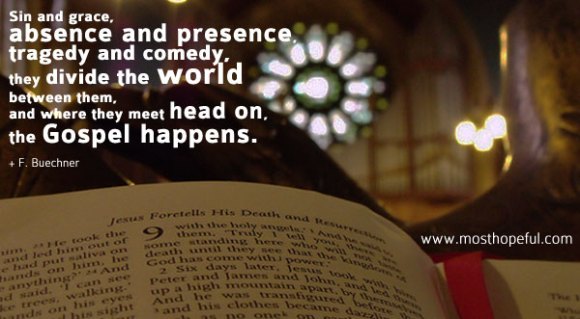
Switching on the lectern light and clearing his throat, the preacher speaks both the word of tragedy and the word of comedy because they are both of them the truth and because Jesus speaks them both, blessed be he. The preacher tells the truth by speaking of the visible absence of God because if he doesn’t see and own up to the absence of God in the world, then he is the only one there who doesn’t see it, and who is then going to take him seriously when he tries to make real what he claims also to see as the invisible presence of God in the world? Sin and grace, absence and presence, tragedy and comedy, they divide the world between them and where they meet head on, the Gospel happens. Let the preacher preach the Gospel of their preposterous meeting as the high, unbidden, hilarious things it is. 

+ Frederick Buechner, from Telling the Truth

Tagged , , , , , , ,

not drumming alone

“Never give up. Never give up. Never give up.” she said into the camera on her computer.

We were finishing class today, and I had just asked my friend Caroline––skyping in from a patio in the shadow of the great Table Mountain in Cape Town––what advice she would give to my classroom full of students going into the world with the issues of poverty and the church on their minds and hearts.

I was sitting in the front of the classroom which I suddenly regretted as these words came out of her mouth.

“Never give up. Never give up. Never give up.”

She went on to elaborate, and my mind floated back to my days in Cape Town last spring almost a year ago. I was in the middle of major transitions where the issues of poverty and the church were becoming issues that meant a world of difference when it came to my job, my income, my church, and my future. I remember sitting, clinging to the future as we now refer to it, scared of what the future held, but knowing there was nowhere to go but into the issues of what it means for the church and its people to worry less about success and more about obedience.

Caroline went on to say to the students, with me sitting in the front of the classroom, “Never give up. You will follow Christ in pursuit of the kingdom, and you will struggle. And you will feel like you are the only one. And you will feel as though you have been beating a drum for a very long time all by yourself and no one is listening, and no one else is beating that kingdom drum…”

Sitting in the front of the classroom, where the students can see me but Caroline cannot, I feel my eyes beginning to well with tears.

“…but you are not the only one beating that drum. And there are others, too, following Christ not into success but into obedience, into the kingdom, who feel as though they are the only ones being champions of justice, and they need to find you as well. Never give up. Never give up. Never give up.”

My intentions had been for our class to pray for Caroline before we ended the Skype call, but we were not able to.

I caught myself trying to say, “Caroline is a dear friend who has taught me much. And she and other very dear friends have reminded me in times that felt quite lonely that it is worth speaking out for justice and working toward the kingdom…” But that is where the thank you had to end, because my eyes were getting thick with tears at the wrong time.

Another friend spoke today at the community-wide Holy Week noon service. “The time is now,” he said, “to worry less about seeking our own success, and more about seeking the kingdom.”

He also reminds me that I am not drumming alone.

I had a conversation tonight with an elderly gentleman about our small house church joining their older congregation in serving the homeless this summer. He reminded me that I am not drumming alone.

A dear friend once grabbed my shoulder at a time when I needed it more than anything else, he looked me in the eyes, and he said, “You are not alone. There are many of us, and we are seeking the kingdom together.” He reminds me constantly that we are not drumming alone.

Thanks, Caroline, for making me choke up in front of my class.

And thanks for reminding me, and them, that we seek first the kingdom together, and that we are not drumming alone.

djordan
Pine Tree Dr.

Tagged , , , , , , , , , , , , ,

because you did not ask

head in the shrubs, photography, surrealism, asking, leadership, authority, questioning, questions

 The questions that learning leaders pose challenge their followers to see complexities and interrelationships in [major issues] and launch inquiries that stretch the bounds of their worldview. Moreover, this work is never done. What is learned one day is used the next as a bridge to considering a new set of understandings and challenges. 

+ from “Learning as a Way of Leading” by Preskill and Brookfield

It isn’t uncommon to reference the idea that Jesus answered most questions with questions. At times when women and men were at risk of facing persecution or losing their lives for following him, it would seem that if there were ever a time to answer directly, clearly, give the people “something to hang their hats on,” break it down because “only a few can understand,” it would have been then; it would have been when guards were carrying him off; it would have been when asked an ultimatum of a question by Pilate; it would have been after coming back to new life. But he only asked questions, adding to the confusion with people who were having a hard time understanding anyway.

There is an ease in going along without questions, resting on what others have said with authority. There is an ease in “taking their word for it,” and leaving the hard stuff to those we think know better. But Jesus engaged those who “wouldn’t understand” with questions that made these even more confusing.

Christ was constantly explaining what the kingdom of heaven was like, and it was always upside-down, backwards, inside-out, heretical, inappropriate. And on-purpose.

And it was always posed with a question. A set of illusive stories with no explanation, but counted on the fact that those listening, who had ears to hear, would indeed hear it.

I had coffee a couple of weeks ago with a friend who had been told not to ask any questions about this and that from those in leadership. Something in her, because of what she knows about what Jesus is up to in her own life and world, forced her to ask more questions. In respecting leadership, she was forced to ask them more questions. Ask others more questions. Listen past the answers sometimes shaped to shut down thought and conversation and merely align allegiance. And she took on the challenge.

What was so thrilling for me was her excitement now on the other side of those initial questions. She is renewed in what her calling is, what her faith is about, what her God is doing in the world, and what Christ has set in motion.

She is reminded all over again of the extreme danger that asking questions poses, and the risks involved when shattering what has been by asking what should be. But more than that, I am reminded of the great job that comes in assuming we are always missing something important, in asking others, in reading and learning, in trusting the largeness of God enough to bring him our questions.

Her face and grin as she sipped her coffee has become a symbol for me of what, whenever I am tasked to lead others, I am really being called to do; God doesn’t need me to tell them what they need to know as if they aren’t smart enough to think…instead, I get to join others in asking good questions about a good God who is making all things new.

djordan
Louisville, KY

Some content on this page was disabled on January 22, 2024 as a result of a DMCA takedown notice from Rodney Smith. You can learn more about the DMCA here:

https://wordpress.com/support/copyright-and-the-dmca/

Tagged , , , , , , ,