when there’s nothing to fight for

When there’s nothing to fight for
nothing to be enamored with
nothing to move into
nothing to be about
nothing to sing of

When we are bored
with the little tales
we tell ourselves

that’s when we fight against.
that’s when we tear down.
that’s when we go after.
that’s when we go under.

But…

There is enough to be fighting for
There is enough to be enamored with
There is enough to move into
There is enough to be about
There is enough to sing of

So when we find ourselves fighting against, tearing down, going after, going under
Give us a glimpse of the kingdom

and we shall sing again.

djordan
Pine Tree

Tagged , , , , , , , , , , , , , , , ,

not willing to walk back in the shadows


‎Heretics,
creative thinkers,
innovators,
seem to appear just when we need them,
despite the high cost of living in opposition.

They do so because they can’t help themselves.
Having seen a brighter light ahead of them,
they are not willing to walk back in the shadows.
Some inner force compels them forward
with a power greater than their fear
of the hostility that awaits them.
That force is God.

+ John Sloat


Tagged , , , , , , , , , ,

lost outside of rome

I was nineteen.

It was one of those ridiculous opportunities for friends to visit a friend studying in Florence for the semester, so we had to take it. My sophomore year of college, I skipped some classes and hopped on a plane (for $444 round-trip) with two friends to visit and see Italy for a whirlwind week. I had no idea how important the things I would see would be, I had no idea how important the place itself was, and I had no idea how absurd it is to live so luxuriously as a teenager…hopping off to Italy.

My first trans-atlantic flight, through Paris, and finally touching down in Rome.

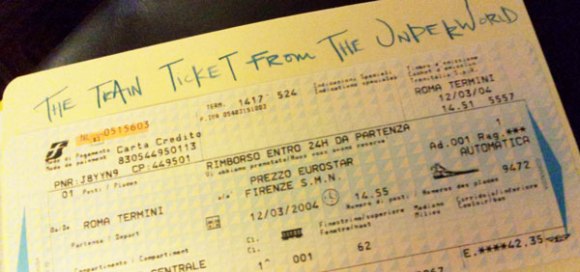
It was a little after lunch time, and we hit the train station connected to Rome’s airport. I was first in line, and I bought the ticket I thought I needed to board the train I thought I wanted to ride to Florence where we would meet up with our buddy.

For whatever reason, I had a book on the journey by Sabrina Ward Harrison that had a page with the following lines ascribed to Walt Whitman: “These days must happen to us.”

[INSERT PIC IF YOU CAN FIND IT)…(I can’t find it. I will continue looking.)

We discovered, after I had already bought the ticket of course, that my ticket was different from my two other fellow travelers, although all were headed to Florence. That’s about all the info we knew, so I asked one stranger what train my ticket was for (I think that’s what I asked because I pointed at my ticket, and then raised both hands palms up thumbs in and raised my eyebrows). He pointed, and I got on a train that said “Florence.”

Should have been safe enough. Alone. 19 years old. First time in Europe. No phone, no language, no numbers, nothing but cash and passport and luggage and ignorance.

It was entirely made of metal. The bench, the ceiling, the panes of the windows, the poles down the middle of the cars to hold onto if it was packed. It was also almost completely empty. I sat down right inside the door of the car I had entered, and pulled out my journal.

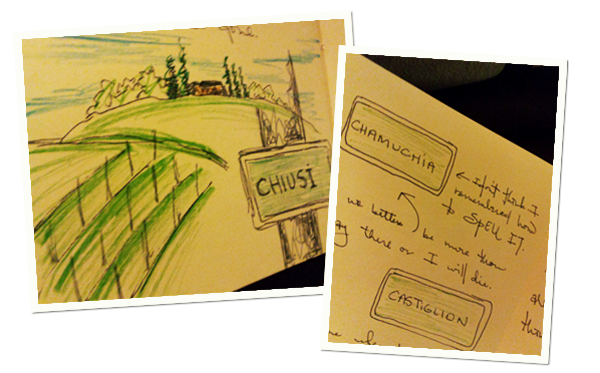
(For the record, I just went through three bookshelves in the house and found the journal, photos included below. That is also where I found the train ticket at the top of this post.)
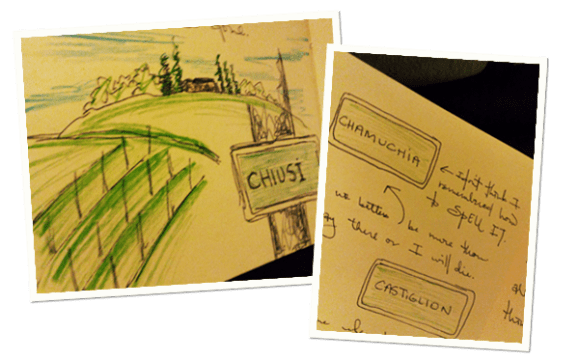
I started drawing the signs of towns that we were stopping in, because the train never seemed to make it to Florence. I learned once I finally arrived that my other two friends got on their train an hour after me in Rome, and arrived an hour earlier in Florence. I had paid for a a ticket on the deluxe train, but boarded the cheapest, slowest, most-stopping train between Rome and Florence. But I was on it, and we had left the station already when that knowledge was given me.

I learned that I had made some mistake when the man in uniform on the train came in, asked to see my ticket, then asked again in English, then looked at my ticket, and then started pointing (at what I think was where the direction of the station in Rome) and back at my ticket. Yelling.

Alone. 19 years old. First time n Europe. No phone, no numbers, no language, nothing but cash and a passport and luggage and ignorant innocence.

About ten seconds in to the man yelling, another passenger from across the isle stood up, walked to the man in uniform, pointed at the ticket, pointed at me, pointed at the man in uniform, pointed at me again, all the while yelling at the man in uniform.

My ticket was punched, thrown back at me, and the uniform left.

The other passenger, who had been having the conversation in Italian, looked at me and said, “Don’t worry about it. We will get there, and you paid more than this train is worth, so he’ll be fine.”

“Thank you,” I said, where the tone of the sentence lands somewhere between a question mark and a period.

“It’s nothing.”

+++

Ten years later, I struggle often as a Social Worker with what language to use about voices, and dignity, and those on the margins. As a middle class, white male who is a Christian, is my responsibility to “give voice to those who don’t have a voice” or “be the voice” for someone? I’ve wrestled this terminology not for being of being politically incorrect, but for concern over the paternalism in all those phrases.

In both therapy and community work, I find myself often in the role of advocate, but I still struggle over what that actually means, what I am actually doing, and whether it is the best thing to do that causes the least potential harm. How to help, how to view the scenario, and how to speak about it in ways that push dignity and justice.

+++

For whatever reason, tonight, thinking about that trip to Italy and remembering my train ride, nineteen years old, alone, money and passport, ignorance and innocence; I was in someone else’s world, and someone who knew the language of the world I was in spoke up for me, defended me, and stood––quite literally––between me and the opponent. The fault was mine, the inability to communicate was mine, the problem was mine, but a stranger stood up, stepped in, and made peace.

There are times when my clients, my friends, families in my community are in “my world” where I know the language and know the games, and I step in on their behalf’s. There are times in return where the world is theirs, and they are my only hope. Reciprocity is inherent, and a beautiful thing. And it’s all helping me better think about people and advocacy and helping and voices.

+++

“It’s nothing.” He said as he went back to his seat.

djordan
Pine Tree

Tagged , , , , , , , , , , , , ,

some days we open our eyes


Some days we open our eyes

and can tell immediately that we are filled with wonder and excitement.
Other days, we open our eyes
and call tell immediately that we are fill with grumpiness and boredom.
And yet the task is at hand
regardless of the way we see the day at hand
in our rolling-over, getting up state.
And you are the maker of all things new,
and we are a vessel of all things new,
Whether we wake up in the mood or not .
Be our coffee.
Be our tea.
Be our reason to start wide-eyed.
And be our reason,
when all is said and done,
to sleep soundly
knowing that all is not well, and all will be well.
djordan
Pine Tree


Tagged , , , , , , , ,

the loudness of silence | one year of www.mosthopeful.com


I was sitting with a good friend a few nights ago over a last minute dinner. We’d made jokes already about who was late (me, as always) and about what it was going to cost me (dinner, even though it never does).

At some point in the meal, after we’d been laughing and harassing and deciding all kinds of things, I realized that we had grown very quiet. But it’s the kind of realizing that it’s gotten quiet after it’s been quiet a while and yet I hadn’t realized no one was talking.

(There’s the other kind of silence, you know, when all parties are dying to speak but no one can think of a thing to say, either because they are bored senseless or the moment has grown too thick for words. This night was neither of those kinds of silences.)

I looked up at my buddy and knew in that moment that the last year for both of us––although in very different ways––had been both hellish and life-giving. We had endured all kinds of things, and moved unsurely but necessarily to the other side of what was lost, and began looking toward what will be found.

We are both still looking, of course, as everyone who is telling the truth about anything at all will admit that he is still looking for what will be found.

But in that moment when I realized no one was talking, but all was well, I realized how much I appreciate this kind of silence. It’s a kind of silence that is no longer pregnant with impending misery and loss and sadness, but has been there when misery and loss and sadness have been there. It’s a kind of silence that is no longer awkward and wishing for words, but has pushed through to where nothing needs to be said, and nothing else has to be made known. It’s a kind of silence that speaks to the fact that while there’s not much to talk about, that means there’s not much to talk about––which means that of all the things the space between me and my buddy has had to hold onto and make sense of, tonight it need only make sense of good food and good laughter and good memories of time when we have carried heavy silences together.

It’s a loudness of silence that makes me thankful for the last year. A year that looked like the end of all things, but ended up being the beginning of all things new.

New hopes for what God is doing through his church in the world.
New hopes for what God is doing through his people in their
businesses, offices, homes, churches, classrooms, streets, neighborhoods, banks, schools,

New hopes while though we feel unsure, unable, unwilling, unfeeling, unhelpful
a year later
after trying
praying
listening
pretending

we still feel, above all, most hopeful.

Most hopeful about the future.
Most hopeful about the stories that will be told about the past.
Most hopeful about what God is doing in the world.
Most hopeful about how God will bring his church to life to join him.
Most hopeful for the way the stories of pain and sadness will resolve.
Most hopeful about the way the stories of excitement and anticipation will continue.
Most hopeful about the coming of God’s great kingdom.

Here’s to one year of mosthopeful.com, and all that has it represents of things lost, learned, and loved.

We cannot walk alone.

djordan
Pine Tree Dr.

CLICK HERE TO SEE THE FIRST POST ON WWW.MOSTHOPEFUL.COM, posted one year ago today. 

Tagged , , , , , , , , , , , , ,

from the archives | loss as loss, not as lesson


In reflecting on the upcoming one-year anniversary of mosthopeful.com on August 23, I’m throwing some of the posts that readers have looked at the most back into the mix. Thanks for allowing me the space. It’s been a most humbling experience.

Below is the most viewed post from the blog over the last year, the first year of the blog. Thanks to the friends, families, and clients who have helped me grow in understanding and practice as it involves those grieving, and for helping me learn that we are all learning how to live in a world that is not yet whole.

+++

View the original post and comments from March 12, 2012


loss as loss, not as lesson


Loss as loss, not as lesson

Maybe it springs from our own deep need to protect ourselves when we know we cannot.

When a tragedy happens of some kind, especially the loss of a son or friend to a kind of accidental death, it is our nature to jump to working at meaning-making. When someone is lost to old age, or even long-term illness, there are many bedside conversations that make space for meaning to be made.

I am sorry for this.
I want you to know this.
I wish we had this.
I want us to do this.

You mean this to me.
You taught me this.
You are loved.

But when an accident happens, or a sudden death, or a suicide, or a crime…
There is no time for words to fill the space.
No hands touching hands.
No way to know they know.

And so we end up stuck on this side of the sleep, trying our damnedest to make sense of the whole thing. We look into every question we could possibly ask to make meaning, and there is none to be found. Often those closest to the loss are stuck spinning in the losing itself, until they can solve it, keep it from having ever happened, get those last words in.

Which of course, proves meaningless as well.

And then there are the onlookers among us, tucking our children in at night, kissing our spouse, patting our buddies on the back, and wondering what we would ever do if we were to lose them.

That’s when we find ourselves making the loss a lesson, as if that makes it worth happening. As if it protects us from it happening to us or those we love. We begin to talk about how “it has taught us …”

And there is an illusion to our nature of doing this that suggests there is meaning as long as we learn something from it. If we make a tragic loss a lesson, it won’t be meaningless anymore.

But I don’t want my dead son, spouse, buddy to be a lesson; I want them to be my son, spouse, buddy. We want lives to be meaningful, not deaths. We want to say their names and images of life, not tragedy, to be conjured up. And when they are gone, especially when I didn’t have time to make meaning with them, I want to grieve. And I want them to be remembered for what their lives taught others, not their meaningless, untimely, horribly tragic death.

The meaning is in remembering who they were.
The grief is in losing them to begin with.

The loss is a loss.
Meaningless.
Void.
Empty.
It is not things as they should be.
It is before all things are made new.

There is, however, meaning in remembering.
And grief is not our enemy, but a sign that we have hearts full of love and woven with connection.
In our caring for the greiving, may we, like our God, be close to those whose hearts are breaking.

Breaking hearts are not a lesson; they are breaking hearts.
And they, in themselves, are worth all the world.

djordan
Pine Tree Dr.


Tagged , , , , , , , , , , , , , ,

from the archives | thank you for your prayers, we are tired of war

In reflecting on the upcoming one-year anniversary of mosthopeful.com on August 23, I’m throwing some of the posts that readers have looked at the most back into the mix. Thanks for allowing me the space. It’s been a most humbling experience.

Special thanks to an awesome friend, Caroline Powell (www.longwindingroad.me), for including us on her sabbatical journey, and for the following guest post.

+++

View the original post and comments from June 10, 2012

“Thank you for your prayers, we are tired of war” | a guest post by Caroline Powell


Caroline Powell is a dear friend of mine and native of Cape Town, South Africa. She works with The Warehouse, also dear friends of mine seeking to see the church be a transformative presence in the community in issues of poverty, injustice and division. Caroline is on sabbatical from The Warehouse, in Caroline’s words, to seek kingdom “stories of hope and people of peace.” I’ve been following her blog these last several weeks, and this post is one I’ve enjoyed the most.

Join Caroline on her sabbatical journey at www.thelongwindingroad.me, and in the meantime, thank her for joining the guest voices here at mosthopeful.com. Her words are always words with which to spend considerable time and generous thought. Thank you Caroline. 


“Thank you for your prayers, we are tired of war” | a tribute to the DRC

When I was planning this trip, one of the first places I desired to visit was the town of Goma, on the Democratic Republic of Congo (DRC) side of the western border between DRC and Rwanda. There were several reasons for this. In Cape Town, I study with and enjoy the friendship and encouragement of several Congolese people, through connections at college, church and my work at The Warehouse. I have been fascinated with and deeply troubled by the story of this part of Africa for some time. I have met some very inspiring residents of Goma through Amahoro-Africa who run awe-inspiring initiatives through their churches in their town, and I longed to see first hand what they are involved with on a daily basis.

Getting there and fulfilling this dream has been a different story but one that has invited me into a deeper sense of love and committed prayer for this nation. Advised by Joel from Goma, that I must  have a visa before trying to visit the DRC, I went about filling in application forms and getting invitations letters from my friends in Goma. Once this was done, and all was sent off to the embassy in Pretoria, the waiting game started. I was convinced that visiting this region was to be part of the plan for my trip and especially felt that I would love to go there to encourage my friends by receiving their hospitality – visiting them despite the fact that at times, there are more people leaving the DRC than coming to visit for a holiday. I prayed about it and felt that, while I would take no unnecessary risks at all, if it was a time of peace, I would strive to spend a portion of my trip there.

At about the same time as I was planning for my visit, rebel warlords in the region were planning their next move and just as my passport was arriving in Pretoria for processing, war was breaking out in the very region I was hoping to visit. My passport got stuck at the embassy for too long, as they were in crisis mode due to the conflict and it became clear that this was not to be part of my journey. I called the visa agency and asked them to send my passport home to me. I wrote to my friends, thanking them for the great effort they had gone to in writing invitation letters, scanning signatures and planning to host me. With a deep sadness in my heart I explained that I would not be visiting. With a hope that they did not sound like empty words, I said that I would be praying for them.

A kind reply came back to me, sharing sentiments that they hoped there would be a chance in the future. It was signed off: “Thank you for your prayers, we are tired of war”

Very few words on a computer screen have affected me as deeply as this simple, sad greeting. In much the same way as I might say “I am tired of being cold” at the end of a long winter in Cape Town, they stared back at me. A stated fact. We are tired of war. A fact that I cannot imagine for my own context and yet a fact for countless numbers of people on our planet.

I have just returned from visiting the town of Gisenyi on the border of the DRC. I had arranged to meet my friend Joel on the Rwandan side of the border that is shared between Gisenyi and Goma, and as I travelled from Kigali towards Lake Kivu, the lake that shares is shores with the two cities, the man seated next to me on the bus pointed out a large tented settlement. “Transit Camp” he told me. We were passing one of the many refugee camps that exist, sometimes temporarily, but often permanently in this part of the world. I have made friends in the past few weeks with people who grew up for many years of their childhood in a camp much like this.

Joel met me at “Grand Barrier”, a not so grand piece of road that makes the enormous difference between living in a land at war and a land in times of peace. This same piece of road operated in the opposite direction during the 1994 Rwandan genocide as thousands of people fled their homeland. Then, the transit camps were on the others side. Today, for me, it is a cul-de-sac on my long and winding road. A country that I can only dream of visiting. Homes, less than a kilometer away with rooms and beds where in more peaceful times, I would have visited and slept. Joel took me on a walking and moto tour of his town from the safe side of the border. The two towns are separated by a stone wall at most in some places, even less in others. They are reportedly the two closest border towns in the world. He showed me the region where his family home was destroyed along with thousands of others during the eruption of Ndiragongo in 2002. I took a photo of him with this still active volcano in the backdrop. He pointed toward where he now lives with his family. We walked and talked- of church, recycling, youth ministry, war, upcoming life events and hope. And then he returned home and I went back to Auberge de Gisenyi and watched some of the Queen’s Diamond Jubilee celebrations on TV in French.

It is my hope that this essay, as insignificant as it is in the grand scheme of things, will serve as a tribute to the Democratic Republic of Congo and her courageous people. There are too many wars like this one in the world for us to pray individually and with understanding for each one, but sometimes, as the case is with me in this season, God brings one thing to your attention, and all you CAN do, is pray. DRC, I pray for hope, peace, courage and patience for you. I pray too, that one day I will be able to enjoy your hospitality on your soil, not just from over a stone wall.

Tagged , , , , , , , , , , ,

from the archives | a time for everything


In reflecting on the upcoming one-year anniversary of mosthopeful.com on August 23, I’m throwing some of the posts that readers have looked at the most back into the mix. Thanks for allowing me the space. It’s been a most humbling experience. This post is especially important to me, as it was a moment of honoring the pain and struggle of the year before, and then celebrating––in advance––what waited in the year ahead.

There were conversations that evening about how we would learn from the ridiculous pains and struggles of the year, and move toward the kingdom with new insight, and new scars, into the future.

A few weeks after that party (talked about below), I was sitting with in Stellenbosch with some of my favorite people in all the world, and I began talking with a friend from London, living and working in Cape Town, about how victories and happy memories are honored with parties thrown and anniversaries given, but the painful experiences and struggles are only valued once we come up with “reasons” for why they happened.

She mentioned, feet in the chilly water at a campsite in Stellenbosch, that we ought honor the painful landmarks in our history as well as the ones we naturally celebrate. The party thrown at the beginning of this year was an opportunity to celebrate and to mourn what had been, and to look with great expectation toward the future, knowing that God is working through his people in his world toward the kingdom.

So, another top-viewed post from the archives…

+++

View the original post and comments from January 8, 2012


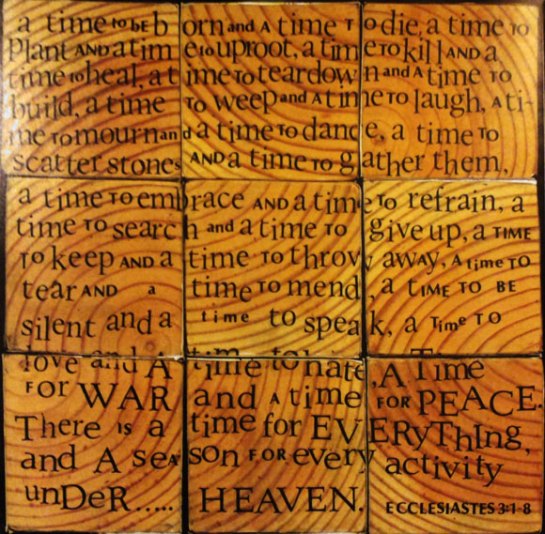
a time for everything


It is with great joy that I enter 2012.

2011 was filled with pain, loss, struggle, sadness, anxiety, and anger.

The year overall was one of seeing the best of circumstances end up as the worst of possible outcomes.

And yet through each season and struggle, there has been tearful laughter, growing community, deeper honesty, brave introspection, and tenuous hope.

And it all feels a little closer to the truth. A little closer to telling the truth.

To others.

To myself.

To the part of all of us that tries to close our eyes to what we know the painful truth is sometimes.

There are times when everything in me wants to arrange my circumstances in ways that hope for the best; those same times, if I were being honest with myself and those around me, I would instead be anticipating the worst. Before this year, I think I’ve tried to push everything, no matter the truth, into a single season.

As if allowing ONLY a season for birth, and then trying to translate death into birth in order to make sense of it.

As if allowing ONLY a season for building, and then trying to add on to things that needed only to be torn all the way down.

As if allowing ONLY a season for embracing, and then awkwardly trying to embrace when I should have refrained from doing so.

As if allowing ONLY a season for speaking out, and then trying to explain why I couldn’t be silent if I had wanted to.

The pain of 2011 has made important room for fall and winter. There is a need and space for dying, for tearing down, for refraining from embrace, for remaining silent. A season for these things.

And in the spaces made from telling the truth about our winters, spring comes on the heels. The ground is made soft, the legs become limber, the imagination becomes ready, and things begin to take root, people begin to dance and build again.

And so here’s to the new year, filled with possibilities for both celebration and mourning. Life and death. Dancing and weeping. Building and tearing down.

And an insistence on the holiness of both––on telling the truth about both–to ourselves and others.

For everything there is season.

djordan
Pine Tree Dr.


Tagged , , , , , , , , , , , , , , , ,

from the archives | when it’s too late

In reflecting on the upcoming one-year anniversary of mosthopeful.com on August 23, I’m throwing some of the posts that readers have looked at the most back into the mix. Thanks for allowing me the space. It’s been a most humbling experience.

+++

View the original post and comments from March 4, 2012

when it’s too late | on john 11


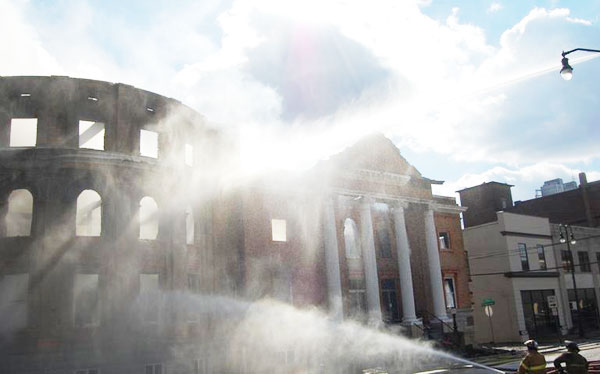
First Baptist Fire, Jackson, TN 2012

It is just after the time when it’s too late.

Our prayers are guided this way. We pray leading up to the time when it is obviously too late. And then we explain why he didn’t show up. Why he didn’t answer.

When our prayers are answered the ways we ask, we give God thanks, and remember it as a way to explain that God indeed does answer prayers.

When our prayers are not answered the ways we ask, when they are not answered in time, we explain that God knows better. We talk about his soveriegnty, and our need to trust him.

We say things like, “Our ways are not God’s ways,” and, “We will know when we should know.”

And in many ways, we come up with explanations either to give God credit, or to let him off the hook.

We pray, and still families fall apart.
We pray, and still jobs are lost.
We pray, and still the famine continues.
We pray, and still we are abused.
We pray, and still we abuse.
We pray, and still the fire burns it all the way down.
We pray, and still the gunshots are fired.
We pray, and still the son is lost.

And so, we say, God knows best. Our ways are not his ways. We will know when we should know.

But not Martha. She is angry.
She had faith, and called him early. When he got sick, she sent for him to get there.

But he did not. He was too late. And she let him know, “If you had only been here.”

And this time, of course, he was not too late. In the ways that he is never too late. There is no too late. Time waits for him, and he does not need time to work in his favor.
And this time, the too late was just on time. When the stone gets pushed out of the way, he comes stumbling out wrapped up like a mummy.
And we talk of the sovereignty of God, Jesus’ power against death, his ways as being other than our ways.

And we are comforted, for a moment. The story helps us take a deep breath, and say to ourselves, it is never too late for him.

But still, we are sitting in the aftermath of
families that have fallen apart.
jobs that are still nowhere to be found.
famine that is murdering millions and millions.
abuse that does not stop.
abusing that cannot stop.
crumbles of chard homes, businesses, churches.
gunshot wounds and hospital noises.
gravestones of our sons and daughters.

And to say the he is never late feels poisonous escaping from our lips.

Martha says, “But even now, I know that God will give you whatever you ask him for.”

In some ways, this makes it worse because we are sitting in the murky puddles of loss and hopelessness.
In other ways, this makes it better because we know that we have seen you more than once defy time and loss and death.

Help us let this make it better.
And when it does not, and we cannot, call for us as you called for Mary, from our mourning…

djordan
Pine Tree Dr.

from the archives | a little help from his friends


In reflecting on the upcoming one-year anniversary of mosthopeful.com on August 23, I’m throwing some of the posts that readers have looked at the most back into the mix. Thanks for allowing me the space. It’s been a most humbling experience.

+++

View the original post and comments from April 2, 2012

a little help from his friends | guest post by Rayna Bomar


rayna bomar guest posts

This is the first guest post here on mosthopeful.com, and I couldn’t be more convinced of its appropriateness. Hugh and Rayna Bomar have become friends of mine these last few years, and their ongoing journey of remembering their son Sam has had an impact in my own life. I hope you glean from Rayna’s words about what has helped and what has not helped as she has been on her own very personal journey with grief. 

In August 2009, as my son Sam started his senior year of high school, I happened upon an essay by a woman named Mimi Swartz entitled “Empty Nest: In a Week He’ll Be Gone – And I Can’t Stand It.”  Her son, also named Sam, was leaving for college a year before my Sam would leave, and I read her words to prepare for what, I thought, I would be experiencing the following August. And, the following August, I did share some of the life changes described by Swartz – dinner for three became dinner for two, my schedule no longer revolved around the school calendar, and the “mundane rituals of child rearing,” just as Swartz had predicted, were gone.  But my role as a mother changed for a reason not anticipated. My Sam didn’t leave for college. Instead, he died on May 4, 2010, ten days before graduation.

There are many things that I could say about the past almost 23 months, but what I would like to do now is share some of the ways that others have helped us get through those months – and a few things that have hindered us.

My husband Hugh and I quickly realized that all grief is personal. What you have experienced losing a loved one, even a child, is not the same as what I have experienced losing Sam. My experience is not the same as Hugh’s experience. Therefore, things that I mention that have helped (or hindered) us may not help (or hinder) you.  I am an expert only about my own grief.

We have been most touched by the kindnesses that have been shown by Sam’s friends. We are in awe of the young men and women who are so naturally compassionate and who have put aside their own grief to help us with ours. They have taken us out to eat on Mothers’ Day and Fathers’ Day, visited on holidays, designed t-shirts and bumper stickers in Sam’s memory, mowed our yard, shared stories about Sam (what we love the most), written letters and sent cards, laughed with us and cried with us, helped with chores, preserved Sam’s spot in the high school parking lot, invited us to their celebrations- I could go on and on.  We are greeted with open arms and a hug. Sometimes we get more than one hug. They tell us that they love us. They share their lives with us and allow us to be part of their future. Their actions are drops of water on parched ground.

What they don’t do is, perhaps, more important. They don’t tell us that it’s almost two years since the accident and it’s time to “move on.” They don’t give us any advice.  They understand that our world changed when Sam died and that we will never be the same. They don’t expect us to be the same because they will never be the same after losing their friend. They don’t try to “fix” us. They don’t make any demands on us. If we feel like a visit, that’s great. If we don’t, they understand, and they don’t take it personally.

Maybe because of their relatively young ages (late teens to early twenties) they don’t have any preconceived ideas about how we should act or feel. Therefore, they don’t think they know what’s best for us, and they don’t try to impose their own feelings on us or try to dictate what is appropriate behavior.

Instead of trying to make us be who they think we should be, they already know who we are. We are Sam’s parents, and we always will be. That’s good enough for them, and it’s good enough for us.

“Death ends a life, not a relationship.” Robert Benchley.

One of the upcoming ways you can join the Bomars in remembering Sam is by attending the 3rd annual Sam Bomar Night at the Jackson Generals. Half of each ticket pre-ordered with the promo codeSamBomar goes to the Sam Bomar Scholarship FundClick HERE to learn more, and to buy tickets for the event on June 23.  

For other most hopeful posts on grief, loss, trauma and resilience, CLICK HERE.


Tagged , , , , , , , , , , , , , , , ,