Tag Archives: justice

things regarded as dead

Screen Shot 2013-04-01 at 8.45.26 AM

I woke up Easter morning to find an email from a friend that only read:

“Today may you start seeing God’s resurrection of things regarded as dead.”

One week later, I’m not sure in what ways I’m starting to see the resurrection of things regarded as dead.

I let a lady check out in front of me today at the store, and she replied that chivalry might not be dead.

Another lady at another store had to ask me a million different questions and try to sell me on a million different offers during the checkout process. I thought nothing of it all until she leaned over the register and said, “thanks, at least, for being nice about all this, young man.”

I went to the funeral today of a good friend’s father who got sudden news of serious cancer, and within weeks, goodbyes were said and tearful thanks given for the notion that the end of life might not actually be an end at all. As much as it still hurts like hell, of course.

And so I wonder, one week after Easter, what it means to begin seeing God’s resurrection of things regarded as dead.

Chivalry.
Kindness.
The lost life of a father.

What about hope that good can overcome evil?
That generosity can overcome greedy anxiety?
That humility beats out power and success and ambition?
That justice can break its way into dark injustices?
That forgiveness is stronger than any force of revenge and retaliation.
That families can come together, no matter how they’ve wrestled apart.
That marriages can make it.
That children can make it to adulthood.
That adults can remember the joy of childhood.
That abundance can make its way to those living in great scarcity.
Abundance and scarcity of money, identity, understanding and freedom.

We don’t build our church buildings next to our graveyards anymore, and we’ve likely forgotten altogether the resurrection we’ve been counting on as a ragtag group of women and men and liars and lovers all these years.

We’ve also likely forgotten that things we’ve already written off and sealed up and buried deep as dead impossibilities are waiting, one week after Easter as much as easter morning itself, for the resurrection.

Hope, generosity, justice, families, marriages, children, adults, abundance, scarcity and equality, identity, understanding and freedom.

Chivalry isn’t dead.

Neither is the hope, and therefore the prayer, that God’s kingdom come, and his will be done, on the earth this week after Easter Sunday, as it is in heaven.

djordan
Pine Tree
Tagged , , , , , , , , , , ,

a ridiculous question

Screen Shot 2013-03-11 at 5.41.08 PM

My students on Monday, Wednesday and Friday often have to suffer through whatever kind of mood I am in. They pretend to do so gladly, and fortunate for their sakes, most days this semester have been great. They have a lot to do with that as they have been an incredibly fun group thus far.

Last week, I found myself exhausted from work. I noticed that all the work involved good things with good people pushing for good progress. We had been looking for and living into signs of the kingdom, and it had all been good. But one evening, the evening before this particular class, I found myself wondering what I was doing, and if it is all worth it anyway.

My mind went back to a conversation I once had with someone questioning the pursuit of the kingdom. “Does it ever get better? Does it ever actually make a difference?” The questions, not ridiculous, come to my mind often if I tell myself the truth. The next question was, “And if it doesn’t ever really get better, why work toward it? All we can do is wait for it. Otherwise, we will get terribly depressed and disappointed, right?”

Back in the present, I found in myself after a great long day of different work in the community wondering what in the world I was doing. The notion that maybe things aren’t getting better seemed to push in harder, and with a particular situation in mind, and I wondered what the point was.

Just before arriving to my classroom the next day to talk to students about the history of faith and efforts toward justice, I ran across this video (below). I knew immediately that I was asking a bad question because I had, as I usually do, turned the situation back to myself. Gravity always pulls me inward, and in its doing, had made me wonder about the worthwhileness of it all. But this piece of work reminded me of the names and faces of people who are changing my world as I walk hand in hand with them toward the kingdom. They are my clients and the families I serve and the communities I work in. They can’t afford to wait, and therefore neither can I. We are the same.

The next time I find myself asking that ridiculous question, I hope I can remember. I showed the video to my students that day in hopes that they will remember also…and that they will hold me accountable to remember as well.

djordan
Pine Tree

Tagged , , , , , , , , , , , , , , ,

good men and the practice of resistance [PART 1]: a guest post by Wes Gristy

the-resistance.-part-1

There’s a line in a song called The Resistance by Josh Garrels that haunts me. It comes at the end of the first verse. After poetically describing the power structures of this world that abuse the masses, Garrels asks, how do good men become a part of the regime? The question assumes these systems of captivity to be the handiwork of good people, good Christians even. Ethical businessmen. Rule followers. It’s an assumption that runs contrary to our own. Unlike Garrels, most of us think that the waves of oppression, domination, and injustice arise solely from the drug lords, crooked politicians, and criminals—in other words, from the bad men. They are the ones responsible for the regime. Yet while bad men certainly play their part, I think Garrels has a point.

The truth is that good men contribute much to the structures of this world. Think about it. Good men are prone to protect, and so they work for stability. Good men like to keep the boat steady, and so they don’t allow for radical course corrections. Good men want to give assurances and make promises, and so they create lots of policies and procedures to keep us safe. Good men like to show the prettier side of things, and so questions that poke holes in their presentations are often labeled as negative or even disloyal. Good men can be conservative in the worst sense of the word, stiff-arming innovation with rolls of red tape, declaring with confidence, “The system works well enough. We’re doing the best we can. Our intentions are noble.” And so the status quo holds fast due to the diligent efforts of good men.

How does this happen? How do good men become a part of the regime? Garrels offers an answer: They don’t believe in resistance. They fail to critically analyze the ideologies of this world, and so they are unprepared to resist them. Too many good men fail to heed the words of the Apostle Paul, “Don’t let yourself be squeezed into the shape dictated by the present age” (Rom 12:2). Obedience here requires active resistance; the regime flourishes by subtle means when we let down our defenses. Without resistance, we’re assimilated, and we don’t even know it.

Without resistance, good men with good intentions will inevitably slip into the patterns of this evil age.

It’s not that sooner or later good men are unwittingly going to turn around and start shooting people, but rather that popular notions, incompatible with the ethic of Jesus, will begin to sound reasonable to embody—certain notions of success, of courageous leadership, of religious conviction, and of personal ambition. These notions slowly become the subject of our conversations, the content of our imaginations, the stories we tell our children, and ultimately the fuel of the very regime we say we despise.

I had a professor who once offered his students this proverb: “I used to think that bad people did bad things for bad reasons. Now I believe that good people do bad things for seemingly good reasons.”

That’s my fear.

That’s why this lyric returns to my mind again and again. And so I pray, Heavenly Father, save me from becoming a good man who quietly and unknowingly becomes a part of the regime. Teach me to practice resistance.

Wes Gristy is an associate pastor at All Saints Anglican Church in Jackson. He’s been married to his kick-butt wife Abbie for eleven years, and they have a brilliant four-year-old daughter and hilarious one-and-a-half-year-old son. Wes is one of my very best friends who has taught me much about the costs of resistance, and about what it actually looks like to push hard into the questions and compassion and work of the kingdom. I’m grateful to him for guest posting, among many other things.

This post is Part 1 of a 2 Part series. For Part 2, CLICK HERE.

djordan

Tagged , , , , , , , , , , , , , , , , , , , , , ,

worth more than a lazy saturday

more-than-lazy-saturdays

I won’t lie. To all my friends with children, jobs that carry them into the weekend, life that carries them over the edge…I wont lie. I usually sleep in on Saturdays. If I’m in town, which is becoming less and less, I don’t think twice about the thrill of sleeping in till nine or ten on Saturday mornings, waking up then only because the dogs begin to insist on it. And I wont lie that most Saturday mornings it’s the perfect thing for me to do.

Be jealous, if you wish.

Today, however, is worth more jealousy than sleeping-in-Saturdays.

This morning at eight I’m ringing the doorbell to meet for a few hours and discuss the art of counseling, to be given encouragement in y wise steps and wisdom in my ignorant steps. And coffee. To be given coffee at eight in the morning since I usually sleep in on Saturday mornings. For two and a half hours beginning at eight in the morning there is discussion over what it means to listen well, to practice well, to watch well and to craft well. Counseling is, as I’m learning, more the art of listening for what the person speaking has known all along but can’t hear himself say, can’t hear herself know. until someone shines it back on them, both sides becoming changed. This morning at eight in the morning, cup of coffee soon to be in hand, I’m ringing the doorbell ready to discuss the art and privilege of therapy.

This morning at ten-thirty, or a few minutes late because the first conversation went long…but we knew that it would…I find myself walking through another door to another meeting. I find myself, new cup of coffee in hand sitting around a huge kitchen table with people I know and people I don’t know. I find myself sitting with people who share, above all, a heart not for names or labels or agendas but a heart for the kingdom and all it involves. I find myself sitting, a little late for a ten-thirty meeting, around a table with people who have won my respect and people who quickly earned it talking big and thinking hard and dreaming wide about what it means for business and food and health and poverty and community to get smushed together in one hopeful spot. Passing the brownies, the hope of a community sitting around tables together having a party as we were this morning. This morning a few minutes after ten-thirty I find myself in the middle of a moment I wont soon forget because a little piece of kingdom come happened around that table this morning while brownies were being passed.

And at twelve forty-five I find myself sitting across the booth from a good friend for late lunch. Laughter and hats and glasses and jeans because it’s Saturday morning after all. The questions thrown out over salads and salmon about what it might mean to follow Jesus beyond harmful clichés or ceramic crosses and into the streets and the cubicles and the living rooms where vengeance is king and jealousy rages and a feeling like maybe we’re a little behind pushes fast and furious into our hearts. Passing the crackers and stacking the napkins, questions thrown out about where we went wrong or where we went right and how we might learn to tell the difference between the two, how we might assume there’s a difference at all. Back to our cars and back to our homes for errands and work and a little time for play, because it’s Saturday afternoon of course.

And then in the evening, a last minute text. Dinner around the table, prepared as we chat. Children run wildly with giggles and stories and hopeful surprises of what it mean to see their eyes and takes on the world. Sitting down in those familiar seats we find ourselves between laughter and tears because so much is known and so much has been seen. Together. There’s no catching up so only the present is told: where we are, what we wonder and what we all hope. Sweats and pullovers, secrets unhidden, because after all it’s a lazy Saturday evening dinner.

And so most Saturdays I don’t think twice, when I can, to sleep late and give thanks that I have the weekend. But today, in the hustle and the few minutes late, I give thanks that I’m surrounded by people pushing well and pushing hard and pushing often into the thin space where we’ve been taught to pray and taught what it means for his kingdom to come and his will to be done on this dusty earth now as it is in his heaven.

djordan
Pine Tree

Tagged , , , , , , , , , , , , , , , ,

a people who tell the truth | thoughts on ash wednesday

from dust you came, and to dust you will return

It occurred to me while getting a cross of ash smeared over my brow, hearing the words, “from dust you came, and to dust you will return,” that one of the things I appreciate the most about the faith I’m finding myself leaning into more and more is that we are a people not only allowed to tell the whole truth, not only even encouraged to do so, but ultimately demanded to do so.

We must tell the truth: the good, the heartbreaking, and the completely unexplainable.

And so we operate in a season of lament and reflection. We begin it by marking ourselves with the dust we come from and the dust to which we will return. We take time to fast from things to remind us of our desperation and dependence on the king of the coming kingdom for anything to be worth telling in the end.

And even when shiny churches and slick preachers grin and tell us how to be happy, we must tell the truth that the world goes not well. Injustice abounds and work toward justice often feels like tiny drops in an enormous ocean. Hearts ache with broken families and open wounds. Loss stings years later like the day death stole life from our fingertips.

And so we tell the truth. All of it.

The hope of the kingdom coming is only truly hopeful if it is the refrain after the we see the deep gray all around us, and admit that we are both broken by it and perpetrators of it.

Until all is made new.

And so, for lent, we remember that from dust we came, and to dust we will return.

djordan
Washington D.C.

Tagged , , , , , , , , , , , , , ,

and once again we sing

Vietnam B-52 Bomb Craters

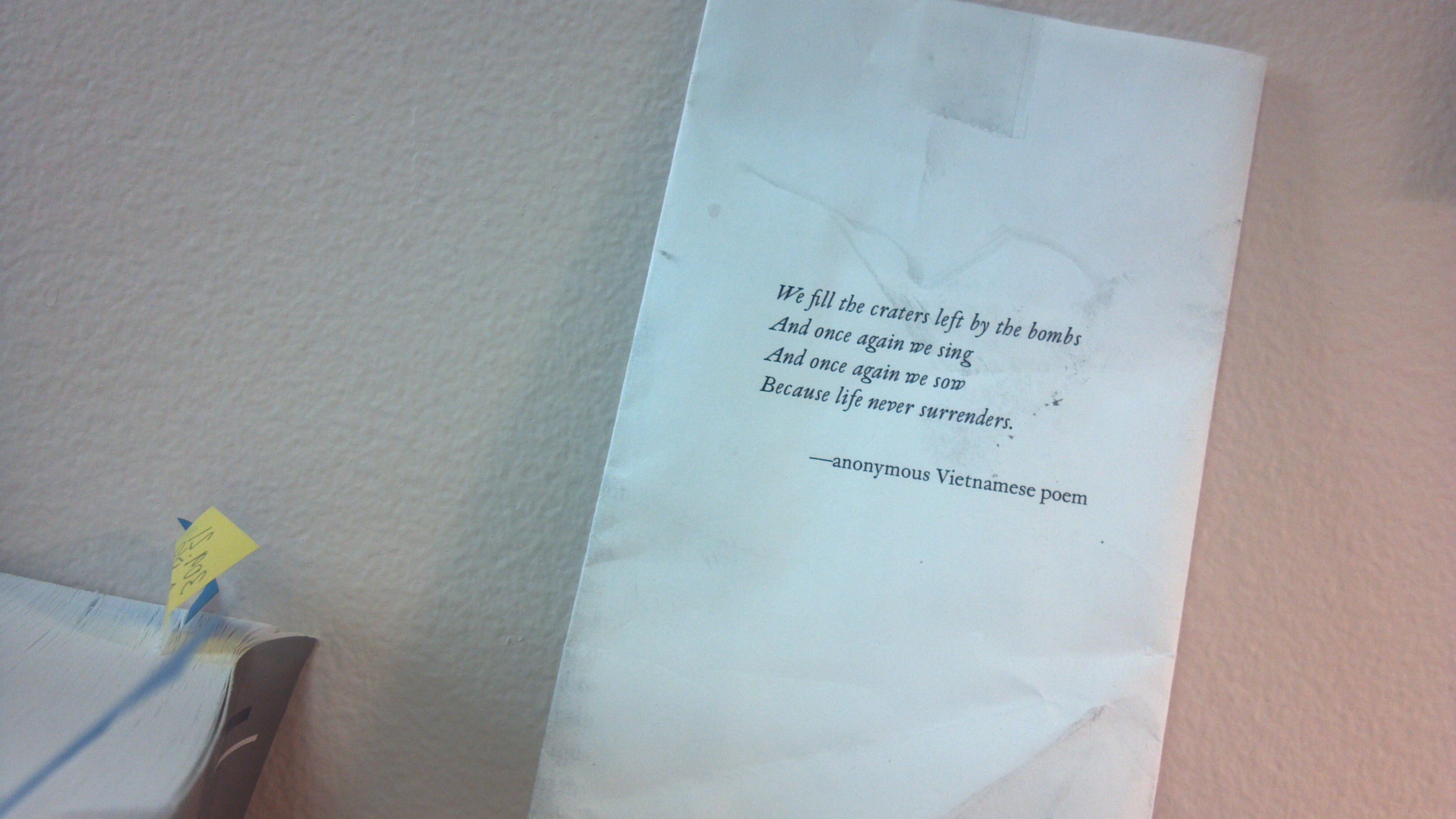
Throughout my last two jobs, I’ve had the same folded-up xerox copy of the first page of a memoir which has the following lines attributed to an anonymous Vietnamese poem taped to the wall above my desk:

We fill the craters left by the bombs
And once again we sing
And once again we sow
Because life never surrenders.

These words struck me when reading the memoir, but these days I don’t remember why. Over the last three years, I’ve thought a great deal about trauma and grief. First motivated to begin understanding it more while working with the survivors of homicide-loss, and then through my own personal journey through difficult work days, and now in the context of the lives of my individual clients as well as communities in which we work for transformation and development.

The notion that suffering and pain, while seen to be inherently private and uber-personal, is in reality communal and fundamentally social, the words are becoming more and more haunting.

As the church moves into communities of violence, systemic injustice, stigma, poverty, materialism, greed, addiction and isolation, we are often afraid to sing songs that the people waiting for the kingdom have sung for hundreds upon hundred of years…

By the rivers of Babylon we sat and wept
    when we remembered Zion.
There on the poplars
    we hung our harps,
for there our captors asked us for songs,
    our tormentors demanded songs of joy;
    they said, “Sing us one of the songs of Zion!” 
(from Psalm 137)

As a people waiting and working for transformation, before we fill the craters, before we take on life again, we must tell the dirty truth about our loss and despair and all that is wrong and evil and messy and undone in the world, in our private and personal worlds, and in our communal and social worlds. If we, those who hold the promise that life never surrenders, can’t tell the truth about the mess of it all, then we aren’t yet ready, aren’t yet brave enough, to sing and sow once again.

2013-02-01_16-01-42_735

djordan
Summar Dr.

Tagged , , , , , , , , , , , , , , , ,

when christmas is over, the work begins

Screen Shot 2013-01-04 at 4.01.13 PM

When the song of the angels is stilled,
When the star in the sky is gone,
When the kings and princes are home,
When the shepherds are back with their flock,
The work of Christmas begins:
To find the lost,
To heal the broken,
To feed the hungry,
To release the prisoner,
To rebuild the nations,
To bring peace among people,
To make music in the heart.

“The Work of Christmas”
Howard Thurman


Tagged , , , , , , , , , , , , , , ,

this side of history | on watching “Lincoln”

abraham lincoln

it’s one thing to sit with a huge twenty-dollar coke
watching the story unfold on the big screen
making decisions pretending like we don’t know how the story goes.

of course, i would vote for the thirteenth amendment.
i’d be a monster otherwise.
i know it has to do with money.
i know it has to do with the economy as we know it.
i know we don’t know how to move forward without slavery.
but, i’m a good enough person to know that i’m in favor of it.

i think to myself, eating popcorn,
watching the story, ending already known, unfolding on the screen.

and I think about the stories unfolding right now
the stories in congress
the stories in the courts
the stories in the projects
the stories in the suburbs
the stories in the churches
the stories in the living rooms
the stories in the villages
the stories in the high-rises
the stories unfolding right now

across not only this city
across not only this nation
but all over the globe

and i wonder,
as i eat my popcorn and drink my twenty-dollar drink,
do I have it in me
to stand for justice
to take the risk
to make the jump

when i have no idea what it will mean about money
when i have no idea what it will mean about the economy as we know it
when i have no idea what it will mean about how to move forward
when i have no idea what it will mean

but, on this side of history,
where will i be standing
one hundred and fifty years from now
when people will be eating popcorn
imagining what they would have done
had they been me.

may we be courageous.

djordan
Pine Tree

Tagged , , , , , , , , , , , , , , , , , ,

from a long line of rule-breakers


History is marked by those pushing
into uncharted waters
unexamined worlds
and mostly unacceptable arenas
where people who were not to be
allowed
accepted
approved or
appreciated

were asked to
contribute
comprehend
compose and
conspire

against the ways that things are
and toward the way that things should be

in the kingdom
in the beloved community
in the new ecology
of a world and
of a community where
rich and poor
sick and well
like and unlike
loud and quiet
important and ignored

sit together
eat together
serve together
weep together
laugh together
learn together
give together
sing together and
hope together.

And while we are still so far behind
we have moved so far ahead
of where we have been

and only a few moments of remembering
will give us the wisdom and the humility
to pray to God–our only hope–that we will keep moving forward
faster and surer than the ways we are pulled to move backward

and we will remember
in our trepidation and
in our eagerness for
things to stay the same

that we are descendants of a long line
of rule-breakers
of peace-makers
of hope-holders and
of kingdom-bringers.

And now is not the time for stillness.

Amen.

djordan
Pine Tree

Tagged , , , , , , , , , , , , , ,

with our necks on the line

MARCEL MOULY "La Vague d'Etrave II"2003

In all the complexities
we hold out hope
that we are thinking
and choosing
and doing well.

but we do not know, of course, if we are.

In all the dramatics
we hold out hope
that we are acting justly
being filled with mercy
and taking steps with humility.

but we fear, of course, that we are not.

Yet even in our unsureness
the tasks wait
the issues wait
the choices wait

injustice waits
cruelty waits
arrogance waits

and we cannot stall
until we feel we are sure enough to move
because work
and lives
and hope is on the line.

So we hold our breath
and step into the unknown
and act and choose and do
our best attempts at
justice and love and mercy
hoping we have chosen well
while willing either way to put our necks on the line
to have acted.

djordan
Pine Tree

Tagged , , , , , , , , , , , , , , , ,