Category Archives: grief and trauma

a people who tell the truth | thoughts on ash wednesday

from dust you came, and to dust you will return

It occurred to me while getting a cross of ash smeared over my brow, hearing the words, “from dust you came, and to dust you will return,” that one of the things I appreciate the most about the faith I’m finding myself leaning into more and more is that we are a people not only allowed to tell the whole truth, not only even encouraged to do so, but ultimately demanded to do so.

We must tell the truth: the good, the heartbreaking, and the completely unexplainable.

And so we operate in a season of lament and reflection. We begin it by marking ourselves with the dust we come from and the dust to which we will return. We take time to fast from things to remind us of our desperation and dependence on the king of the coming kingdom for anything to be worth telling in the end.

And even when shiny churches and slick preachers grin and tell us how to be happy, we must tell the truth that the world goes not well. Injustice abounds and work toward justice often feels like tiny drops in an enormous ocean. Hearts ache with broken families and open wounds. Loss stings years later like the day death stole life from our fingertips.

And so we tell the truth. All of it.

The hope of the kingdom coming is only truly hopeful if it is the refrain after the we see the deep gray all around us, and admit that we are both broken by it and perpetrators of it.

Until all is made new.

And so, for lent, we remember that from dust we came, and to dust we will return.

djordan
Washington D.C.

Tagged , , , , , , , , , , , , , ,

and once again we sing

Vietnam B-52 Bomb Craters

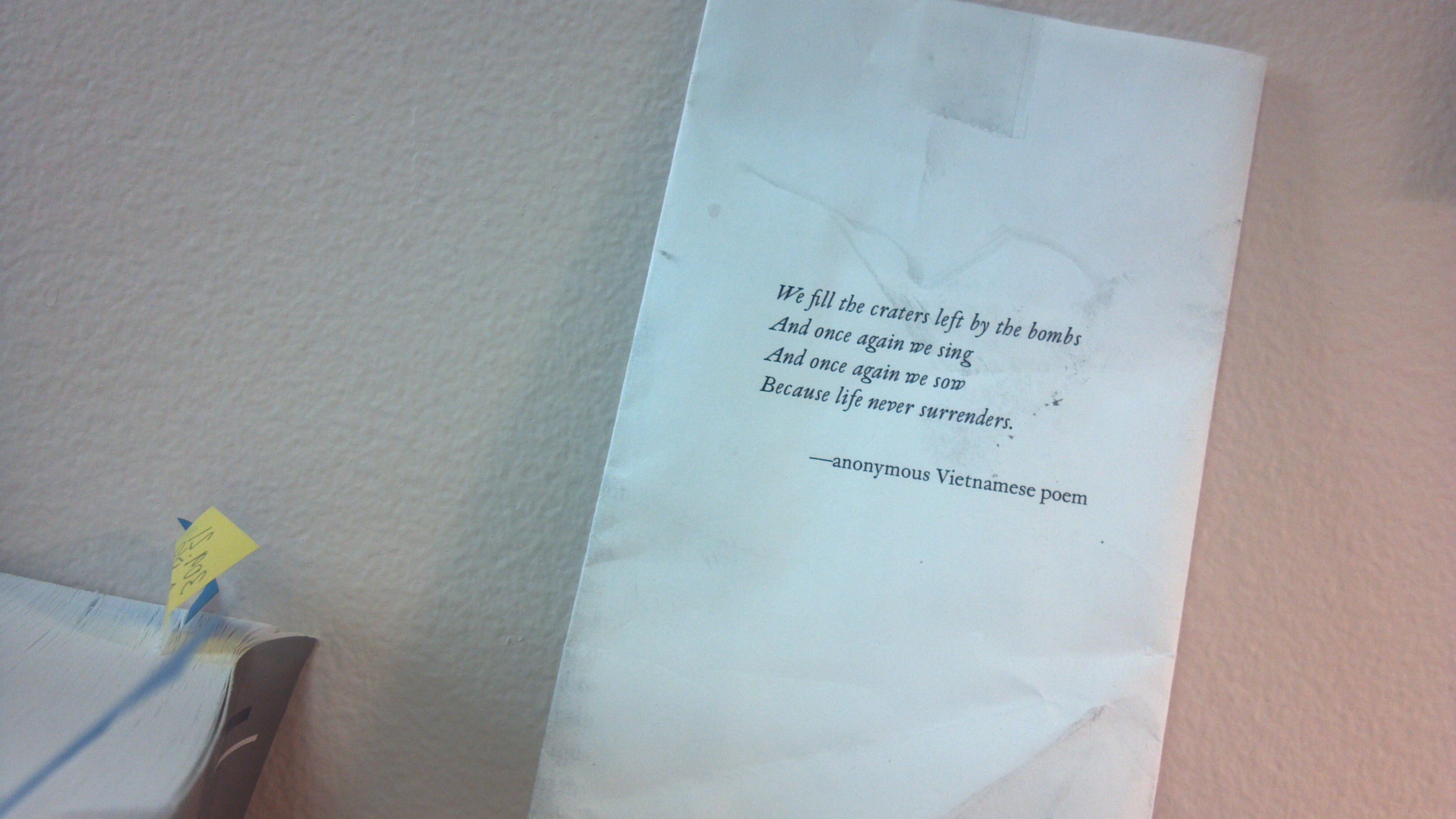
Throughout my last two jobs, I’ve had the same folded-up xerox copy of the first page of a memoir which has the following lines attributed to an anonymous Vietnamese poem taped to the wall above my desk:

We fill the craters left by the bombs
And once again we sing
And once again we sow
Because life never surrenders.

These words struck me when reading the memoir, but these days I don’t remember why. Over the last three years, I’ve thought a great deal about trauma and grief. First motivated to begin understanding it more while working with the survivors of homicide-loss, and then through my own personal journey through difficult work days, and now in the context of the lives of my individual clients as well as communities in which we work for transformation and development.

The notion that suffering and pain, while seen to be inherently private and uber-personal, is in reality communal and fundamentally social, the words are becoming more and more haunting.

As the church moves into communities of violence, systemic injustice, stigma, poverty, materialism, greed, addiction and isolation, we are often afraid to sing songs that the people waiting for the kingdom have sung for hundreds upon hundred of years…

By the rivers of Babylon we sat and wept
    when we remembered Zion.
There on the poplars
    we hung our harps,
for there our captors asked us for songs,
    our tormentors demanded songs of joy;
    they said, “Sing us one of the songs of Zion!” 
(from Psalm 137)

As a people waiting and working for transformation, before we fill the craters, before we take on life again, we must tell the dirty truth about our loss and despair and all that is wrong and evil and messy and undone in the world, in our private and personal worlds, and in our communal and social worlds. If we, those who hold the promise that life never surrenders, can’t tell the truth about the mess of it all, then we aren’t yet ready, aren’t yet brave enough, to sing and sow once again.

2013-02-01_16-01-42_735

djordan
Summar Dr.

Tagged , , , , , , , , , , , , , , , ,

scarred by struggle, transformed by hope

scarred-by-struggle,-transformed-by-hope
I received a book in the mail today from a friend I met through the blog.

Multiple conversations have been had via email, with time and oceans in between, about issues of faith and justice and loss and hope and hopelessness and holding on. When I recently had a time of near blog-silence, she checked in to see how things were. She immediately hit right on the nature of the issues adding to the silence, and gracefully wrote words that echoed like prayers of acceptance of creative silence, and requesting of hopeful imagination.

And today, after waking up to run, pour a slow cup of coffee and then get back to work at Area Relief Ministries for the first time since mid-December, I walked in to see a package on my desk. I opened it up and immediately knew who it was from, as this friend had referenced the book in an email during those dry days.

The following is an excerpt, and the book itself, sitting on my desk in its packaging waiting quietly like the sneaky gift it was is now a reminder, of how the kingdom community is broader and larger and more powerful than I remember on most days. It is ebbing and flowing in and out of our quiet and alive places, keeping us moving and pushing forward, even when we aren’t sure why it’s worth it.

So to this friend, and the other friends of which there are many brave and marginalized kingdom-souls, who are willing to tell the stories of struggle in an effort to sing the true songs of hope, I cannot say thank you enough.

djordan
108 S Church

“Hope is rooted in the past but believes in the future. God’s world is in God’s hands, hope says, and therefore cannot possibly be hopeless. Life, already fulfilled in God, is only the process of coming to realize that we have been given everything we need to come to fullness of life, both here and hereafter. The greater the hope, the greater the appreciation of life now, the greater the confidence in the future, whatever it is. 

But if struggle is the process of evolution from spiritual emptiness to spiritual wisdom, hope is a process as well. Hope, the response of the spiritual person to struggle, takes us from the risk of inner stagnation, of emotional despair, to a total transformation of life. … The spirituality of struggle gives birth to the spirituality of hope.” 

from “Scarred by Struggle, Transformed by Hope,” by J.D. Chittister


Tagged , , , , , , , , , , , , , , , , ,

intolerance of uncertainty | thoughts on a new year

Las_Vegas_New_Years_Celebrations_0aede

It’s no doubt that the things which are the most important for us to know are the things which, once heard, feel the most obvious. The things which, once said, feel the most simple. And yet, it is these things which are often, once heard and said, the things which change us the most. The things which make the biggest impact in our worlds because even though they are obvious and even though they are simple, they are still the things which are most important and have the most impact.

A New Year’s resolution has been to read an article a workday. Workday means ultimately five articles a week, and article means a research or peer-reviewed journal article, so what to do when throwing a party or how to build biceps fastest doesn’t count as articles.

I was reading, a few days ago (because I’ve also learned that New Year’s resolutions I wait to start until New Year’s are 100% less likely to happen than New Year’s resolutions I start a few days before) an article* about depression, anxiety and rumination. I was reading for a client that I’ve been making little progress with, and also reading for myself as is almost always the case whether any of us in the field choose to admit it or not.

The article speaks to depression, anxiety and rumination, or ongoing perseverative thoughts about situations or details, as moderated by the intolerance of uncertainty. And while the phrase “intolerance of uncertainty” feels as common and as known and as obvious as any other phrase that’s said over coffee or in elevators or across lunch tables, I felt myself freeze in the phase of the written words, as if the obvious and known was suddenly becoming an answer to a mystery.

The more we are intolerant of what we can’t control and what we don’t know, the greater our anxiety, depression and stalling.

With multitudes of caveats and uncontrollable variables, the notion has stuck with me since. The ability that I, or others, have to tolerate uncertainty influences the way we see the future and handle its impending realities in the present. Since all of the future is uncertain, no matter the degree at which we enjoy misleading ourselves, my ability to tolerate that uncertainty is a predictor of my emotions, attitudes, and decisions.

Since reading this article, no doubt an encouragement to keep up my New Year’s resolution, I’ve been challenged to face each day with a reminder to myself that what is to come is unknown, and my trust in the fact that all things are done well and that all things work together is and will be a major factor in my ability to move forward well into the grief and joy that lies ahead in 2013.

Here’s to an uncertain new year.

djordan
Pine Tree

* Liao, K. Y. & Wei, M. (2011). Intolerance of uncertainty, depression, and anxiety: The moderating and mediating roles of rumination. Journal of clinical psychology, 67(12), 1220-1239.

Tagged , , , , , , , , , , , , , , ,

on advent | before we sing the song of Christmas

Screen Shot 2012-12-22 at 9.06.20 AM

My house is actually clean because I threw a party here a week ago.
The Christmas tree has stopped shorting out with the help of an extra extension cord.
All the gifts are in and waiting to be wrapped.
Money is in the bank, and a job waits for me when I return from the holidays.
Evenings and meals with candlelight and laughter are planned nightly for the next week.
There is plenty to be joyful for in the days approaching Christmas for me.

But couples wrestle with miscarriage.
Clients wrestle with families falling apart.
Participants wrestle with utilities being shut off.
Loved ones wrestle with pressing in depression and hopelessness.
Men wrestle with finding a bridge under which to put a pillow for the night.
Strangers wrestle with missing six-year-olds for Christmas morning.
Friends wrestle with the murdered son, husband, wife, daughter.
There is plenty to be broken-hearted for in the days approaching Christmas for me and others.

Enter the truth of advent.

Beyond flashy Christmas programs and shiny Christmas cards
taken twenty times until we liked the way our chins looked,
Beyond rhetoric over guns and entitlement and taxes and “wars on Christmas,”
sits a spinning world that while some goes well,
much goes not well.

Enter the truth of advent.

Skipped for Christmas morning by many churches and Christians
following in line behind consumers and the mighty dollar,
Advent waits in the dark nights before Christmas morning
telling the truth
allowing the tears
holding out hope
that while the world goes not well
the kingdom comes.

And when advent is allowed to enter
and linger under candlelight,
the words of the old hymn make a little more sense,
and make Christmas morning a little more important,
because we were allowed to wait for Christmas.

O ye beneath life’s crushing load,
Whose forms are bending low,
Who toil along the climbing way
With painful steps and slow;
Look now, for glad and golden hours
Come swiftly on the wing;
Oh rest beside the weary road
And hear the angels sing.

For lo! the days are hastening on,
By prophets seen of old,
When with the ever-circling years
Shall come the time foretold,
When the new heaven and earth shall own
The Prince of Peace, their King,
And the whole world send back the song
Which now the angels sing.

Until the new heaven and earth own their King,
May we tell ourselves the truth of Advent
before we sing the song of Christmas.

Amen.

djordan
Pine Tree

Tagged , , , , , , , , , , ,

12.1.12 World Aids Day | a guest post by Rebecca J. Vander Meulen

2012-11-cobue 227

The following post was written by a friend living and working in Mozambique whom I first met through the blogosphere. After exchanging emails, we realized we shared a mutual friend and kingdom-bringer in Cape Town, South Africa. This writing is for World Aids Day which is today, December 1, 2012. Thanks to Rebecca for her, as always, honest and difficult while hopeful and hopefilled words. 

+++

Thuli was standing in front of us, telling us that she “should” have been dead—but that she was alive, thanks to anti-HIV antiretroviral medication.  While others were crying tears of joy, I left the celebration banquet sobbing with anger and jealousy.  I rejoiced in Thuli’s health, but I was angry that she would probably have already lost her life if she had been living in Mozambique instead of South Africa.  The year was 2004, and antiretrovirals, or ARVs, were not yet widely available here.  What was the prescription for most Mozambicans who were recently diagnosed with HIV? A healthy diet (not an easy task for the average subsistence farmer), treatment of opportunistic infections, and hope.   Many people told me they’d rather die not knowing their status than find out they were living with HIV and “die early” from the associated despair and shame.  Hope, while potentially a useful supplement to medication, seemed to me to be a sorry substitute for it.

One evening this October, a woman was admitted to the health center in Cobue, a small village in a remote corner of Mozambique.  Because of the Anglican Diocese of Niassa’s comprehensive “Salt, Light, Health” community health project and many “Life Team” activists who work in the Cobue region, Cobue offers better health services than most communities its size.

I had been told that this woman was “not well.”  The next morning, upon meeting her, these words proved to be a dramatic understatement.  Infected ulcers and bed sores covered large areas of her body. These raw wounds left her unable to sit up or walk.

Cobue’s seasoned doctor, made woozy by these oozing sores, began removing dead tissue.  A traditional midwife and the patient’s mother waved cloths to keep the flies at bay.

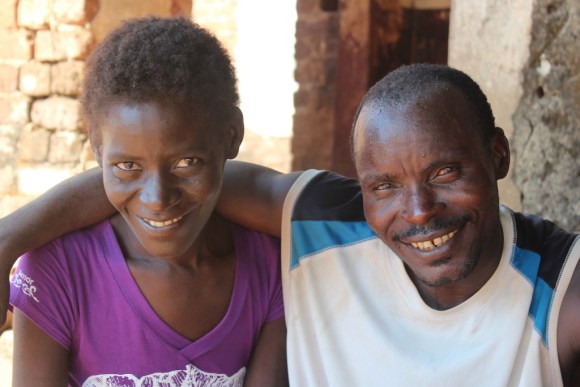
Her prognosis was poor.  But her name? Esperança. The Portuguese word for “hope.”  And for Esperança, hope proved to be stronger than the bacteria that fought for her life.

2012-10-cobue 280

A team of dedicated people worked for hours each day to clean Esperança’s sores. Though I imagine the process was agonizingly painful, I never heard Esperança complain or grumble.

But behind Esperança’s wounds lurked an even more concerning problem: her immune system had been decimated by HIV.  HIV works within the human body by attacking CD4 cells, which serve as commanders in the body’s defense system.  Someone with a healthy immune system typically has a CD4 count of maybe 1000. A CD4 count of 350 or below indicates widespread damage to the immune system, and is a cause for significant concern.  Esperança’s CD4 count was 12.

She had first been diagnosed with HIV in 2008 and had faithfully taken her ARV medications twice a day, as instructed. But the ARVs were no longer working.

In hushed discussions with the doctor, I compassionately hoped that Esperança could at least recover to the point of being able to sit up before she died.

How rational—or naïve—I was.

Three days into her wound care, with thousands of milligrams of antibiotics circulating through her body, Esperança greeted us with glee.  Giddy, she explained that she had managed to leave her bed overnight to go to the bathroom outside.  This was something she hadn’t done in weeks.

Esperança, already all too familiar with death (having lost her only child), now admits that death was on her mind during these days of hospitalization. But that morning, her joy of having been able to get out of bed overwhelmed her thoughts of death.

A team of efficient and dedicated people in high places got authorization from the national Ministry of Health for Esperança to begin a new regime of ARVs—a significantly more expensive set of “second line” medications that are only available to a small proportion of Mozambicans living with HIV.

Within days, Esperança’s increasing mobility and healing sores proved that these new ARVs were effectively halting HIV’s reproduction within her body.  Esperança continued to improve, and was discharged from the hospital only a month after I’d dreamed that she’d be able to sit up before she died.

She arrived home to surprised celebration.  Friends and neighbors told her they didn’t think she’d ever step foot in Mala again.  The “Mother’s Union” women’s group surrounded her with prayers of thanksgiving.

2012-11-cobue 140

Esperança had clung to the hope that too often eludes me. She had the courage to live beyond the facts, fully aware of the possibility of being humiliated in that hope.

William, a fisherman turned HIV technician extraordinaire, and one of Esperança’s primary caregivers, explains “most people didn’t think she’d live to seek the weekend.” “I praise God.”

Esperança has gained seven pounds in the past two weeks.
2012-11-cobue 209

Today’s global World AIDS Day theme is  “Getting to Zero: Zero new HIV infections. Zero discrimination. Zero AIDS related deaths.”  Properly managed, HIV is no longer a death sentence.  We are still far from that reality here in Mozambique, where tens of thousands of people still die annually from AIDS-related causes. But Esperança’s life gives flesh to the vision of zero deaths.

Esperança wouldn’t be alive today without second line ARVs. She wouldn’t be alive if her family hadn’t received treatment and teaching about HIV from Salt, Light, Health and Life Team activists. She wouldn’t be alive if her mother, her primary care-giver over the past months, had given up. She wouldn’t be alive without the daily wound care she received from a team of informally trained lay people.  She wouldn’t be alive without the thoughtful conversations between several different doctors, hundreds of miles apart. She wouldn’t be alive without the activists around the world who lobbied over the years for lower ARV prices, and the PEPFAR funds that made her medication available. But the obligatory prerequisite to all of that was her own deep hope. Esperança’s esperança.

2012-11-cobue 190

Yes, medicines saved Esperança. But had she had any less esperança, she would never have made it to the phase where she could have received these medicines.  Esperança lives today not only because of the miracle of newfangled medicines, but also because of good old fashioned hard work and her resilient human spirit.

I didn’t know Esperança before October. But I imagine that she must have practiced living out her name for years.  Only a well-practiced hoper could have hoped like she did.

Cobue, 1 December 2012
Rebecca J. Vander Meulen
rvandermeulen@fastmail.fm
www.rvmphotography.com

Tagged , , , , , , , ,

no longer on our own

you’ve been walking a while
mostly in the dark
trying your best to make a map
of where you’ve been
in hopes that you can make a guess
of where you’re going

but the hill has been upward
for such a long time now
you’ve almost decided
you’re not going anywhere or
you’ve been pointed in the wrong direction

but you’ve done your best
to hold out in hopefulness
that you’re almost to the break in the climb

but it’s been in the walking
mostly alone
that you’ve learned the deep value
of holding on to the lantern
with a dim and fickle light
because it’s all you’ve had
to make out where you’ve been
and maybe where you’re going

but we see you now
coming up on the break
in the hill you’ve been climbing
mostly in the dark
mostly alone

and we know what you’re feeling,
mostly we do,
because we remember that climb very well

because of what we remember
we feel our own hearts
jump in our own chests
because of what we remember well

the lost and lone ranger
we remember the fear
we remember the conversations with ourselves
we remember the almost giving up
we remember the almost freaking out
we remember the almost giving in
we remember wondering if we’ve lost our minds
we remember the choice of going back to the crowds
because it felt like the only alternative
to being lost and alone forever

all here together
we now see a glowing
just above the crest of the hill
and all here together
we know that soon
our lights will wrestle the shadows together

you see us
we see you

suddenly that walk was worth it
suddenly the lost and alone and the lesson inside them
have done their work
have done their time

and now, all together
we walk with the light
wrestling the shadows
learning the path

the hill always breaks
and there’s always a crowd ahead of us
waiting, with hearts jumping in chests

because finding each other
is as thrilling as being found

We are no longer on our own.

djordan
León, Nicaragua

Tagged , , , , , , , , , , , , , , , , , , ,

the class who shows up | on the 5th annual homicide-loss walk

After five years of standing in line watching men and women, propped up babies on hips and grandparents escorted with walkers, this year was different altogether.

It is both encouraging and discouraging to see the crowd grow year after year at the Commemorative Walk for survivors of homicide-loss. It’s been my privilege to listen to and learn from these men and women in a weekly support group, but to see them walk through candlelit paths holding photos of their murdered husbands, sons, grandsons, wives, mothers and grandmothers is altogether horrifying and holy at the same time.

And it has been every year these last five years since the very first walk. It is always holy in the way honestly telling the honest truth is always holy and almost always horrifying.

But this year, there was something new for me as I stood in the evening’s mist.

Looking into the line of men and women with faces barely glowing from the candles in their hands, I saw my students. The clock strikes nine every Monday, Wednesday and Friday and my students are faithful to be patient with me in class as I dance onto tangents, threaten with grades and bribe with food. They have listened to me grow awkwardly teary about the histories of movers and shakers from the margins of the field whom God has used to bring kingdom change across the globe. They have held on as we’ve acted out counseling sessions, as we’ve debated the reasons for poverty and welfare, and as we have pushed the questions of power dynamics and our goodwill to the limits. They always show up.

But this night, lining the sidewalks where women and men who have become dear to me walk through their glowing candles and make clear that their murdered loved ones will not be forgotten, my students showed up. As tears filled my own eyes, I lost my breath in thinking that these very students were standing physically and symbolically right on a dangerous line. They were being both witness to the hard and horrible and hopeless truths like rampant homicide in a community, and were also making a symbolic promise that as social workers who are Christians they will join in the kingdom work to make peace on earth as it is in heaven.

My prayer for those students and any of my students, is that some day in the not-so-distant future there will be professors of Social Work or Theology or Education or Business standing up in front of their own classes telling the names of my students, and talking about how they pushed in from the margins to make peace and to change the world with and for Christ and his kingdom.

And when I hear those stories told, I’ll remember the way their faces glowed this night.

djordan
Pine Tree

RELATED POSTS | what they are teaching me | what they are teaching me 2 | when others tell their stories

Tagged , , , , , , , , , , , , , ,

the truth in aspirations

One of the guiding tenants of my profession, social work, and what must be a guiding tenant of the Christian faith as we are made in the image of a creative and compassionate God, is one of the lines from Saleeby’s strengths perspective which suggests that we must take the aspirations of others seriously.

We are trained, of course, to allow this to shape our imaginations in our work with clients, families and communities, no matter what the problem at hand is. At all costs, we take seriously the aspirations of those we serve.

In the case of this story, they are beautiful aspirations which allow others the opportunity to live when they are realized. It is, for me, a reminder of the serious truth in the aspirations of children, and it is a a challenge to take seriously every child’s aspirations, even if they are small, because we can also, as the guiding strength’s perspective says, assume that we do not know the upper limits of the capacities of others.

Enjoy.

djordan
Pine Tree

Tagged , , , , , , , , , , , , , ,