Tag Archives: faith

beyond trayvon

beyond trayvon

beyond even the tragedy of a teenage life lost
which is tragedy enough all by itself
is the tragedy that we cannot have
a conversation about the place in which we find ourselves
that goes beyond Trayvon

we have a story on our hands that rocks the airwaves
and makes for good television, whether legal or talk or music or news
and the story gets stuck in the soundbites
ignorant and hollow and poorly polarized
that sell ads for laundry detergent and weight loss aids

and all the while
there’s an issue on our hands
much greater than Trayvon Martin
which is by itself the loss of a teenager walking down the street
and is a great loss all its own

we have an issue on our hands that makes it impossible
to have real and needed conversations with people of the “other”
we know by name, not our token “other friends”
about what it means to live
black
white
hispanic
asian
gay
rich
poor
single
mentally ill

and in the meeting of our differences
we might find the answers that could lead us
from violence and hip-shooting ignorant vigilantism
to the deep and horrifying and necessary conversation
about what it means to work toward
a day when everyone,
perfectly different,
becomes perfectly alike and different together
celebrating kingdom come.
toward justice.
toward compassion.
toward the ordered throwing of stones.

But, because we can’t think outside the lines
given us by the news that sells laundry detergents and weight-loss aids
we run the risk of being stuck in a conversation that ends
with more hatefulness, ignorance and racism.

But, because we know we are ultimately able to think outside the lines
we run the risk of asking questions that citizens of the kingdom ask
with more compassion, empathy, and christlikeness.

and the story changes depending on which risks we decide to take.

God give us courage to take good risks.

djordan
Pine Tree Dr.

OTHER POSTS ON RACE AND RISK AND COURAGE

it’s dark in here
failure to imagine
rosa parks
let us turn our thought today

Tagged , , , , , , , , , , , , , , ,

he loves the justice

Screen Shot 2013-07-09 at 8.19.53 PM

I got an email yesterday afternoon from a friend and coworker in Nicaragua. She is fighting for justice in a case of child abuse, and has seen this thing from the very beginning to where it currently stands. We’ve been praying together via email and Skype conversation. We’ve been spreading the word and asking others to pray who hold the child and the situation close to their hearts and minds.

We pray, of course, when we don’t know what the hell to do.

She arranged for many bodies to be seated in the courtroom when the case was heard to make it clear that we are watching, the eyes of many from around the world are watching, and we seek justice. And we demand it.

I received an email from her yesterday afternoon that brought me to tears.

We correspond often, and I speak horrible Spanish and she speaks incredible English, but one can only imagine the wrestle of trying to make sure we understand what is being said and what is not being said.

Her email, however, made it perfectly clear. In a kind of correct English from the words of a highly-educated Nicaraguan spoken in a way a native English speaker never would have spoken, I have been repeating her phrase both in my mind and out loud since.

We’ve been waiting, you see, for news from the trial. Will those who’ve committed abuse against children be held accountable? Will reasonable measures be taken to ensure that they are no longer able to perpetrate violence against other women and children?

Her email had this phrase buried in with many other words, but it is this phrase in particular that has been on my mind ever since.

“Thank you for praying. Our God he hears our prayer. And he loves the justice.”

Words from an attorney, among many other things, who is working tirelessly toward kingdom come on the ground in Nicaragua where justice doesn’t have the luxury of being a theological issue; where the luxury of whether or not or even how to talk about the kingdom of heaven is not a conversation, but rather a life and death issue. Words from her speak so clearly about the heart of God in the middle of seeking the kingdom where all points to hopelessness and loss.

“Thank you for praying. Our God he hears our prayer. And he loves the justice.”

The perpetrator of violence was found guilty in the courtroom that morning.
The story is not over and the work is not done, but the anthem of his people remains:
Our God, he loves the justice.

djordan
Salt Lake City, Utah

Tagged , , , , , , , , , , , , , , , , , , ,

this side of history | on watching “Lincoln”

abraham lincoln

it’s one thing to sit with a huge twenty-dollar coke
watching the story unfold on the big screen
making decisions pretending like we don’t know how the story goes.

of course, i would vote for the thirteenth amendment.
i’d be a monster otherwise.
i know it has to do with money.
i know it has to do with the economy as we know it.
i know we don’t know how to move forward without slavery.
but, i’m a good enough person to know that i’m in favor of it.

i think to myself, eating popcorn,
watching the story, ending already known, unfolding on the screen.

and I think about the stories unfolding right now
the stories in congress
the stories in the courts
the stories in the projects
the stories in the suburbs
the stories in the churches
the stories in the living rooms
the stories in the villages
the stories in the high-rises
the stories unfolding right now

across not only this city
across not only this nation
but all over the globe

and i wonder,
as i eat my popcorn and drink my twenty-dollar drink,
do I have it in me
to stand for justice
to take the risk
to make the jump

when i have no idea what it will mean about money
when i have no idea what it will mean about the economy as we know it
when i have no idea what it will mean about how to move forward
when i have no idea what it will mean

but, on this side of history,
where will i be standing
one hundred and fifty years from now
when people will be eating popcorn
imagining what they would have done
had they been me.

may we be courageous.

djordan
Pine Tree

Tagged , , , , , , , , , , , , , , , , , ,

no longer on our own

you’ve been walking a while
mostly in the dark
trying your best to make a map
of where you’ve been
in hopes that you can make a guess
of where you’re going

but the hill has been upward
for such a long time now
you’ve almost decided
you’re not going anywhere or
you’ve been pointed in the wrong direction

but you’ve done your best
to hold out in hopefulness
that you’re almost to the break in the climb

but it’s been in the walking
mostly alone
that you’ve learned the deep value
of holding on to the lantern
with a dim and fickle light
because it’s all you’ve had
to make out where you’ve been
and maybe where you’re going

but we see you now
coming up on the break
in the hill you’ve been climbing
mostly in the dark
mostly alone

and we know what you’re feeling,
mostly we do,
because we remember that climb very well

because of what we remember
we feel our own hearts
jump in our own chests
because of what we remember well

the lost and lone ranger
we remember the fear
we remember the conversations with ourselves
we remember the almost giving up
we remember the almost freaking out
we remember the almost giving in
we remember wondering if we’ve lost our minds
we remember the choice of going back to the crowds
because it felt like the only alternative
to being lost and alone forever

all here together
we now see a glowing
just above the crest of the hill
and all here together
we know that soon
our lights will wrestle the shadows together

you see us
we see you

suddenly that walk was worth it
suddenly the lost and alone and the lesson inside them
have done their work
have done their time

and now, all together
we walk with the light
wrestling the shadows
learning the path

the hill always breaks
and there’s always a crowd ahead of us
waiting, with hearts jumping in chests

because finding each other
is as thrilling as being found

We are no longer on our own.

djordan
León, Nicaragua

Tagged , , , , , , , , , , , , , , , , , , ,

with our necks on the line

MARCEL MOULY "La Vague d'Etrave II"2003

In all the complexities
we hold out hope
that we are thinking
and choosing
and doing well.

but we do not know, of course, if we are.

In all the dramatics
we hold out hope
that we are acting justly
being filled with mercy
and taking steps with humility.

but we fear, of course, that we are not.

Yet even in our unsureness
the tasks wait
the issues wait
the choices wait

injustice waits
cruelty waits
arrogance waits

and we cannot stall
until we feel we are sure enough to move
because work
and lives
and hope is on the line.

So we hold our breath
and step into the unknown
and act and choose and do
our best attempts at
justice and love and mercy
hoping we have chosen well
while willing either way to put our necks on the line
to have acted.

djordan
Pine Tree

Tagged , , , , , , , , , , , , , , , ,

pain is no measure of his faithfulness

Reflecting one year later on a great deal of change and uncertainty, loss and newness, anger and sadness, knowing and knowing nothing, I’m reminded by a friend tonight of the words below. On the eve of the homicide-loss support group beginning again, and the ways we try to hold the pain of great loss and injury saying both that it should not have been this way and yet somehow hoping God is still faithful, I’m reminded of these words. When I curl up on a couch with a neighbor and hear of wrestling with family and wrestling with heartache and wrestling with what we thought would be versus what actually is, and then wrestling with how to look a neighbor in the face and tell the truth about it all–– and ultimately how we try to make sense of God in it all––I’m reminded of these words.

And more than anything, I’m reminded that I need not push so hard to try to force something meaningless to make sense; to try to force something heartbreaking to be lovely; to try to force a fix on anything that is broken. I can, however, say that the heartache and loss and grieving and wrenching and uncertainty are no measure of his faithfulness. And so we fight not to make sense of it, not to make it prettier or easier to share over a game of bridge or a glass of wine, not to make it a lesson for Sunday School class that ties nicely into felt and boards. Instead, we fight only to manage to open our hands, and open our hearts, and do our best to remain open to what waits ahead. We wrestle to remember that the mess is no measure of his faithfulness.

Especially one year later.

So to my friend, thanks for the reminder.

djordan
Pine Tree

I believe in a blessing I don’t understand 
I’ve seen rain fall on wicked and the just 
Rain is no measure of his faithfulness 
He withholds no good thing from us 
No good thing from us, no good thing from us 

I believe in a peace that flows deeper than pain 
That broken find healing in love 
Pain is no measure of his faithfulness 
He withholds no good thing from us 
No good thing from us, no good thing from us 

I will open my hands, will open my heart 
I am nodding my head an emphatic yes 
To all that You have for me 

I believe in a fountain that will never dry 
Though I’ve thirsted and didn’t have enough 
Thirst is no measure of his faithfulness 
He withholds no good thing from us 
No good thing from us, no good thing from us 

I will open my hands, will open my heart 
I am nodding my head an emphatic yes 
To all that You have for me 

No good thing from us, no good thing from us 
He withholds no good thing from us 

I will open my hands, will open my heart 
I am nodding my head an emphatic yes 
To all that You have for me

+ Sara Groves, “Open My Hands” from Invisible Empires

Tagged , , , , , , , , , , , , , , , , , ,

calling out in the darkness

I sat this morning watching a video (below) that highlights the last five years of a homeless ministry that houses and feeds the homeless in churches every night of the winter months. My mind went back to one evening about six years ago spent with Jonathan Stewart and Wes Gristy; we had been making and serving sandwich dinners on Friday evenings in a parking lot downtown, and our question had become “are there homeless in our community?”

In following that question and other rumors that accompanied it, we met at the church late one evening, made a pot of decaf coffee, and headed to the amphitheater where we had heard those who were homeless stayed.

I remember conversations about exit plans, what we would talk about, how we would find them. We parked facing the main road, flashlights in hand, and started walking through the damp ground toward the amphitheater calling out in the darkness.

“Are you there?”
“We won’t hurt you.”
“We aren’t the cops.”
“We have coffee.”

There was, of course, no one there.

Six years later, with churches across the community working together to host those who are homeless in their buildings night after night, what seems most certain now is that we were, indeed, calling out in the darkness.

We are, those of us fortunate enough to have grown up in church, blessed with a great deal of treasured heritage, and at the same time plagued by a deep spiritual paternalism that we can’t see until we are staring our ignorance straight in the face.

Were I to ask “Are the homeless christians?” the answer would no doubt be, “not necessarily.”
Were I to ask “Are the homeless not christians?” the answer would no doubt be, “not necessarily.”

But were I to have asked “Why do we serve the homeless?” the answer might have likely been “to show them Jesus.”

We are still often calling out in the darkness.

Six years later, I can say that I have learned more about who Jesus is and what he has done from the Christian men who are homeless in our community. Their homelessness is not a result of their not-Christian-ness. And they were not necessarily waiting around for me to show them Jesus.

They are often showing Christ to me, as even Jesus made clear that when we interacted with them we were interacting with him.

But we say we serve to show them Jesus, so we do little looking to see him in them.

But that is changing with those who are willing to open their eyes and see that when we have experienced relationship with those in need, we have experienced relationship with Christ.

Here’s to a future of continuing to open our eyes more and more, and continuing to call out in the darkness less and less.

Theirs is the kingdom, of course.

djordan
South Church St.


OTHER RELATED POSTS | the fear of the weak among us | we can assume | crack our great ambitions

Tagged , , , , , , , , , , , , , , , , , , , , ,

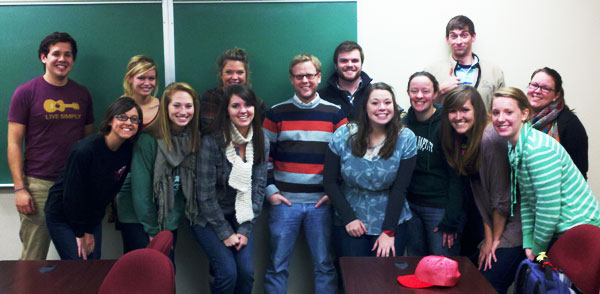
The best first class ever, and what they are teaching me

I debated before my very first classroom teaching experience whether or not to pretend like I knew what I was doing. Whether or not to tell the truth when we began that they were joining me on a journey that was the first of its kind for me, or “Don’t let them see you sweat,” as I’ve heard people in leadership say to me before. It never settled well with me. We all sweat. Why shouldn’t they see it?

I think when I walked into the room, I still had not made up my mind. They were seated quietly (this once), waiting to see what the shape of the class would be. I was just as curious as they were.

“Well, I tried to decide whether to pretend like I know what I’m doing with you folks, but, I feel like I should come clean: This is my first undergraduate teaching experience. So there. Now you know.”

Apparently, my mouth had decided the game plan but had not remembered to inform my mind.

“Uh oh…” someone said, then the room laughed, and then we began one of the most enjoyable experiences I’ve ever had. Definitely the best first class ever. Admitting that I would likely sweat that very first day allowed us to sweat together, and made something very communal, spiritual and human possible and present in the room.

We engaged for the next semester in a class about “faith-based social service,” and the wheres, hows, whys, and whats of how the church and people of faith bring the good news that God through Christ will make right all things cursed by sin, bringing his kingdom come on earth as it is in heaven. Things you can get fired for talking about. Things like the human heart, sex-trafficking, homelessness, planned poverty, economic injustice, christian arrogance and ignorance, poverty, greed, pride, loneliness, mental illness, individualistic idolatry, systemic injustice, abuse, trauma, and on and on and on.

“As far as the curse is found,” the old hymn reminds us. And it’s found far beyond only our human hearts and inside our churches, but in our broken communities waiting to see and hear the good news all the same. The big and broad good news that has more to do with everything else than it has to do with us.

And as a class, we began to engage these issues, tried different typologies out on them, dressed them in different best-practice approaches, and delved into scripture to see what it is we work toward and how we are called to work toward it. Throughout, we explicitly tried to guide our discussions and studies with a few questions that we would ask of each other, authors of the texts, practitioners in the field, and pastors in our churches:

1. Is it a bad either or?
Are these bad either/or scenarios that we are working within? Have we picked a side on something that may not (although it very well may) be a real either/or situation? How can we back up enough to see this clearly?

2. What are the assumptions?
What assumptions are we working from but ignoring as we move forward? Have we questioned these assumptions, and are we okay with them if we are building on them? How can we notice these assumptions? Who or what can be engaged to reveal them to us?

3. What are the power dynamics?
What power dynamics are at play, and what are they costing us and those we serve? Are we being honest to notice them, or are we trying to convince ourselves that they don’t exist? Whose voice and eyes can help us see them, and readjust?

4. Where did this information come from?
Where did this information come from? Is it valid? Is it biased? (Yes.) So where is the other side of the bias, and have we considered it? Are we looking for the truth, or looking for something that defends our current stance?

And finally,

5. What is absent but implicit?
Built out of the narrative therapy tradition that has stolen my imagination, this question is important and fresh. What have we left out of our questions, our conversations, our research, our planning, our programming and our praying? And what can its absence reveal to us about how we may be thinking wrongly or ignorantly about the issues? Whose voice, opinion, insight or criticism are we ignoring, and what does that reveal about us and our work?

When the class would be engaged in discussion, and a student would offer one of these questions to help push us into more clarity, I would feel my insides jump for joy. More than any solutions or approaches we came to as a class, or read about in our texts, the impact for Christ and his kingdom that is likely to be had will come from a student being guided by the curiosity and humility that these guiding questions encourage. So when they were thrown into the conversation by the students themselves, I would immediately envision them running organizations, pastoring churches, or working in businesses in the future, throwing out these same questions from the field, the pulpit, or the boardroom.

It makes me beyond hopeful.

And then, the best of all, toward the end of the semester, I was challenged––called out––by a student when I made a comment beginning with a phrase I had warned them to be wary of. In talking about a particular issue, the words, “Well, it all boils down to this: …” came from my lips.

I didn’t hear them. But my students did. One spoke up from the back, “But Donald, does it really? Does it really all boil down to that?” Much like that first class, we all laughed, someone says, “Uh oh….” and we continue with a more honest, more appropriate, more life-giving conversation than ones stifled by a person in the front informing everyone of how complex and nuanced issues “all boil down” to something that they of course do not and cannot. I had been called out, and it was the most rewarding experience of the entire semester.

So to those students, the best first class I will ever have, I give my deep thanks! You have taught me to be comfortable with what I do and do not know. You have taught me that laughing at myself and the clumsiness of the process creates space for honest dialogue and true progress. You have taught me that respect comes in the form of accountability and honesty, not position or title. And you have taught me that making room to be called out can be most rewarding.

And you have taught me that there is much to be hopeful for as you enter the world with the good news of Christ and his kingdom. The practice fields, the pulpits, and the boardrooms you operate in will be graced with a fresh humility and curiosity that will always be pregnant with the hope of all things being made new.

I look with great anticipation toward your futures.

djordan
Pine Tree Dr.

Tagged , , , , , , , , , ,