Category Archives: on

dear 2015

mosthopeful-post-1.2.16

One year ago at this time I was toasting with friends that, if nothing else, are evidence that God is up to unforeseeable and perfect trouble all the time. We were sitting around an evening campfire in the Cederberg, South Africa. We had been speedily doing nothing at all after I had arrived hours earlier after over 24 hours of flight and New Year’s champagne somewhere over the Atlantic.

We were sharing words about what the next year might mean for us, wrapping up both our hopes and our predictions in one tiny word. When it came around to me, I said the word “next” which was immediately met with laughter. Shortly thereafter, when I repeated it, these friends realized I wasn’t passing my turn, but was rather choosing the word “next” as my choice of a defining word for 2015. Next in employment, next in understanding, next in outlook.

I’m never sure if self-fulfilling prophecy is a legitimate reality or simply a filter for reflective thought, but 2015 was no doubt the year of “next.”

I learned more about people, who they say they are, how they really are, and how things work than I ever wanted to know in 2015. I met people and groups and neighborhoods and communities I thought I knew about but learned I was completely ignorant of and disconnected from. I became friends with people I would have never known about but now can’t imagine operating without. I faced my biggest fears and insecurities, and faced the world the next day realizing that people are just as evil and just as good as I had imagined. I realized how hope and reality fight constantly, leaving me in a fragile reality where the battle is not over yet but I’m supposed to operate as if I know the ending.

I enter 2016 with texts of jealousy-inducing pictures from the same friends in the same Cederberg. I’m not sure what my word for 2016 is yet, but I’m grateful for all of the next that 2015 brought. I’m no longer afraid of “the worst” that others are capable of bringing, because they’ve brought it and I’m still standing. I’m no longer ignorant of so much of my own city I desperately need to be in relationship with, and I can’t go back operating as a wealthy white kid who doesn’t know what it’s costing everybody else. I’m no longer wondering if fighting when I might not win   is worth it.

I’ve learned the good fight is always worth it. And I’ve learned that if I’m paying attention, there are always people who’ve been fighting and losing the good fight a long time who have a lot to teach me about being honest and brave. About taking up what Sara Groves calls the things that are “too heavy to carry and impossible to leave.”

So to 2016, I’m not sure what you’re bringing, but I’m sure that I’ll be ready.

djordan
Pine Tree Dr.

Tagged , , , , , , , , , , , , ,

you will go to church tomorrow

you-will-go-to-church-tomorrow
About five years ago, I sat next to her the morning she was trying church again. I understand why she had quit trying altogether up until now…the threats and the punches from her husband, the need to stay in the marriage from her old church and pastor, the reality of how in hell to care for her children and protect herself at the same time. I couldn’t believe she showed up to begin with. And on that Sunday morning, the sermon itself was ultimately about how wives should keep doing the right thing even when their husbands’ don’t in hopes that their husbands will come around. God bless.

For people dealing with socks in the floor or toilet seats left up, perhaps this is not a problematic statement. But the reality that more than two thirds of christian women in violent relationships feel like it’s their duty to tolerate the violencemakes it a problem. The difficulty with knowing that nine out of ten church-going, christian women interviewed felt that their husbands used their religion and doctrine to support their abuse2 makes it even messier.

I worked at the church at that time, so I found myself on Monday morning wringing my hands while deciding whether or not to mention this difficulty to the preacher. When walking in that morning, one of the staff who worked there at the time asked if I had been at church the day before and what I thought about it. After playing dumb and answering with questions, it became clear that she was a survivor of domestic violence and left the sermon the day before feeling guilty for leaving the marriage. Another conversation with yet another church staffer made it clear that there were at least two women in the building who had been in “christian” marriages in the past where domestic violence was present. They had both pushed courageously through their church’s tradition that you have to stay, wait it out, and keep doing the right thing in hopes that your male “head of the christian marriage” will come around. The two of them before 9:30 in the morning made it clear that I had to mention this issue to the preacher in hopes that in the future he would be willing to make the caveat to avoid these silent sufferers leaving church thinking God is mad at them for their bravery in avoiding assault.

His response when I scheduled a meeting with him about the issue?

“You can caveat a sermon to death.”

A few days later, an additional response.

“It’s not your place to talk to me like you’re my teacher.”

I managed to leave my employment at that church too many months later after these interactions. I’ve learned in the meantime, now serving my second year as chair for an incredible nonprofit working to empower women and men in abusive relationships to get the hell out, the reality that many churches are afraid to address head on the issues of domestic violence out of fear that people are looking for excuses for divorce.

Please catch your breath with me.

Many churches and their male pastors, in this area at least, are afraid to address head on the issues of domestic violence and sexual assault out of fear that women are looking for excuses for divorce. Or, for the incredibly important reason that we can “caveat a sermon to death.”

To my friend that Sunday morning sitting next to me, leg and arm muscles tightening as you received word from the pastor that you should stick it out, I’m so sorry. I wan you I left. I moved on. And I wish I had never invited you. To church staff who pushed through the same issues, I’m so sorry. I left. I want you to know I moved on. And so did you. To the women who are still in church and still in marriages and still wondering whether or not God honors marriage more than your own safety and dignity, I have good news. He is for you.

This past Sunday, I watched as the Executive Director of WRAP, the nonprofit working to empower survivors of sexual and domestic violence, climbed the steps to the microphone at my church during the middle of the service. I felt my watery eyes turn on as she spoke gently and directly about the number of women who show up for services at WRAP and say that they were afraid to tell their churches because they were afraid they wouldn’t be believed. I watched the priest walk over to this woman as she was trying to make her way off the platform as he said, “please don’t go yet. If I can, I’d like to pray for you and the people your organization works with.” I watched him put his arms around her and say, “Thank you God for women like Daryl, and for places like WRAP, and for the work they do as a part of your church to let people know your heart if for marriages and families of mutual respect. You are a God who wants peace in families, and safety for all in the family. We know, God, that you are never for the abuse of your children. So we say today that we stand with you against domestic violence for all reasons.  Empower your servants to work with great power to free those in danger, and know that you are with them.”

You will go to church tomorrow. Is your church willing to honor peace over abusive marriage? Ask. Find out. Make it an issue, and make sure that your church will speak up. The people affected by these issues won’t cause problems in your congregations; they will go home and take another fist to the face. The burden is ours. The insistence is His.

djordan
Pine Tree

If you or someone you know is experiencing or has experienced domestic or sexual violence, contact WRAP by visiting www.wraptn.org. 

Nash, S. T., Faulkner, C., & Abell, R. R. (2013). Abused conservative Christian wives: Treatment considerations for practitioners. Counseling and Values (58). October, pp. 205-220.
2. Nickmeyer, N., Levitt, H. & Horne, S. G. (2010). Putting on Sunday best: The silencing of battered women within Christian faith communities. Feminism and Psychology. (20)2. February, pp. 94-113.

Tagged , , , , , , , , , , , , , , , , , , , , , ,

Lord willing, we won’t keep growing

Our Jackson Home posted a piece I wrote reflecting on this year’s Remember Me Walk for survivor’s of homicide loss. This group is astounding to me, and I’ve copied some of the post below with a link to read it in its entirety. And if you have not yet checked out Our Jackson Home, you should probably get on the ball.

Screen Shot 2015-09-30 at 2.50.23 PM

The crowd was larger this year than any crowd the past seven. The Carl Grant Events Center at Union University was filled with tables surrounded by people of all kinds, ages, colors, and worlds held together by the sad reality that someone they loved has been murdered—some of them fifty years ago and some five months ago. The reality that no one truly understands this grief is echoed in the camaraderie across the room. “Lord-willing,” they say, “we won’t keep growing. We don’t want other people to know what this feels like.”

Grief is breathtaking. All have experienced it, and we know the deep-down grumbling in our guts that must be an echo of the deep-down grumbling in our souls.

A life is lost. A story ends. …

Click here to keep reading on Our Jackson Home

Tagged , , , , , , , , , , ,

carry on, warrior

Screen Shot 2015-09-18 at 10.05.10 PM

“People hurt the things they fear,” has become for me one of the most haunting lines of Glennon Doyle Melton’s not-so-new book.

And I’ve tried about ten times now to type out how Carry On Warrior has made me exhale so strongly and peacefully over the last week as I’ve been reading it. Her words have been a kind of subversive undertone to everything else I’m seeing and reading as the news unfolds.

Something in me is pushing hard against the rhetoric of hatefulness and fear, of greed and warmongering I hear predominantly from Christians as each day breaks across the globe. Something in me is pushing hard against this fear of neighbor, fear of other, fear of different. Since when did Jesus say kill for my sake, hate for my sake, marginalize for my sake? Something in me is pushing hard through the psuedo-christian noise for voices that speak to something altogether clear, and noble, and lovely, and gracious, and simple and beautiful. I don’t feel the need to kill the person who threatens to kill me; I feel the need for peace. I don’t feel the need to hurt the person who has hurt me; I feel the need to forgive. And I need to know other people feel that need too. And I need to know how to move into that need.

I don’t know how, though.

And Melton doesn’t claim to know how either, but somehow her words in Carry on Warrior actually begin to do it. Honoring a kind of David-like offense to face the giants of anxiety and fear and terrified christian culture, she manages to walk to the middle dropping one piece of heavy armor after the next knowing that it might be her end.

But also knowing that it might be her only chance in hell at an actual beginning.

I’m envious, really. But hopeful. I’m working to lean in to the call to be honest and hospitable when it means standing with those the church is screaming at and setting targets on. I’m working to lean in to the challenge to show up and do my best to return justice for injustice, generosity for stinginess, and even openness for rigidity and fear. It’s infuriating, and then again completely freeing. Something as if from another world altogether.

People harm the things they fear, she says. I’m doing my damnedest to stop being afraid.

djordan
Pine Tree Dr.

To follow her blog, visit momastery.com, and click here to find “Carry On, Warrior.”

Tagged , , , , , , , , , , , , , , , , ,

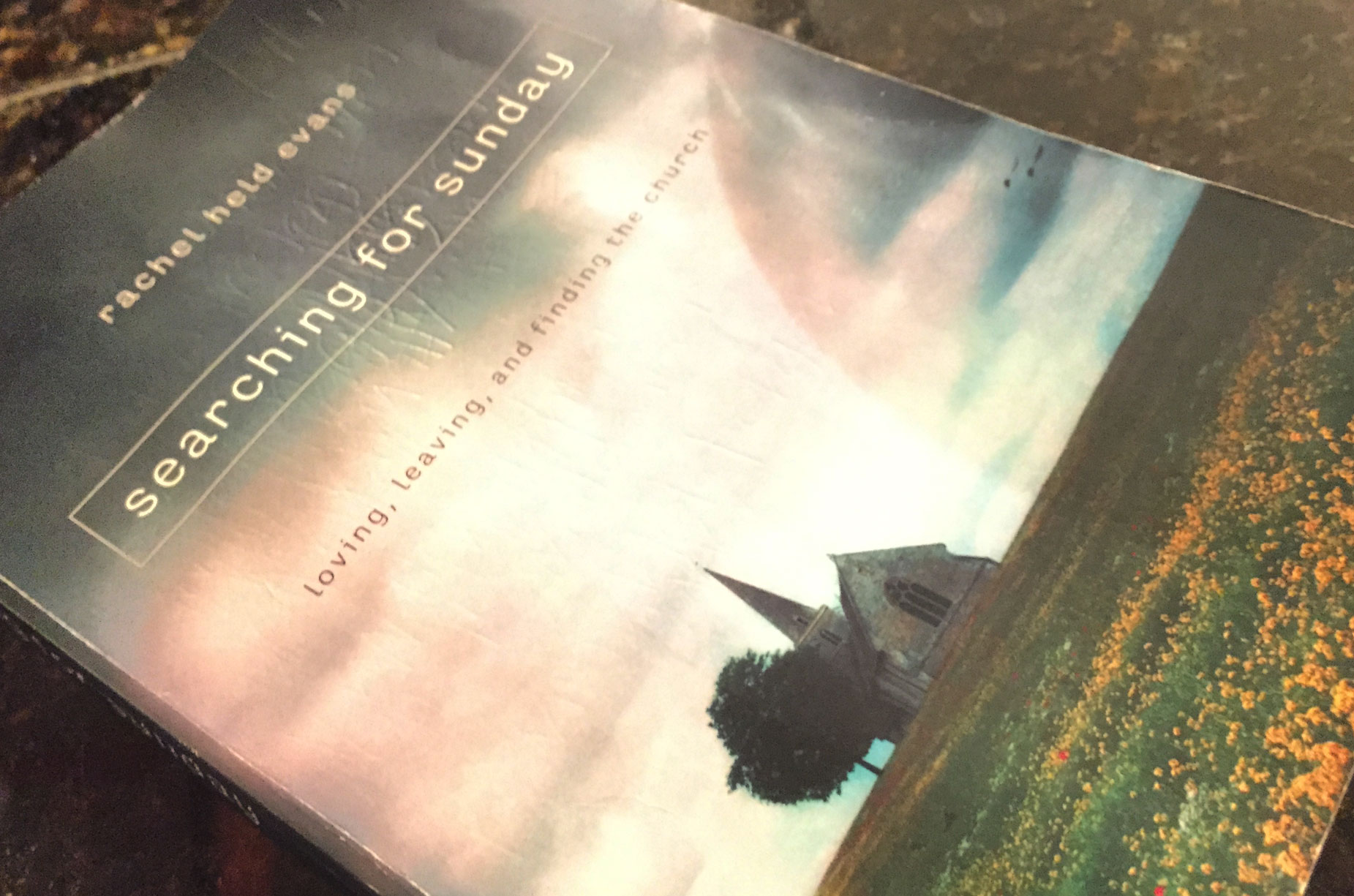
on Rachel Held Evans “Searching for Sunday”

searching-for-sunday

While finishing Rachel Held Evan’s new “Searching for Sunday” as she begins thanking different friends and people for their contributions to the work of the book, I immediately noticed that my skin was covered in goosebumps. Throughout the book, chapters begin with quotes from other authors, theologians or musicians. In passing each quote, I realized that they were authors who also had joined me on a journey from loving church, to leaving church, to finding church again. Madeleine L’Engle, Nora Gallagher, Frederick Buechner, Walter Brueggeman, Brian McLaren, Anne Lammott, Barbara Brown Taylor, Becca Stevens, and on and on and on. The way the book itself resonated with something in me apparently forgotten was registering more and more understandable as each name graced the pages. A sense of camaraderie was surfacing, like we had all been having these conversations together.

And then in hitting the acknowledgments, a section I’ve come to read in every book as to me it presents a kind of undercover autobiographical picture of the author, she thanked many of these people, referencing food, wine and tables as a common location for their work together on life and ultimately on the living behind this book.

My mind drifted to the last few months in my own life. High expectations met with a deep drop of disappointment and numbing hopelessness that permeated much of my community. It drifted to my travels across the ocean and to the coast, sitting and reading and eating and drinking with friends and family. These are the same friends and family who journeyed with me during a deep love of church. They were with me when I realized for the first of many times that church will be as out of touch and off track as any other group of normal people. They were with me when I couldn’t bare to look church in the face because it was unrecognizable as the body of healing and hope and restoration and justice that I had learned it was supposed to be. They were with me sitting on a living room floor every Sunday night managing crying babies and prayerful questions about what it means to be tiny christs in the world. They were with me when I snuck into the back row of big church for an Easter service because something in my blood wouldn’t let me stay home. And they were with me I said what I swore I would never say again as i committed to a group of people learning together what it means to live as Christ in a world clamoring for us to figure it out.

And were I to be writing a book about loving, leaving, and finding church, I would write in the acknowledgements about all of these people and their tables. Dinner on Greencastle and Harper Cove. Breakfast and mimosas on Mimosa Drive. Happy hour at Picasso’s and Flat Iron and the Fat Cactus. Cheese and whiskey on Smith Dr. and sundowners at Camps Bay. Coke zeros and weird cookies under the rustling thatch looking out toward the Nicaraguan volcanos. These meals and drinks have been peppered with the words of Buechner, L’Engle, Brueggeman, Stevenson, Alexander, Meyers, McLaren. They have been soundtracked with the music of Sara Groves and Josh Garrells and Bono and the Indigo Girls. They have been hemmed in by the wise words of good friends.

And if any of us look carefully enough, there are small stones somewhere in each these places, whether restaurants or rancheros or vineyards, that mark something important. They mark tiny moments of thin space where God was real for just a moment, whether in hopelessness or surprising hope. They mark signs of the kingdom with other people who have been both lost and found. Rachel Held Evans and her people. Me and my people. There are lots of us out there looking for each other in hopes that we can find ourselves. The book was a reminder to keep searching for Sunday.

djordan
Pine Tree Dr.

To find Searching for Sunday, click here. 

Tagged ,

a kind of rumbling

  
It wasn’t at all that there were a few other languages loud enough to notice, but English was still the loudest. There was no prevailing language; the rhythm of the words held the group of roughly thirty together as much, I suppose, as the gathering just after seven for Eucharist held us together. I’m glad the words are now, after all these years, buried somewhere deep inside me. Otherwise the thin layer of contact-floating tears would have made it impossible to read them. Still it was nearly impossible for me to speak them.

     Your kingdom come…

With my awareness of Pentecost still keyed up, whatever it means and whatever I’ve made it mean, I heard the phrase in multiple languages said together so that it spun into a kind of rumbling made familiar by rhythm. I got the phrase uttered, and then had to stop again only to listen. The language to my right was different from that to my left. Neither was the same as mine.

     … Your will be done on earth as it is in heaven
     … Makwenziwe ukuthanda kwakho nasemhlabeni, njengokuba kusenziwa emazulwini
     … laat u wil geskied, soos in die hemel net so ook op die aarde

To lean into the rhythm, celebrate the diversity, and dare for the gritty risk of kingdom on earth outside the doors of the cathedral after final thanks and hallelujahs…we might, then, sense the same kind of rumbling being spun in the streets. 

djordan
Cape Town

Tagged , , , , , , ,

kingdom comes over hot chicken

10906123_10153007402159443_4467631661083573300_n

Several weeks ago it was at a greenhouse under the South African sun. It was with two friends, one from South Africa and one from England, both in Cape Town now chasing the kingdom hard and fast. One works to transform the way housing is addressed for those living in informal settlements by way of valuing inherent wisdom, skill and reality. The other is working to address issues of gang violence, trauma, and youth development not only in Cape Town but in the hearts and plans of those around the world.

A few weeks later, it was in Nashville, Tennessee. We were talking about whether hot chicken was hot enough or too hot as we prepared for a wedding a few hours later. Friends without the pretense of worry of doing it right or doing it fancy, it was a celebration of choosing to do it and do it together. Friends willing to push through the new uncertainty of what it means to be a community surrounding those who are choosing to do life together. Friends who will argue over the heat of Nashville’s hot chicken in the morning, pretend not to cry at a lifelong commitment in the afternoon, and dance like no one knows what dancing is supposed to look like in the evening.

And this week, like last week, and like the other weeks in between was at the altar rail at a little church on the north side of town. Hands out, breath held, eyes up, it all swelled together. I’ve heard my priest and favorite friend say before that when we kneel at the rail, we share in communion with those with us in that moment, those who are gather at Christ’s table around the globe, and those who have both joined the table in centuries past as well as those who will come after us with the same assurances and the same uncertainties as we knelt at the rail today.

This morning, hands out, I joined them. I joined my brothers and sisters in Cape Town. I joined my sisters and brothers over hot chicken in Nashville. I joined my own local church community, and all those who were at their own churches both in my own city and in cities around the globe and through the ages.

I’ll work toward justice tomorrow and push against institutional power and greed.
I’ll seek beauty and laughter and silliness tomorrow with adults who hate it and children who love it.
I’ll do paperwork and billing tomorrow and wonder what I’m doing and why I care.
I’ll push a few steps forward into and few steps back from the kingdom of God.

And I’ll only be able to do anything at all tomorrow by the mystery of
the power that somehow shakes the rail every time I kneel,
whether at a nursery in Cape Town
or over hot chicken in Nashville
or the altar at my little church.

His kingdom comes.

djordan
Pine Tree Dr.

Tagged , , , , , , , , , , , , ,

on psalm 35 | what I want; what I want to ask for; what I need

psalm35a

What I want is to know you are for me,
which seems odd to ask;
that you over and in and of all things
might stand up for me and
fight for me and
stop attacks against me.

I know I need to hear from you,
though;
I need to hear that you are,
if not now then ultimately,
saving me and prepared to be saving me
from everything that fights against me
and inside me
and around me.

You see that I’ve been fighting for a while now?
You see that I’ve been asking for you for a while now?

I want to ask of you
I want a promise of you
that anyone
that any person
that any group
that any funder
that any fearer
who may be after me
who may be scared of me
anyone who gossips or finagles or whispers
in piety or privilege or petty or paranoia or peril or against me
would be put on the front page
under headlines of shame or confusion
under headlines of disaster or destruction.
I want to hope that whatever they hope happens to me
ultimately happens to them, but worse.
More public.
More noticed.
More shamed.

And I think<
were that to happen,
I might be happy, finally.
If those in other worlds of piety and paternalism,
if those in other worlds of arrogance and ambition,
might finally be put in their place,
I think I might,
then and then only,
sing a song of honest gratitude to you
giving thanks that things are well
and trusting finally that you are King
and trusting finally that I’m with those who win.
Trusting finally that I’m worth it;
that this is all worth it.
I would be such an incredible person
when they all get what they deserve.

I promise.

It feels granted, of course,
for me to wait for their demise.
Because when they struggled, I struggled.
Because when they defended, I defended.
Because when they were offended, I retreated.
Because when they were angry, I apologized.

And maybe I need to know
after all this time
that you are for me.

Because it feels like you
just watch.

Like you just do nothing.

I’m sorry for saying it, I guess,
that It feels, sometimes,
like I’m paying attention
and you just aren’t paying any attention.

How long do I have to ask for help?
How long do I have to wait for some kind of validation?

Do you refuse to help me?
Am I all wrong about all of this?
And I pushing away from what you are pushing toward?

I can’t believe it,
so if I’m all wrong,
fight me.

But if not,
will you stand up for me at least?
And if you won’t stand up for me at least,
will you let me know you’re for me?

I’ll give it back to you,
whatever that means.
whatever that costs.
I swear it.

I suppose, finally,
whether or not you decide to be for me,
I need to ask that you be for those,
no matter how big
no matter how small
no matter how wealthy
no matter how poor
no matter how crazyno matter how appropriate
no matter how irreverent
no matter how pious
no matter how marginalized
no matter how important
no matter how detested
no matter how esteemed
no matter how quiet
no matter how loud

I suppose, finally,
even though what I want to ask,
after all this nonsense and ridiculousness,
is that you be for me,
in a way that shows you are against them,

I need to ask less that you be for me
and more that you be for those
who seek
your peace
your shalom
your kingdom
your King.

And while I’m afraid to let you off the hook,
because I fear you might take advantage of it;
and while I’m losing some confidence in you,
because you aren’t doing what I’m hoping you will do

if I still tell myself the truth,
even then,
even if you don’t prove it to me,
or if I’m not convinced that you do ––
stand up for me that is ––
I have little choice
but to keep pushing forward
for your peace
for your shalom
for your kingdom
for our King.

I have seen and learned too much
to only stand with
the big
the wealthy
the appropriate
the pious
the esteemed
the loud.

I can’t stand with the men of standing.
They stand on those you are for.

So even if they win today,
kind of,
I’m working toward,
more than today:
all the days.
I’ll keep talking about
how you empower
peace, shalom, kingdom;
how you empower your King.
And for that,
no matter what I need to ask of you,
I’ll sing songs of hope and thanks about you.
And the crowds will,
finally,
sings songs of hope and thanks about you,
won’t they?

But seriously.

djordan
Pine Tree Dr.

image from The Ismar David Electronic Archive
Click here for Psalm 35 \ NRSV 
via BibleGateway

Tagged , , , , , , , , , ,

the era at hand

photo 2

At about a hundred miles an hour it came crashing into my chest this morning, moving up quickly to my throat where it stole my breath and then my eyes which began to pour. In the wind, behind sunglasses and under one of my grandfather’s many straw fishing hats, I was skimming quickly to our next drop in spot with three buddies as the sun was coming up over the gulf where we’ve been staying these last few days. The boat’s captain letting us know how far in to drop and what was likely on our line before it ever came into site was scouting out our next most likely location.

The four-word refrain came to mind. I followed it just under my breath to see what song it was connected to, and then, the crashing. First chest. Then throat. Then eyes.

sad fruitful broken true

I didn’t realize until this morning out there on the dramamine-calmed water that this is the first trip to the beach I’ve been on since losing both grandparents who taught me to love traveling here, feeding the birds, chasing the fish, eating out, cooking in, and laughing hard. As time passed, so did their health, but the beach would still happen. Moves from porch to den to restaurant  became slower and slower, but each still an important move worth taking the time to make.

This morning, out there on the water, still burning by the sun under his straw fishing hat, I realized that it has been the years and years of family and storytelling and value-passing that makes me fight, over and beyond fighting for meaningful work and meaningful impact, for meaningful friendship and meaningful experiences. To see and to feel and to taste the holiness in clinking glasses in my own home or half a world away. To honor and to savor the time spent with and the time spent where.

And in the hurricane of memories that stormed perfectly over and into me this morning, I was at once overwhelmingly grateful and overwhelmingly heartbroken. To have the privilege of three decades filled with enough love and honor and legacy to miss so deeply all at once left me exceedingly grateful and sad. The era of those kinds of gifts has passed. Forever. It’s almost too much to take in.

There is, however, the era at hand. It is in these days, then, that reveal the ways in which I choose to remember all these good things that have in no way been withheld from me. It is in this era that I will either wake up before the sun and meet my buddies to fish deep in the ocean, or I will only mourn the loss of the days that have already passed. To truly mourn, to truly grieve and to truly honor all that is lost must, in the truest of ways, involve making deep and rich meaning of all that is ahead.

And must acknowledge the ripe and possible realities of the present moment. Crashing in and all.

+++

The words I found after chasing the refrain are from the Sara Groves’ song This House are listed below:

it took me by surprise
this old house and these old feelings
walked round and looked inside
familiar walls and halls and ceilings

where I’d dream and plan
every moment of sunshine
this was my whole world
it was all I knew
like the hull of a seed
this old house cracked wide open
as I grew

hadn’t given it much thought
hadn’t been back here for a while
everything looks so small
seen through the memories of a child

who would dream and stare
from that second story window
that was my whole world
it was all I knew
like the hull the of a seed
this old house cracked wide open
and I flew

sad fruitful broken true

memories for miles and miles
summers falls winters and springs
Ruby you take it in
see he’s withheld no good thing

+++

djordan
723 Whiskey Bravo
Seagrove Beach, FL

Tagged , , , , , , , , , , , , , , , ,

crossing the street to find your way home | thoughts on “the hundred-foot journey”

Screen Shot 2014-08-18 at 9.54.05 PM

Our greatest fear, of course, is that we might be viewed as in some way similar to the “them” to our “us”. We’ve worked desperately for centuries now at defining clearly and bloodily who we are with and with whom we are not. Who we are like and who we are not like. And when the “us” and “them” becomes less theoretical and more the new next-door neighbor, less conversation and more colleague, less hypothetical and more here-and-now, we find our heart-pounding pulse and back-of-the-neck skin overrun with the fast-beating terror that there is no longer enough space between us and them.

In terror and anxiety, thus in our most not-yet moments, we move on anxieties and insist certain actions that involve thinking, moving and working in ways which keep the lines clear, humans separated, and enemies inhumane are needed. We have to keep the peace by keeping the road as clear barrier between our home and theirs, and the hundred-foot journey in between.  

But once in a while, perhaps because we have a kind of holy blood in us because we are human, we can’t help ourselves. We cross the street, take one-hundred steps, (counted in fury and scheming at one point and now counted in calm humility and prayerfulness), and appear at the front door of the other, the non-separate, the human beings across the street. The front door of his home, bearing witness to his family and their dreams, their hopes, their stories, their legacies, their fears, their burdens and their dirty spots. We appear at the front door, newly-terrified and deeply-anxious, but already too far across the street, already there, already one-hundred steps too many in to turn around.

So we meet our neighbors. We learn their names. We hear their stories. We sing their songs. We sit at their tables and we eat their meals. 

And absent-minded of our terror and anxiety, we realize that in traveling the distance we have found our neighbors, in making the journey we have found our place, and in crossing the street we have made our way home. 

We pray that our new neighbors would move in, and that we would cross the street to find ourselves. As we are bold to pray for terrifying things because we’ve been taught to do it, teach us what it means to come home in your kingdom. 

djordan
Pine Tree

Don’t miss The Hundred-Foot Journey on the big screen. If you miss it, you’ll regret it…and so will your neighborhood. 

Tagged , , , , , , , , , ,