Category Archives: learning to live

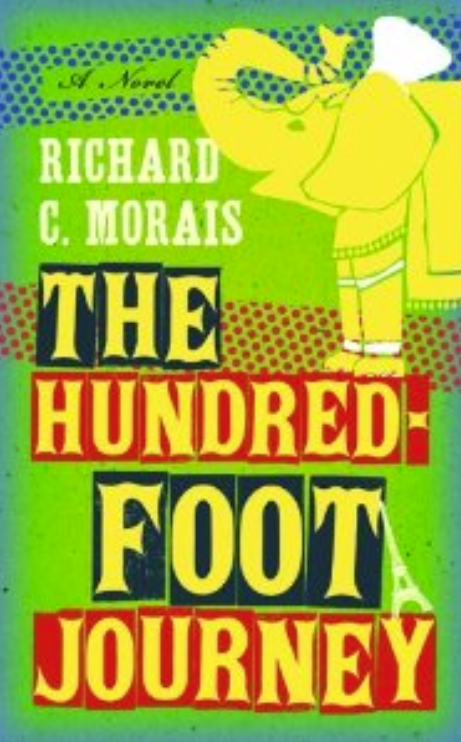
crossing the street to find your way home | thoughts on “the hundred-foot journey”

Screen Shot 2014-08-18 at 9.54.05 PM

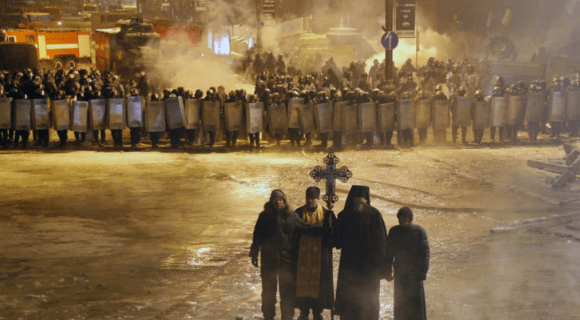
Our greatest fear, of course, is that we might be viewed as in some way similar to the “them” to our “us”. We’ve worked desperately for centuries now at defining clearly and bloodily who we are with and with whom we are not. Who we are like and who we are not like. And when the “us” and “them” becomes less theoretical and more the new next-door neighbor, less conversation and more colleague, less hypothetical and more here-and-now, we find our heart-pounding pulse and back-of-the-neck skin overrun with the fast-beating terror that there is no longer enough space between us and them.

In terror and anxiety, thus in our most not-yet moments, we move on anxieties and insist certain actions that involve thinking, moving and working in ways which keep the lines clear, humans separated, and enemies inhumane are needed. We have to keep the peace by keeping the road as clear barrier between our home and theirs, and the hundred-foot journey in between.  

But once in a while, perhaps because we have a kind of holy blood in us because we are human, we can’t help ourselves. We cross the street, take one-hundred steps, (counted in fury and scheming at one point and now counted in calm humility and prayerfulness), and appear at the front door of the other, the non-separate, the human beings across the street. The front door of his home, bearing witness to his family and their dreams, their hopes, their stories, their legacies, their fears, their burdens and their dirty spots. We appear at the front door, newly-terrified and deeply-anxious, but already too far across the street, already there, already one-hundred steps too many in to turn around.

So we meet our neighbors. We learn their names. We hear their stories. We sing their songs. We sit at their tables and we eat their meals. 

And absent-minded of our terror and anxiety, we realize that in traveling the distance we have found our neighbors, in making the journey we have found our place, and in crossing the street we have made our way home. 

We pray that our new neighbors would move in, and that we would cross the street to find ourselves. As we are bold to pray for terrifying things because we’ve been taught to do it, teach us what it means to come home in your kingdom. 

djordan
Pine Tree

Don’t miss The Hundred-Foot Journey on the big screen. If you miss it, you’ll regret it…and so will your neighborhood. 

Tagged , , , , , , , , , ,

burnt burger buns

Screen Shot 2014-06-14 at 12.09.08 AM

They are a large part of what made me so grateful for the evening.

It was also fun that the three-year old kept asking about the “toast” in the oven. It’s not fun when the car breaks down, when questions linger in the air about bills and responsibilities and logistics. It’s not fun when things feel like they are spinning faster and faster and if one thing goes they’ll all go most likely. And normally a day like today closing out with burning burger buns would not be fun at all. But burnt burger buns and a three-year old asking about toast while the “adults” spill out their own worries and concerns and forget to notice the toast in the oven that will soon sandwich the burger beams helpful.

The laughs oozing from simultaneous exhaustion and relief over the dinner table are also part of what made me grateful for the evening. They were present not because it’s all figured out, not because things are resolved, not because the car is fixed, the bills are paid and the plates are stacked rather than spinning. But fun instead because after a three-year old prays, his tiny, waited-for and prayed-for face now here in the room with us hovering over those burnt burger buns he tried to tell us about, there are people sitting around the table eating, laughing, worrying and living forward. And doing it together in one way or another. It makes the day worth a toast again.

The burgers were delicious, by the way.
But it was the burnt buns that will make me remember to give thanks and pause for good moments and great friends.

djordan
Pine Tree

Tagged , , , , , , , , , , , , , ,

the funeral laugh

Screen Shot 2014-06-12 at 9.37.56 AM

You know it.

And please.
Don’t act like you don’t know it.

Don’t act like you don’t know what the funeral laugh is. If you pretend that you don’t know it, I’ll know you’re lying and that’s an entirely different thing to address. We’re together here, you and me.

We all know what the funeral laugh is.
And we’re all guilty.

That inappropriate laugh in the moment where we are faced with the reality that the clock stops ticking one day. The clock stops ticking and the reality rushes in that we are more time-limited than we are prepared to admit. And we don’t know why things happen the way they do, why pain and progress get shaped and honored and forgotten the way they do; why pain lasts and hope lasts; why the possibility of something different for the future can operate with larger and stronger and broader strength than the reality of the way things have been in the past.

That completely inappropriate laugh that surprised us as much as anyone who heard it before we muffled it with a cough or choke or some other lame cover.

We can pretend as though we are wired for money or wired for sex or wired for love or wired for prestige.
But we can’t pretend for long.
Because once we catch anything we chase,
it sheds its skin
and we realize that we are naked and selfish,
insecure,
hopeful,
and powerless in more ways we care to consider.

And that’s when in stings.
It’s gonna be the funeral laugh or the funeral wail. One is coming out and we can’t help it.
We are at the funeral. We know that the person in the casket is highlighted by a story that now has defined lines of what was and wasn’t accomplished.
And we are terrified.
And rightly so, because we are afraid of what the present reality means for us when we shove it up against the reality of the future.

But, it’s that laugh that comes out. And in the same way it’s poorly timed and poorly placed, it’s also unexpected and sends a surge to the abdomen which sends a surge to the brain. And the surges remind us that we are, today, in this moment, alive. And we are alive in a place that is filled with people on the edge of laughter or tears, people ourselves included, who are still making the little choices one after another because our clock is still ticking. Our story still has options.

So we remember our inside jokes and laughs.
So we send cards to the mailbox with stamps and seals that say thanks again for everything.
So we let the other person in front of us in traffic, in line, in thought.
So we pause and raise a glass to make a toast that’s more a prayer than the blessing would have been.
So we make a decision to risk admitting we are powerless and hope that something rises to catch us.
So we wear party hats when making grown-up decisions that aren’t fun because we are alive and here to make them.

So we decide to choose the laugh at that inappropriate time that’s marked by real and gritty silence and seriousness. We know that we will wail again in a moment, and we know that both are actually fine.

But right this second, we choose the laugh. And then it won’t stop. We can’t stop it.

At this funeral, in this thin space where we are asked again that huge question about what it means to move forward in the world we will stop moving in, for a time, one day, we choose the funeral laugh. Because we can. And because we must.

djordan
Pine Tree

Tagged , , , , , , , , , , , , ,

moving forward. always.

It’s all a mess, of course.
We run into it knowing that we have a plan
We run into it knowing that we have the knowledge
to fix it
to solve it
to make it better
We burn to fix it, to solve it, to make it better
So the fact the we have the change to
put the plan into action
and use our knowledge to make it better
must mean that all will be well
because
we are ready
to make it well.

But then,
we wake up to the news of
all gone wrong.
all unexpected.
all that is against all we’d hoped for
worked for
longed for
waited for
prayed for.

It’s in that moment
of course,
that we realize it’s all a mess
and we begin to wonder if plans and knowledge
and we begin to wonder if the burn to solve it, to fix it
are an existential mocking of sorts.

And yet
even waking up to the news of
loss
death
murder
backward
pointlessness

we can’t help but rub our eyes and
do our best to face forward
and look upward
and work to put our plans and knowledge
back to work
knowing that we may not actually ever get what we hope for
but knowing even more that
we are not willing to hope for less.
Even in the mess.
So we move
forward.

always.

and so we are bold to pray.

djordan
Pine Tree Dr.

Tagged , , , , , , , , , , , ,

remembering my first class ever

In preparing for a brand new online class, created from scratch, I’ve been reviewing a lot of the materials I’ve used for other classes. In wondering how to teach through an online class, my first ever, the 5 Guiding Questions that I use in every class I’ve ever taught, I came across a blog post from the very first college course I ever taught. They appeared one day in class, to help guide the conversation, and they have been on the board, in the conversation and on the tests and quizzes for the nearly 10 different classes I’ve taught since then.

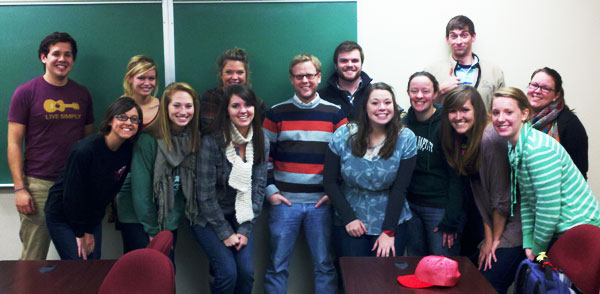
In reflecting on them this evening, and reflecting on where they were coming from as I was teaching that first class ever…in reflecting on the friendships and colleagues that the students in this picture have become, in reflecting on what I’ve learned since then, they become even more meaningful.

I had agreed to teach this course while still working at a church. I found out between accepting the role of teaching this course while working at the church and when the course would actually begin that I would be encouraged by the pastor to give my resignation because I didn’t fit with his vision. I realized later, in that same conversation, that the problem was I viewed leadership as engaging the people, the congregation, the community in discerning what God was doing and where we should be going.

I learned then, and later, that these five guiding questions had guided me out of a job that I loved but could not stay in, and into several jobs that I’ve since fallen deeply in love with. To my students that very first class, you really were the best first class ever. You taught me much, and your friendships have proven invaluable, restorative, and inspiring.

djordan
Pine Tree

The original post can be viewed by clicking here. 

I debated before my very first classroom teaching experience whether or not to pretend like I knew what I was doing. Whether or not to tell the truth when we began that they were joining me on a journey that was the first of its kind for me, or “Don’t let them see you sweat,” as I’ve heard people in leadership say to me before. It never settled well with me. We all sweat. Why shouldn’t they see it?

I think when I walked into the room, I still had not made up my mind. They were seated quietly (this once), waiting to see what the shape of the class would be. I was just as curious as they were.

“Well, I tried to decide whether to pretend like I know what I’m doing with you folks, but, I feel like I should come clean: This is my first undergraduate teaching experience. So there. Now you know.”

Apparently, my mouth had decided the game plan but had not remembered to inform my mind.

“Uh oh…” someone said, then the room laughed, and then we began one of the most enjoyable experiences I’ve ever had. Definitely the best first class ever. Admitting that I would likely sweat that very first day allowed us to sweat together, and made something very communal, spiritual and human possible and present in the room.

We engaged for the next semester in a class about “faith-based social service,” and the wheres, hows, whys, and whats of how the church and people of faith bring the good news that God through Christ will make right all things cursed by sin, bringing his kingdom come on earth as it is in heaven. Things you can get fired for talking about. Things like the human heart, sex-trafficking, homelessness, planned poverty, economic injustice, christian arrogance and ignorance, poverty, greed, pride, loneliness, mental illness, individualistic idolatry, systemic injustice, abuse, trauma, and on and on and on.

“As far as the curse is found,” the old hymn reminds us. And it’s found far beyond only our human hearts and inside our churches, but in our broken communities waiting to see and hear the good news all the same. The big and broad good news that has more to do with everything else than it has to do with us.

And as a class, we began to engage these issues, tried different typologies out on them, dressed them in different best-practice approaches, and delved into scripture to see what it is we work toward and how we are called to work toward it. Throughout, we explicitly tried to guide our discussions and studies with a few questions that we would ask of each other, authors of the texts, practitioners in the field, and pastors in our churches:

1. Is it a bad either or?
Are these bad either/or scenarios that we are working within? Have we picked a side on something that may not (although it very well may) be a real either/or situation? How can we back up enough to see this clearly?

2. What are the assumptions?
What assumptions are we working from but ignoring as we move forward? Have we questioned these assumptions, and are we okay with them if we are building on them? How can we notice these assumptions? Who or what can be engaged to reveal them to us?

3. What are the power dynamics?
What power dynamics are at play, and what are they costing us and those we serve? Are we being honest to notice them, or are we trying to convince ourselves that they don’t exist? Whose voice and eyes can help us see them, and readjust?

4. Where did this information come from?
Where did this information come from? Is it valid? Is it biased? (Yes.) So where is the other side of the bias, and have we considered it? Are we looking for the truth, or looking for something that defends our current stance?

And finally,

5. What is absent but implicit? 
Built out of the narrative therapy tradition that has stolen my imagination, this question is important and fresh. What have we left out of our questions, our conversations, our research, our planning, our programming and our praying? And what can its absence reveal to us about how we may be thinking wrongly or ignorantly about the issues? Whose voice, opinion, insight or criticism are we ignoring, and what does that reveal about us and our work?

When the class would be engaged in discussion, and a student would offer one of these questions to help push us into more clarity, I would feel my insides jump for joy. More than any solutions or approaches we came to as a class, or read about in our texts, the impact for Christ and his kingdom that is likely to be had will come from a student being guided by the curiosity and humility that these guiding questions encourage. So when they were thrown into the conversation by the students themselves, I would immediately envision them running organizations, pastoring churches, or working in businesses in the future, throwing out these same questions from the field, the pulpit, or the boardroom.

It makes me beyond hopeful.

And then, the best of all, toward the end of the semester, I was challenged––called out––by a student when I made a comment beginning with a phrase I had warned them to be wary of. In talking about a particular issue, the words, “Well, it all boils down to this: …” came from my lips.

I didn’t hear them. But my students did. One spoke up from the back, “But Donald, does it really?Does it really all boil down to that?” Much like that first class, we all laughed, someone says, “Uh oh….” and we continue with a more honest, more appropriate, more life-giving conversation than ones stifled by a person in the front informing everyone of how complex and nuanced issues “all boil down” to something that they of course do not and cannot. I had been called out, and it was the most rewarding experience of the entire semester.

So to those students, the best first class I will ever have, I give my deep thanks! You have taught me to be comfortable with what I do and do not know. You have taught me that laughing at myself and the clumsiness of the process creates space for honest dialogue and true progress. You have taught me that respect comes in the form of accountability and honesty, not position or title. And you have taught me that making room to be called out can be most rewarding.

And you have taught me that there is much to be hopeful for as you enter the world with the good news of Christ and his kingdom. The practice fields, the pulpits, and the boardrooms you operate in will be graced with a fresh humility and curiosity that will always be pregnant with the hope of all things being made new.

I look with great anticipation toward your futures.

djordan
Pine Tree Dr

Tagged , , , , , , , , , , , ,

to travel alone

Screen Shot 2014-05-21 at 10.39.15 PM

To travel alone out of state for several days is a certain kind of luxury. Yes. There is training all day long in a stale training room that could be identical to the one in your own office basement, but then training ends a few minutes earlier than planned. You now find yourself anonymous in a new city with new people and a new zeitgeist you’ve never been wrapped up in before.

And to travel alone means you don’t feel guilty, finally, to have your headphones blaring music which you are probably humming or badly singing harmonies to just under your breath to make it even worse. So you are walking down streets and looking in windows and in people’s eyes with a soundtrack of your favorite music pretending as if, since they will not see you again, that they don’t see you staring at them now. While you hum or sing badly just under your breath.

And then to travel alone means you pull up a chair and sit at the bar top with a book and more time than you remembering having in the last several weeks with nothing planned or pushing in on it from every angle. So you pull out the book, order a drink and maybe an appetizer, and then you sit and watch the people lining the rest of the dimly lit bar top, the people scattered at low, round tables along the edges of the restaurant, the people walking hand in hand down the sidewalk who may or may not live there but you suspect they do.

And suddenly, you begin to see something very familiar in this out-of-state place at this out-of-state bar top as this anonymous observer. You begin to see couples and groups and buddies and girlfriends laughing or bitching or crying or pontificating, and you see yourself and your friends at your tables in your restaurants on your streets. You see people passing plates and tasting each other’s drinks and it seems as though you belong because that’s what you do when you sit in your place with your people.

To travel alone out of state for several days, followed by your own soundtrack and land suddenly in the world of other humans, you ultimately find your own humanness. You find your friends and your enemies and your struggles and your hopes as you watch them pass the plates and share their glasses, and something feels oddly familiar. In the presence of the humanity of others, we find our anonymous selves at home. And at home, we find ourselves.

djordan
Lantern Restaurant, Chapel Hill, NC

Tagged , , , , , , , , , , , , , , , , ,

Remembering Sam Bomar today

In remembering the life and legacy of Sam Bomar today, even as just a few days ago multiple scholarships were given from the Sam Bomar Scholarship Fund, special thanks again and as usual to Rayna Bomar for her important and thoughtful words.

Originally posted April 2, 2012 as a guest post by Rayna Bomar, that post and its subsequent comments can be found HERE.

rayna bomar guest posts

This is the first guest post here on mosthopeful.com, and I couldn’t be more convinced of its appropriateness. Hugh and Rayna Bomar have become friends of mine these last few years, and their ongoing journey of remembering their son Sam has had an impact in my own life. I hope you glean from Rayna’s words about what has helped and what has not helped as she has been on her own very personal journey with grief. 

In August 2009, as my son Sam started his senior year of high school, I happened upon an essay by a woman named Mimi Swartz entitled “Empty Nest: In a Week He’ll Be Gone – And I Can’t Stand It.”  Her son, also named Sam, was leaving for college a year before my Sam would leave, and I read her words to prepare for what, I thought, I would be experiencing the following August. And, the following August, I did share some of the life changes described by Swartz – dinner for three became dinner for two, my schedule no longer revolved around the school calendar, and the “mundane rituals of child rearing,” just as Swartz had predicted, were gone.  But my role as a mother changed for a reason not anticipated. My Sam didn’t leave for college. Instead, he died on May 4, 2010, ten days before graduation.

There are many things that I could say about the past almost 23 months, but what I would like to do now is share some of the ways that others have helped us get through those months – and a few things that have hindered us.

My husband Hugh and I quickly realized that all grief is personal. What you have experienced losing a loved one, even a child, is not the same as what I have experienced losing Sam. My experience is not the same as Hugh’s experience. Therefore, things that I mention that have helped (or hindered) us may not help (or hinder) you.  I am an expert only about my own grief.

We have been most touched by the kindnesses that have been shown by Sam’s friends. We are in awe of the young men and women who are so naturally compassionate and who have put aside their own grief to help us with ours. They have taken us out to eat on Mothers’ Day and Fathers’ Day, visited on holidays, designed t-shirts and bumper stickers in Sam’s memory, mowed our yard, shared stories about Sam (what we love the most), written letters and sent cards, laughed with us and cried with us, helped with chores, preserved Sam’s spot in the high school parking lot, invited us to their celebrations- I could go on and on.  We are greeted with open arms and a hug. Sometimes we get more than one hug. They tell us that they love us. They share their lives with us and allow us to be part of their future. Their actions are drops of water on parched ground.

What they don’t do is, perhaps, more important. They don’t tell us that it’s almost two years since the accident and it’s time to “move on.” They don’t give us any advice.  They understand that our world changed when Sam died and that we will never be the same. They don’t expect us to be the same because they will never be the same after losing their friend. They don’t try to “fix” us. They don’t make any demands on us. If we feel like a visit, that’s great. If we don’t, they understand, and they don’t take it personally.

Maybe because of their relatively young ages (late teens to early twenties) they don’t have any preconceived ideas about how we should act or feel. Therefore, they don’t think they know what’s best for us, and they don’t try to impose their own feelings on us or try to dictate what is appropriate behavior.

Instead of trying to make us be who they think we should be, they already know who we are. We are Sam’s parents, and we always will be. That’s good enough for them, and it’s good enough for us.

“Death ends a life, not a relationship.” Robert Benchley.

One of the upcoming ways you can join the Bomars in remembering Sam is by attending the 3rd annual Sam Bomar Night at the Jackson Generals. Half of each ticket pre-ordered with the promo code SamBomar goes to the Sam Bomar Scholarship Fund.

For other most hopeful posts on grief, loss, trauma and resilience, CLICK HERE.

Tagged , , , , , , ,

I am alive.

Screen Shot 2014-05-03 at 9.47.41 PM

I’m not sure if it comes from my stomach, or maybe from my lungs, or if it actually originates in my throat itself. The language, though, is quite apt that it chokes me up suddenly. I may be speaking about something that feels important but only distantly related to me, and I feel it clench in my throat and somehow trigger the possibility of tears. I may be accidentally thinking of visiting someone who is no longer here to visit. I may be caught by surprise remembering rhythms that no longer exist. It may be the newness of new lives, new relationships, new opportunities, new challenges that do it.

Whatever it is, it comes seemingly out of nowhere and reminds me, ultimately, that I am alive.

I am alive.

If it’s singing at volumes and octaves that I would never sing in front of someone else, it’s the reminder of being alive. If it’s weeping suddenly because life is more confusing than anyone ever said it would be, it’s the reminder that I’m alive. If it’s a ten-second gap with a client where something happens and all of both of us comes crashing into a single pregnant and powerful moment and we sit in silence knowing that something beyond us has happened, it’s the reminder that I’m alive. A dance with the dogs. A drive with the windows down. A game with a child. Laughter with friends. Tears in startling places. Thin space with students or friends or clients or coworkers.

We are alive.

There’s the challenge, of course. Even when longing to freeze the moment because it feels like it’s perfect enough and true enough and thick enough to rest in it forever, I can’t because life doesn’t freeze that way. Even when longing to make the moment disappear because it feels like it’s too empty and ugly and sticky and deathly to be worth existing in, I can’t because life doesn’t erase that way.

But in the space between wanting to make something last forever and wanting to make something never have happened at all, I remember that I am alive. And being alive itself is worth savoring and leaning into with all the goodness and all the crap of it, trusting that in leaning into both the goodness and the crap, we lean more into our true selves.

And we are alive.

djordan
Pine Tree

Tagged , , , , , , , , , , , , , , ,

all this color | guest post by wes gristy

Screen Shot 2014-04-09 at 5.58.09 PM

Why is it so difficult to learn a new language? Not a foreign language, but a new way of talking about things. For the last seven years or so, I’ve been enamored with a renewed vision of my faith. Not an altogether different faith; it’s the same one I grew up with, only now things that were once grayscale are showing signs of color.

+++

I still believe in God, the Father Almighty, creator of heaven and earth, only now he’s the God committed to seeing his creation fully restored, reuniting all things in heaven and on earth.

I still believe in Jesus Christ, His only Son, our Lord, only now he’s the Jewish King who brought Israel’s story to its world-renewing climax, and so bringing humanity’s story to its world-inheriting and world-reigning climax.

I still believe that he was conceived by the Holy Spirit and born of the Virgin Mary, only now his being God is more about God being faithful to the covenant he made with Israel, and his being man is more about Israel being faithful to the covenant they made with God.

I still believe that he suffered under Pontius Pilate, was crucified, died, and was buried, only now those things matter because of the kingdom agenda Jesus embodied from his birth to his death.

I still believe that he descended to the dead, and that on the third day he rose again, only now his journey from death to life launches the new creation God intends for the whole cosmos.

I still believe that he ascended into heaven, only now am I beginning to understand why that ascension subverts economic systems, political powers, and hailed ideologies.

I still believe that he will come again to judge the living and the death, only now do I see judgment as a thing of beauty, that glorious day when creation is finally liberated from all that has caused its ceaseless groaning.

I still believe in the Holy Spirit, only now am I open to his supernatural presence working through me and the entire church to bring God’s kingdom to bear upon this present age with great power and wonder.

I still believe in the holy catholic church, only now as more than a beneficiary of his transforming grace and love, but as an agent of it as well.

I still believe in the communion of saints, only now has this communion become a foretaste of the kind of community that is promised for all those who seek first the kingdom of God.

I still believe in the forgiveness of sins, only now these sins have grown to include systemic injustice, economic oppression, environmental exploitation, and religious arrogance.

I still believe in the resurrection of the body, only now it’s a resurrection not to heaven, but to a heaven and earth reunited, consisting of everything glorious in both the physical and the spiritual world.

I still believe in the life everlasting, only now it’s life as it should be, every human hope and desire amplified exponentially in the presence of God, among a flourishing people, and enjoying all of creation.

+++

A new language is clearly required, but learning its syntax and phrasing is cumbersome. The words fail me. I can’t articulate what is resonating inside, how I sense the pieces coming together, and how this new story is able to integrate everything that awakens our souls.

How do you talk about this? How do you talk about all this color? The kingdom of God, all things new, flourishing communities, heaven and earth reconciled, peace and justice filling the earth, creation regained, a restored world—these are feeble attempts.

And then how do you talk about these things in relation to sin, to Israel, to the prophets, to the law, to Jesus, to the cross, to justification, to right doctrine, to grace? And then how do you communicate the integration of these ideas in a way that not only inspires, but is intelligible; in a way that breaks old patterns of thinking without undermining the truth imbedded in those old patterns of thinking; in a way that opens up a colorful world without disregarding the black-and-white outlines of that world?

It’s a constant frustration of mine, that this new language eludes me still. Just when I think I’ve found a rhythm, I stutter again and miss another opportunity. Is the gravity of those older formations too much for me to lift off the ground into a sky filled with a whole new vocabulary? Or is this new world too magnificent for any mere mortal to describe? Is it a battle that can be won, or one that will never end?

I keep trying.


by Wes Gristy

Tagged , , , , , , , , , , , , , , , , ,

us and them

Screen Shot 2014-03-03 at 8.37.22 PM

At the moment it becomes
“us” and “them”
we’ve lost.
we’ve thrown in the towel.
we’ve waived the white flag.
we’ve thrown the grenade.
we’ve waged the war.
we’ve fired the shot.
we’ve sold our sole.
we’ve eaten the fruit.

At the moment it becomes
“us” and “them”
we’ve allowed ourselves
the illusion that we aren’t all connected
the illusion that we aren’t all the same
the illusion that we aren’t all both Cain and Abel
the illusion that we aren’t all both perpetrator and victim
the illusion that we aren’t all,
ultimately,
the best and the worst of ourselves.

So at the moment that we choose
to buy into the lie
that it’s “us” and “them”
we buy into the lie
that we can treat others in ways
we would never allow our own to be treated.
that we can make choices for us that have consequences
we would never allow ourselves to be the recipient of.
that we can speak in ways that objectify others to an extent
we would never allow for those we love.

So at the moment that we choose
to buy into the lie
that it’s “us” and “them”
whether defined
by race
by income
by status
by guilt
by geography
by belief
by doctrine
by ideology
by education
by gender
by any of the other illusions of separateness that have
proven to be crutches since we
stabbed each other in the back when it all began
it is in that moment that
the very “us” we are hoping to protect
is lost to a state of
otherness that we thought
we were guarding against all the while.

At that moment,
we lose what we thought we were fighting for.

djordan
Pine Tree

Tagged , , , , , , , , , , , , , , , , ,